Showing posts with label S. Fred Singer. Show all posts

Saturday, 15 January 2022

The corrupted tobacco economist network Part 63 - National Center for Policy Analysis

Overview of previous posts here

The National Center for Policy Analysis was another think tank where the corrupted social cost economist could spread their word


The next battleground: Indoor air

Dwight R. Lee
 in 1992 wrote the NCPA report The next environmental battleground: Indoor Air, opposing any form of regulation of indoor-air quality (IAQ). The report is also one of the first examples of a social cost economist questioning EPA's objectivity and neutrality. 

On top, it is making outrageous claims like government regulations on IAQ would kill 1900 extra people a year [sic]. 

Lee proposed the Tobacco Institute to make a presentation of the report at the EPA's 23rd International Symposium on Environmental Analytical Chemistry. 

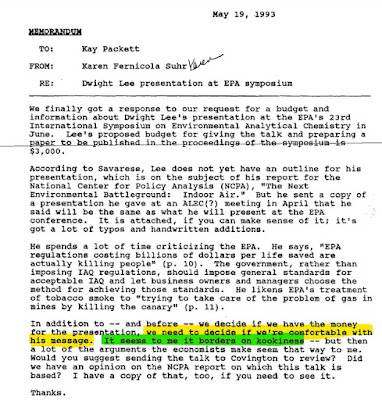
Tobacco Institute's Karen Fernicola Suhr wasn't sure what to think of the proposal as she Lee's claims were so ridiculous:


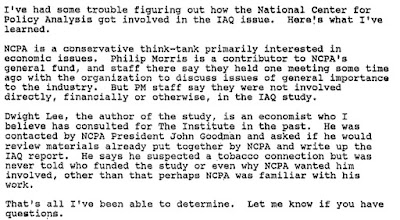
It wasn't the only weird thing about this report. The Tobacco Institute also was wondering why the NCPA cared about Indoor Air Quality at all


The Tobacco Institute in 1992 wasn't really sure why the think tank bothered to write on indoor quality. A 1993 letter sent by Tom Hockaday (of PR-firm APCO Worldwide) to Philip Morris hints the report actually was written on the command of APCO

S. Fred Singer, Dwight R. Lee

Nor Singer (a physicist), nor Lee (an economist) have any qualifications to judge indoor air-quality science.

Meanwhile, the program of the 23rd International Symposium on Environmental Analytical Chemistry shows Lee was one of the speakers, so despite the "cookiness", the Tobacco Institute probably paid him the $9.000 he asked for. Lee wrote an article after the presentation.

It's hard to decide  which my favorite sentence is in the article: "EPA is no better at central planning than the Soviets were" or "Each polluter is better informed than EPA authorities on how to reduce pollution at least cost and is certainly more motivated"

I do understand why Karen Fernicola Suhr staed the tobacco industry had to decide if it felt comfortable with his message. And Why she felt his message borders on kookiness.


Attacking all environmental sciences

But even beofre the 1992 report above,  the National Center for Policy Analysis was already attacking almost all environmental sciences, in the 1991 report Progressive environmentalism: a pro-human, pro-science, pro-free enterprise agenda for change. The head of the taskforce writing the report was Richard L. Stroup, another tobacco economist from the network.

The taskforce consisted of an interesting list of names, besides tobacco economists there are a lot of people listed who would get known as climate skeptics.

Network economists involved in the NCPA environmental task force were (besides Stroup) : Terry L. Anderson, Allen Dalton, Bruce Johnson and of course  Dwight R. Lee

Other tobacco consultants mentioned in this task force were Thomas J. DiLorenzo, Kent Jeffreys, S. Fred Singer and  James H. Miller. And a lot of people from other think tanks, like Joseph Bast (Heartland Institute), Fred L. Smith (Competitive Enterprise Institute), David J. Theroux (Independent Institute).

The reports attacks a wild array of environmental topics. The report might be an early example showing how libertarians started attacking all environmental sciences, not because they have much knowledge on the subject, but rather because it doesn't fit their worldview.

Saturday, 18 December 2021

The corrupted tobacco economist network Part 60 - Alexis de Tocqueville Institution

Overview of previous posts here

The previous blogpost mentioned in 1994 the Independent Institute authored the open letter against the Clinton Health Reform Plan. But the Independent Institute was not the only think tank aiming to work with the tobacco industry. 

The Alexis de Tocqueville Institution invited itself to the industry in this letter to Philip Morris. Was AdTI at this point no pro-tobacco ? Probably not, the letter illustrates it all started with a remarkably one-sided and bit silly opposition against the tax-increase in the health reform plan. Thos one-sided viewpoint ultimately would become disastrous for the think tank. 

Tim Lambert wrote a blogpost in 2004 (The Astroturf de Tocqueville Institute) showing the AdTI indeed started working with the tobacco industry in the 1990's.


The S. Fred Singer report

In 1994, late S. Fred Singer, best remembered as climate pseudo-skeptic, authored the Alexis de Tocqueville Institution report Science, Economics, and Environmental Policy: A Critical Examination. This report probably was ordered by the tobacco industry.

Early 1994, Cesar Conda, then president of the Alexis de Tocqueville Institution, had not decided yet who would author the paper (is not it lovely they already know what the report would conclude, without even knowing who would be the author?). Het wrote this remarkable letter: 


Cesar Conda Alexis de Tocqueville Institution


The letter summarizes the corruption of this think tank: fake report, fake endorsements, wide press circulation. And all that for just $20.000


The letter also shows the focus was no longer only to attack regulations on tobacco, other environmental subjects would be thrown under the bus too. And indeed, it is in the pool of different American extremist conservative industry funded think tanks that organized global warming denial would finds its roots.

The letter summarizes the corruption of this think tank: fake report, fake endorsements, wide press circulation. And all that for just $20.000

A while later, Conda wrote another amazing letter


Clearly: this report was as corrupted as a report can be.

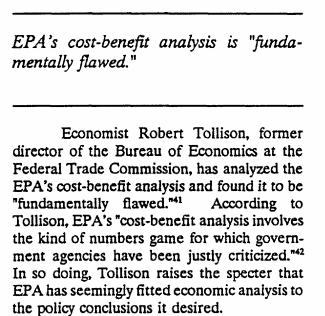
The report contains the following passage:

Robert D. Tollison

No, the report does not mention Tollison's connections with the tobacco industry, nor the fact the industry indeed paid the AdTI the $20.000 for the report

No, the report does not mention Tollison's connections with the tobacco industry, nor the fact the industry indeed paid the AdTI the$20.000 for the report. All in all, it's not even that much money and from the industry's point of view, this must have been a bargain to corrupt a think tank for an amount of money lower than an add campaign in a newspaper

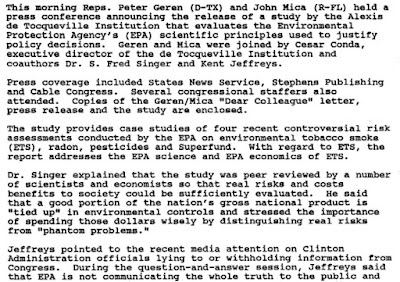
In the draft version S. Fred Singer was named the first author and Kent Jeffreys the second author. It is unclear why Singer is listed as the reviewer (and not author) in the final report and why suddely Jeffreys "authored" the report.


The industry wanted to use the report for lobbying, that much is certain

Alexis de Tocqueville Institution


The report had the desired result. Samuel Chilcote, president of the Tobacco Institute reported
S. Fred Singer

Who those "peer reviewers" were is a mystery, but probably the 1994 advisory board of the AdTI gives a clue: with Gary M. Anderson, Jeffrey R. Clark, Robert B. Ekelund, Dwight R. Lee, Mark Thornton, Robert D. Tollison, Richard K. Vedder and Richard E. Wagner, eight of the nineteen board members were members of the economists' network. Probably they were the not so critical reviewers of the report.

In 1995 the AdTI published another excise tax report, this time not by the economists though, but by John E. Berthoud, president of the National Tax Payers Union.

In 1998, the AdTI's draft report Tobacco Smuggling: A Worldwide Phenomenon was sent to the tobacco industry.

This is not the work of an independent think tank.

Thursday, 31 December 2020

The corrupted tobacco economist network Part 56 - Philip Morris broadens the attack

Overview of previous posts here

In 1991, even before the EPA report stating second hand smoking kills, Philip Morris circulated a list of scientists the industry thought would be willing to attack EPA. 

It's no longer about tobacco alone The list is 45 members long and it shows how the industry recruited their 'contrarians': the industry carefully looked for any person, sane or not, contesting the current status of scientific knowledge.


(...)

and one of the more active members in the tobacco economists network with one of his well known unnuanced views:

Dwight R. Lee

Dwight Lee Says giving the EPA authority over indoor air "would be like giving a machine gun to a child" is not regarded by the industry as an utterly bonkers viewpoint, but as an actual possibility: the document showed PM was looking for any contrarians and/or extremists who might be useful to implement the tobacco industry's attack on EPA. Sane or not. 

(do notice the list also mentions well known early climate pseudoskeptics S. Fred Singer and Patrick Michaels). 

Saturday, 14 November 2020

The corrupted tobacco economist network Part 54 - Working with Think tanks

 Overview of previous posts here

Tobacco Employee Roy Marden was one of the tobacco employees responsible for the communication with think tanks. He wrote the following memo, titled Tobacco Strategy on the think tanks he was responsible for (the industry divided the think tanks between a couple of its employees)

Roy Marden

(...) (the document is 6p. long)

The tobacco industry sought the help of right-wing think tanks to fight excise taxes.

In 1995, the Tobacco Institute sent a memo, mentioning that the economists still were able to provide op-eds in no less than 30 states. The same memo illustrates how the industry worked with the different think tanks


A similar document was written in 1998, most likely by Roy Marden. Notice how long the list is. It no longer only mentions thinks tanks, but many journalists, and even an actor and a magician (???). It's not clear why the document mentions Dwight R. Lee and Walter Williams, but it is possible Marden was not aware of their membership in the social cost economists network. Do also notice he mentions he's on the board of the Heartland Institute. 

[ETC, the list is a couple of pages long]

While there always have been contacts between the industry and think tanks, and they worked together since at least the 1980's, it was only in the 1990's that the industry's involvement would become so pervasive that one could say the industry 'owned' some of these organizations.

In the long run, think tanks probably were much more powerful allies than a secret network of economists ever could have been.

S. Fred Singer wrote his infamous Alexis De Tocqueville Institution's tobacco-paper in 1994 (see further), with Robert D. Tollison helping him. Tobacco economists were working with the Heartland Institute since at least 1991. The Independent Institute was was joined by many members of the economists' network. In 1994, Tollison and Wagner became members of the Independent Institute's advisory board.

Thursday, 8 September 2011

Voorspelbaarheid

Rypke Zeilmaker Climategate.nl S. Fred Singer
ik voorspelde hier dat Rypke Zeilmaker nooit zou ingaan op het feit dat Fred Singer niet meer of niet minder dan gelogen heeft over zijn financiële banden met de fossiele brandstoffen-industrie en die voorspelling is uitgekomen .
Dat wetenschappelijk onderzoek gefinancierd wordt is een evidentie en dat, Exxon uitgezonderd, de petroleumindustrie beseft dat onderzoek een wezenlijk onderdeel is van vooruitgang vind ik wel net zo fijn. Dat een onderzoeker gefinancierd wordt betekent uiteraard nog niet automatisch dat die onderzoeker corrupt is. 
Gekeken moet worden –moet ik dit nou echt nog neerpennen- naar wat er met die middelen wordt gedaan. En dan blijkt dat Singer’s werk er vooral uit bestaat wetenschap aan te vallen, in plaats van te zoeken naar vooruitgang.
Het feit dat Singer liegt over zijn financiering is daarbij veelbetekekend. Dat het Zeilmaker geen ene moer kan schelen dat Singer liegt al evenzeer.
Het PCCC publiceerde ondertussen al een antwoord op de belangrijkste fouten in Singer’s presentatie tijdens zijn bezoek aan het KNMI. Een video met de lezing in Brussel kan je hier vinden; Singer heeft zoals verwacht  niets gezegd dat niet allang weerlegd is.
Ondertussen is Wolfgang Wagner, hoofdredacteur van Remote Sensing, opgestapt na de publicatie van Roy Spencer’s ondermaatse laatste worp en worden de resultaten van het interessante CLOUD-experiment op allerhande blogs gestrecht tot iets wat onmogelijk uit het onderzoek valt te concluderen. Business as usual dus.

Sunday, 28 August 2011

The one where S. Fred Singer lies about his funding and is NOT coming to Belgium ?

S. Fred Singer Belgium Johnson Masson Debeil SEIIClaes Johnson just announced S. Fred Singer will not be coming to Belgium during his European tour, after Belgian IPCC vice-chairman Jean-Pascal Van Ypersele contacted the organising Société Européenne des Ingénieurs et Industriels with this letter :
.La SEII et l'honnêteté scientifique Monsieur le Secrétaire général,
La SEII soutient-elle implicitement le déni climatique, à la veille du congrès mondial des ingénieurs à Genève consacré aux défis énergétiques (où j'aurai l'honneur de donner une "keynote lecture") ?
L'utilisation du papier à lettres de la SEII par votre administrateur M. Masson pour l'invitation ci-jointe le suggère malheureusement, malgré une phrase hypocrite pour indiquer que la SEII ne "sponsorise" pas l'événement.
Vous devez savoir que MM Fred Singer est une personne dont l'honnêteté scientifique laisse fortement à désirer. Ses activités de désinformation sont financées par les lobbies des combustibles fossiles (voir XXXXXXXXXXXXXX) , et il est scandaleux qu'une telle personne puisse être associée, de près ou de loin, à la SEII et à la Fondation universitaire.
Des collègues éminents m'ont écrit que M. Johnson ne valait pas mieux. Un de ses "textbooks" récents, où il parlait à tort et à travers des changements climatiques, publié par le Royal Institute of Technology (KTH, Suède), a dû être rétracté par ce dernier tellement il contenait d'erreurs.
Merci de me dire très rapidement quelles mesures la SEII compte prendre pour se distancier de cet "événement"? Je serais heureux également de savoir quel est le mandat de ce "think tank" de la SEII sur les changements climatiques que Mr Masson préside (alors que son CV n'est pas disponible sur le site de l'Université d'Antwerpen, et que je n'ai jamais entendu parler de ses compétences en matière de climat).
Cordialement, Prof. Jean-Pascal van Ypersele
In short, Van Yp states Singer’s scientific honesty is lower than one would desire, and Singer gets funded by the fossil-fuel industry.
Singer responds :
  • Why am I not surprised by this disreputable action of this IPCC officer.After all, we know from Climategate emails that these people will go to any length to suppress scientific dissent. Even to libel and to use bald-faced lies.
  • Of course, I am not supported by fossil-fuel industry. That is complete nonsense and invention
  • My Europe visit is paid by the Ettore Majorana Foundation -- to give an invited talk at a climate conference in Erice. I am using the occasion to accept additional invitations to speak (without lecture fees) at the Univ of Hamburg, Imperial College, Univ of Paris - Jussieu, and of course at the KNMI in De Bilt. By happenstance I was also invited to address 100+ engineers in Zurich.
  • Our IPCC colleague van Yp also questions my honesty. Well now -- the IPCC has been using me as a scientific reviewer, I publish regularly in peer-reviewed journals and am an elected Fellow of several scientific societies. So there must be some who disagree with van Yp.
Singer is stating in his reply he’s not being supported by the fossil-fuel industry. Which simply is a lie.
Of course Dutch denialists like climategate.nl’s Rypke Zeilmaker are not pleased with the cancellation. But what they are not mentioning, and probably never will, is Singer’s lie.
Singer’s Astroturf group Science and Environment Policy Project received US$ 10.000 from Exxon in 1998 and 2000.
The +/- 20p NiPCC-report was worth US$ 143.000, through an intermediate source, as the industry isn’t stupid enough any more to fund directly (as they have to publish their funding). And of course this NiPCC report was complete nonsense.
Earlier in his career, when he was still a tobacco lobbyist, Singer received US$ 20.000 for a report trying to manufacture doubt on the relation between passive smoking and cancer. Many more fascinating documents on Singer”s lobby career can be found in the Legacy Tobacco Documents Library. Of course don’t expect the Dutch denialists to ever mention this library. Remember I got banned on De Dagelijkse Standaard when mentioning Labohm lied when telling he didn’t know about Singer’s funding. Getting too close to the source I guess.
Meanwhile, it seems the Singer & Johnson meeting will become a private meeting.

Monday, 15 November 2010

Merchants of doubts : interview with Naomi Oreskes


Naomi Oreskes Eric Conway Merchants of Doubt
Science historian professor Naomi Oreskes just appeared in a radio-interview in Australia to talk about her book Merchants of Doubt. In the interview (and book) she explains how a few people, driven by ideology, started attacking scientific topics they feared would be an attack on freedom. The attack started in the circles around the George C. Marshall Institute and the first scientific topic that was attacked was not climate science but tobacco. With the financial aid of big industrial companies, the strategy used is manufacturing doubt, helped by the philosophical perversity proving something is right isn’t as easy as you might think.
As the strategy is still deployed until today, it is extremely important to both understand the strategy of doubt and to understand the importance of freedom-ideology and the somehow paranoid visions sometimes associated with it. Even though Oreskes talks about the American situation, you can easily compare what Oreskes talks about in the interview and the situation in the Low Countries and you’ll find out there’s a striking resemblance.
The role of ideology in understanding climate scepticism in Holland is pretty obvious. The sceptical website Klimatosoof even explicitly states in its FAQ-section : we suppose members of the Groene Rekenkamer are fighting for maximal personal and economical freedom (…) and belong to the libertarian fraction, a philosophy that wants to decrease the role of the government on every domain.
When you look at the other big climate sceptical webpage in Holland, climategate.nl, you’ll also recognize what Oreskes said. The first sentence in Rypke Zeilmaker’s latest post reads : Many "’scientists’ see global warming as an excellent tool for a socialist reform-agenda. Hajo Smit on the other hand is the perfect example of the role of paranoia in the debate. Hajo Smit often accuses people, without any provocation or apparent reason, that they want to censor or lock up unwanted individuals just like the Nazis and Communists did.
At present, the Dutch doubtmaster is Hans Labohm, an economist. He doesn’t understand climate science and sticks to quoting dubious claims he finds on the internet, even when he knows what he says is wrong or misleading. Once you recognize what he’s doing you’ll see that when he gets challenged about the mistakes in his posts or in the work of people he cites, he shows no interest whatsoever in the content of what he writes or the fact of what he says is correct or not. Instead he’ll give a reply like “…but the important things is to remember the science is not settled !”. He’s not interested in science but in manufacturing doubt. Which is no coincidence: one of the three scientists Oreskes talks about is S. Fred Singer, and it is this very same Singer who has close contacts with Labohm and they frequently show up together all over Europe.
I know what is written in this post is something I've said many times before on this blog, but understanding the role of non-scientific doubt and the important role of bias linked with a person’s ideology is vital in understanding the climate debate. So I will keep on hammering getting that message through.
The WtD-blog has a good post today on how the industry is involved in feeding the "uncertainty-meme" and manipulating the audience : Wolves in sheep's clothing : how big tobacco wanted to mimic the global warming sceptics and establish a "fake" NGO

Sunday, 31 October 2010

Uitstekend artikel in De Morgen

EDIT : het artikel zelf kan hier nagelezen worden


In de Vlaamse krant De Morgen van dit weekend staat een uitstekend artikel gebaseerd op het boek Merchants of doubt van Naomi Oreskes dat uitlegt hoe milieuproblemen steeds opnieuw aangevallen worden volgens de tabaksstrategie.
Ongeacht wat het milieu-topic is bestaat de strategie eruit dat er niet beweerd wordt dat een probleem onwaar is, maar dat er nog niet bewezen is dat het wel wààr is.
Dit is een bewuste strategie die heden ten dage nog steeds gebruikt wordt door mensen als S. Fred Singer, of in het Nederlandstalige taalgebied door Hans Labohm. De bedoeling is duidelijk : twijfel creëren bij het grote publiek over de zekerheden die de wetenschap heeft, en die gefabriceerde twijfel vervolgens gebruiken om iedere vorm van overheidsoptreden als “voorbarig” te veroordelen.
Het herkennen van deze strategie is één van de key-issues die een geïnteresseerde leek moet begrijpen om te kunnen oordelen of een zogezegde wetenschappelijke onenigheid wel degelijk een debat binnen wetenschappelijke kringen zelf inhoudt, of dat het slechts om een opgezet spel van lobbyisten gaat die bij het grote publiek twijfel willen zaaien.
In het geval van het klimaatprobleem is het duidelijk dat de tabaksstrategie nog steeds gevolgd wordt. Doordat onze hedendaagse media vaak vertrekt vanuit het idee “laten we eens een debatje houden tussen voor- en tegenstanders” komen klimaatskeptici bijhoorlijk vaak in het nieuws. Door de manier waarop onze media georganiseerd zijn ontstaat hierdoor bij het grote publiek de foutieve indruk dat "de wetenschappers het zelf niet weten".
De wetenschappelijke realiteit echter is dat er binnen academische kringen geen enkele twijfel bestaat over de menselijke invloed op de huidige klimaatverandering.

Saturday, 19 September 2009

The Climate Foundation

Roots of the Dutch Climate Scepticism series, part 7
Before looking at the Heidelberg Appeal Nederland, i want to have a look at another organisation that ultimately would join the DGR-coalition : the Climate Foundation (in Dutch : Stichting Klimaat).

J.T. ‘Hans’ Grashoff

The climate foundation was an organisation with a clear vision : the only reliable sources of energy are oil and nuclear power. Any other alternative (wind, hydrogen) is dismissed.
The President of the Climate Foundation was J.T. Grashoff. This very same man also is president of the Foundation Pro Automobiles. Seriously.
The environmental views of Pro Auto are exactly the ones you would imagine. An example is their comment on a news article on new techniques to reduce CO2, on which they add themselves :
Comment of Pro Auto : the environmental mafia still did not proof that CO2 is the cause of climate change.
Globally, only 1 to 4% of CO2 is anthropogenic, therefore it’s terribly arrogant to claim this limited percentage is responsible for such a big phenomena.
[they fail to notice we ADD this percentage annualy, resulting in a rise from 280 ppm (1850) to 385 nowadays]
Former Dutch State Secretary Van Geel, while looking how the The Netherlands could reach their Kyoto-targets and reducing CO2-emissions, launched ideas like limiting the maximum speed for cars and by building more windmills. In a response, Pro Auto & Stichting Klimaat in 1993 organised a seminar with he aim of presenting the “real” facts about climate change.

Adriaan Broere


The Climate Foundation was found in 2001, and besides Grashoff one of the more vocal founding members was Adriaan Broere, a man who often described as a geophysic even though actually he only has the bachelor degree. He spent most of his professional career in the US, and returned to Holland after his retirement and started calling himself a climate researcher. Which he is not, nor has he ever been one.
The level of his criticism isn’t very impressive. An article on his visions (and the ones of Arthur Rörsch) starts as follows :
They can’t even predict the weather of tomorrow, and yet they say in a hundred years we all permanently will have to walk around in our swimming pants !
More interesting is a text Broere wrote himself. He drops a lot of red herrings and makes plenty of errors like stating “most of the 120.000 glaciers are actually growing”. The only thing to remember from his entire text is the name of a person Broere explicitly calls his mentor : S. Fred Singer. Once again there’s a clear connection between Dutch climate sceptics and Singer
Since the Climate Foundation joined the DGR-coalition, their website is no longer online, which is a pity. It used to contain prominent links to websites like Pro Auto and Libertarian.nl …

Friday, 18 September 2009

The Heidelberg Appeal

Roots of Dutch Climate scepticism series, part 6
A whole lotta astroturf groups
Before continuing the journey through Dutch climate scepticism, it is necessary to make a little side trip outside the country. In my post on Frits Böttcher, i mentioned the existence of an astroturf group called ESEF, which is considered to be the European counterpart of another astroturf group called The Advancement of Sound Science Coalition. This seems to have been the mothership.
But as seen many times when looking at the work of the industry, several small astroturf groups were founded. One of them is the International Centre for a Scientific Ecology (ICSE) which despites it’s name had very little to do with science. Sourcewatch describes it this way :
This organisation purported to be a grassroots scientific think-tank, but it was actually a scientific lobbyshop funded by a coalition of tobacco, asbestos, oil, coal and energy interests. For this reason it is often referred to as the "Heidelberg coalition" or "Heidelberg organisation" in the literature.
ICSE was ran by Michel Salomon and was working closely with S. Fred Singer’s personal toy Science and Environmental Policy Project (or SEPP). Salomon eventually would join SEPP. Both men also were member of the advisory board of ESEF, while ESEF’s Böttcher was part of the SEPP advisory board. All over, there are very close connections between the several astroturf organisations.
The Heidelberg Appeal
Michel Salomon is the man who wrote the text of The Heidelberg Appeal as a response to the 1992 Earth Summit in Rio de Janeiro
The Appeal stated that its signers "share the objectives of the 'Earth Summit'" but advised "the authorities in charge of our planet's destiny against decisions which are supported by pseudo-scientific arguments or false and non-relevant data. ... The greatest evils which stalk our Earth are ignorance and oppression, and not Science, Technology and Industry."
The Heidelberg Appeal was signed by a lot of scientist, including many Noble Prize Winners. The text nowhere mentions climate change, but remains vague all over. Nevertheless, with some bending and twisting, the lobby was able to make it look as if it did conclude there’s no consensus on the subject.
As stated many times before on this blog, the industry understood perfectly well that when someone is already biased against something, that person does not need to be convinced by proving science to be wrong, it's sufficient to create doubt that science is right, and this nothing but another example of how they are trying to create confusion.
Remarkably, the spreading of the document mostly went via … the tobacco industry.
Tobacco industry & Heidelberg appeal
This document and this one which were made public in the Tobacco Legacy Documents library leave no doubt about the roots of the Heidelberg Appeal. I’ve mentioned before that when the science was leaving less and less doubt that second-hand tobacco smoke indeed IS harmful; the tobacco industry in the 80’ies & beginning of the 90’ies was looking for a allies to form a broader coalition to attack science. this document by tobacco industry law firm APCO provides a brilliant insight in what the industry wanted :
As we stated during our meeting in London, we believe that a TASSC-like group can succeed in Europe. European policymakers place a significant amount of importance on objective research - particularly as it relates to technical issues. TASSC, if created properly, can become a credible commentator to complement or spearhead business objections to unfair public policies and pronouncements.
TASSC climate lobby tobacco astroturfing
Moreover, by creating a coalition that is dedicated over the long run to speak out on issues relating to scientific integrity, TASSC can become a frequent, consistent source of information for media, conferences, etc. - in essence a "watchdog group" that wants scientific facts, not emotional reactions, to determine public policy. When considering the formation of a TASSC-like group in Europe, we think it is important to begin where we started in the United States by identifying some key objectives Specifically, we recommend that a European TASSC be formulated to do the following:
  • Preempt unilateral action against industry. .
  • Associate anti-industry "scientific" studies-with broader questions about government research and regulations.
  • Link the tobacco issue with other more "politically correct" products.
  • Have non-industry messengers provide reasons for legislators, business executives and media to view policies drawn from unreliable scientific studies with extreme caution.
To achieve those objectives, we encourage a TASSC group in Europe to focus on a few key messages, such as: (i) science should never be corrupted to achieve political ends; (ii) economic growth cannot afford to be held hostage to paternalistic, overregulation; and (iii) improving indoor air quality is a laudable goal that will never be accomplished as long as tobacco smoke is the sole focus of regulators. Obviously, each of the messages needs to be modified to be useful in each of the European nations.

INTEREST AND SUPPORT IN EUROPE FOR THE ISSUE OF SOUND SCIENCE
Already, there are several opportunities to establish TASSC in Europe. We have had extensive conversations with our Grey/GCI network in Europe, which encompasses offices in 33 cities and 19 countries. They also are confident that scientists and businesses can be attracted to the group if it is positioned in a credible manner
As a starting point, we can identify key issues requiring sound scientific research and scientists that may have an interest in them. Some issues our European colleagues suggest include:
  • Global warming
  • Nuclear waste disposal
  • Diseases and pests in agricultural products for transborder trade
  • Biotechnology
  • Eco-labelling for EC products
  • Food processing and packaging
In each of these issues, there has been considerable discussion as to whether sound science is being used as a basis for these decisions. The diversity of these issues, and their tremendous impact upon business and industry, provides an excellent "tie-in" to the work TASSC is currently undertaking in the United States.
The document leaves no doubt : global warming scepticism was nothing but one of the many issues the tobacco industry hoped to use in a broad attack on science. It also explains why so many leading climate sceptics (Singer, Milloy, …) have their toots in the tobacco industry. The effort to create a European branch of TASSC finally would result in the ESEF organisation of Frits Böttcher. It is in this circle of lobby groups the Heidelberg Appeal has its roots.
In 1993 in Holland an organisation was found called Foundation Heidelberg Appeal Netherlands (HAN), and which would quickly work together with Böttchers Global Institute. HAN would later on become one of the organisations to form De Groene Rekenkamer, therefore i’m going to spent some more time on them in another post.
Wednesday, 12 August 2009

Frits Böttcher

Roots of Dutch climate skepticism series, part 5
Next in the history of Dutch climate skeptics series is a man with an extraordinary CV : Carl Johan Friedrich (Frits) Böttcher.

After WW2, Böttcher (1915-2008) was a professor at Leiden University where he was teaching the remarkable combination of Chemistry and Graphology.

He had to give up the latter though around 1960 because by then the pressure of the academic world, considering graphology to be pseudo-scientific nonsense, became too big.

Somewhere in the 50's Böttcher also found the time to become a part-time scientific advisor for Shell. A position he'd keep for the next 30 years.


European Science and Environement Forum Frits Böttcher
European Science and Environment Forum
The Club of Rome
In 1963 Böttcher, having professional contacts with the Dutch ministry of education, told them he was surprised there was so little interest in the forthcoming conference of the just found OECD. This ultimately resulted in the ministry asking him to lead the delegation.

By that time he also became the first president of the Dutch Advisory Board for Science-Policy. In this position, he and some delegation- leaders from other countries were invited by the OECD to a conference on the results of population growth.

As a result of this involvement, Böttcher would become one of the founding fathers of the resulting Club of Rome, which in 1972 would publish the famous Limiths to Growth report.

It's considered to be one of the world's first expressions of a serious ecological concerns towards the future. It would also be one of the first to be attacked by environmental skeptics :-)


The quote
When his membership of the Dutch scientific board ended (1976), Böttcher started The Global Institute for the Study of Natural Resources. The financial resources for the institute were Shell and the automobile industry.

In the beginning of the 90's, Böttcher became a vocal climate skeptic. After a TV-debate in which Böttcher declared there's no CO2-problem, Lucas Reijnders said to Frits Böttcher : "You know very well yourself what you said is incorrect" to which Böttcher gave the legendary answer "yeah i know, but i'm against nuclear energy"


Big Tobacco Lobby
In 1994 (at age 79 !) Böttcher started the European Science and Environment Forum (ESEF), together with Roger Bate and John Emsley. ESEF declared that, in order to remain independent, it would only accept funding from the sales of its publications. Two years later, Roger Bate would ask Philip Morris for a £50,000 grant.

ESEF is linked, via shared staff (Julian Morris and Roger Bate) and a shared web server, to the International Policy Network and the Sustainable Development Network.

ESEF can be considered as a European version of Steve Milloy's The Advancement of Sound Science Coalition (TASSC). The aim of the now defunct ESEF was to bring tobacco advocacy into a larger field of environmental issues, like the ban on growth hormone for livestock (in Europe, it's illegal), restrictions on pesticides, etc.

In 1998, the academic members of lobby tool ESEF contained a lot of well known climate skeptics. Read and weep : Sallie Baliunas, Robert C. Balling, Sherwood Idso, Patrick J. Michaels, Harry N.A. Priem, Michel Salomon (the author of the Heidelberg appeal), S. Fred Singer, Willie Soon, Gerd-Rainer Weber, while Richard S. Courtney was listed as a bussiness member.

Böttcher in his turn would become a member of the advisory board of S. Fred Singers Science and Environmental Policy Project (SEPP)

Böittcher would publish two books on the subject of climate change :

  • Science and fiction of the greenhouse effect and carbon dioxide, The Global Institute for the Study of Natural Resources, 1992,
  • CO2, Klimabedrohung oder Politik? (in English : CO2, climate fraud or politics?), samen met H. Metzner, Paul Haupt, 1994
Böttcher called global warming a conspiracy involving a few hundreds of scientists and politicians.


The Heidelberg Appeal
It is in this environment of Big Tobacco lobbygroups like ESEF & TASSC that the Heidelberg Appeal would arise. Which is material for the next episode in the series.

The Heidelberg Appeal would lead into a Dutch division called Stichting Heidelberg Appeal Nederland (stichting HAN) which would become one of Hollands prominent anti-environmental groups.

HAN soon start to coöperate with Böttchers aforementioned private tool The Global Institute for the Study of Natural Resources and in 1997 they would start the Science and Society Forum (SSF). In a 2007 interview Böttcher stated the global institute still existed on it's own with one employee.

Frits Böttcher passed away on november 23, 2008.

Friday, 7 August 2009

It's a fact. A CFACT.

EIKE Klima CFACT Holger Thuss
Yesterday i pointed out that the EIKE-group which is behind the '60 German scientists dissent over global warming' open letter to Chancellor Angela Merkel has a lot of ties with some well known astroturf groups.

It seems the Committee for a Constructive Tomorrow (CFACT) deserves more attention than i gave it, hence this follow up post.


CFACT lobbying international
Like any normal organisation, CFACT needs some humble money to survive. Luckily for them, the organization did find some sponsors as sourcewatch discloses :

Media Transparency calculates that between 1991 and 2006 CFACT gained $1,280,000 from 18 grants from only two foundations -- the Carthage Foundation and the Sarah Scaife Foundation.

The Carthage Foundation granted $1,105,000 to CFACT between 1991 - 2006, while the Sarah Scaife Foundation sent $175,000 to the group between 1996 - 2001.

(...)

Greenpeace's ExxonSecrets website adds that Exxon has contributed a further $577,000 between 2000 and 2007

While looking at climate skeptics, i often see numbers Exxon is spending on different astroturf groups. $577.000 to one and the same group is a lot. Even for Exxon.

So why is this humble organisation receiving all that money ? The website of CFACT says about how things started :
Holger J. Thuss EIKE CFACT director lobby
Holger Thuss
In 1985, the Committee For A Constructive Tomorrow (CFACT) was founded to promote a positive voice on environment and development issues. Its co-founders, David Rothbard and Craig Rucker, believed very strongly that the power of the market combined with the applications of safe technologies could offer humanity practical solutions to many of the world’s pressing concerns.

Actually CFACT is a free-market tool set up specifically to lobby for libertarian solutions for environmental issues. Therefore, it's not a surprise that the advisory board of CFACT is full of well known climate skeptics like Sallie Baliunas, Pat Michaels, Sherwood Idso & Robert C Balling, who all are connected to free-market thinkthanks.


The Good Dr Thuss
According to his own CV, in 2004 Holger Thuss, a master in history, law & politics founded and became executive director of CFACT-Europe.

As you can see from his CV, Thuss is a man who is in the middle of European politics, serving a.o. the former president of the European Union, Jacques Santer. This probably explains why wikipedia tells us CFACT-Europe "quickly garnered a strong reputation for its public policy work in Europe"


For CFACT, Holger Thuss did what a lobbyist for a free-market group has to do : attack climate science. Thuss, together with the Institute for Free Enterprise, was organising the 2007 Berlin Climate conference where G.E. Beck & lobbyist S. Fred Singer were allowed to present their views.

An event repeated in June 2009, where some more well known skeptics were invited to speak. Well, at least Thuss did what his job-description is telling him to do : try to spread and promote climate-skepticism as much as possible.


EIKE
Now you probably all are wondering : why is Jules wining about CFACT all the time, while the '60+ scientists for Merkel' letter was sent by EIKE, not CFACT.

Well, here's the answer : the president of EIKE is noone else but CFACT-Europe's executive director Holger Thuss. Auch.

So in 2009, still the lobby is using fake grassroots organisations, like EIKE, to pollute the climate change debate.

On the open letter to Angela Merkel, EIKE & CFACT director Holger Thuss is signing as nothing but a "concerned citizen". Yarly


As a little bonus, try looking at lobby-tool EIKE's scientific council and see if you recognize any names of scientists.

Sunday, 2 August 2009

Roots of the Dutch climate denialists, part 3 : stichting kernvisie

The Stichting Kernvisie (or Foundation Nuclear Energy) was found in 2000 and the president is emeritus Rob Kouffeld, who was working on Energy Technology in the Technical University Delft.

In its newsletter, the Stichting Kernvisie's main focus of course seems to be promoting nuclear energy and it considers Nuclear Power to be one of the answers to the climate change problem.

Even though the reasoning is completely logical, there's something odd going on : De Groene Rekenkamer (DGR) is an organisation of climate skeptics claiming there's basically no man-made climate problem, while Stichting Kernvisie uses this same climate-subject as one of the reasons to be pro nuclear power. Apparantly Stichting Klimaat is satisfied by one side of DGR's story, being their applause for nuclear power.

But there's more going on, as is shown beneath the widget


Rob Kouffeld
On top of the apparant contradiction above, when having a closer look one sees Stichting Kernvisie's president Rob Kouffeld (who is member of the advisory board of DGR) is one of the people signing a letter published in the Dutch newspaper Volkskrant saying man is not altering climate.

So while the Stichting Kernvisie's publications may be accepting manmade climate change, Kouffeld himself clearly does not. How he manages to rhyme those two opinions is something i cannot explain, it looks like the man is playing double game.

As can be seen often in an enviro-skeptical environment, what matters is not the arguments used (they can be excluding each other, it doesn't matter), but what matters is the conclusion. In Kouffeld's case : the promotion of Nuclear Power. And both Stichting Kernvisie and DGR do so.


The S. Fred Singer letter
The letter mentioned above, which has spread widely over the internet, is extremely important as it reads as a "who's who" in Holland. Yet the truly amazing thing with this letter is the appearance of a name of a person without direct connections to Holland. That man is S. Fred Singer, the man who built a career as a lobbyist for anyone who needed an anti-environmentalist viewpoint.

It's the first yet not the last time we'll see Singers name appear in the history of Dutch climate skepticism, as it seems to be S. Fred Singer who seems to have been their most important international contact, and this from the very beginning of the Dutch anti-environmentalism.

Sending letters signed by a bunch of (supposed) experts, as we see here, actually is a tactic which the international climate change denialists have used over and over again. Looks like Singer has been a good teacher to Hans Labohm, the author of the letter. Obviously, there's also a clear connection between the names on that letter and De Groene Rekenkamer, as we will see later on.