Showing posts with label James M. Buchanan. Show all posts

Saturday, 27 June 2020

Corrupted tobacco economists network, Part 36: even more pro-tobacco books

Overview of previous posts here

Charging beneficiaries for public services (1989)

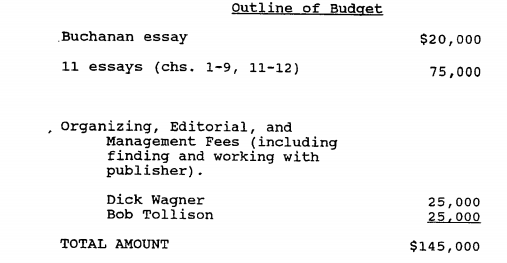
Probably the authors liked the money they made writing books and in 1988, Tollison and Wagner proposed writing a book Public Services: User Charges and Earmarked Taxes in Principle and Practice (notice Wagner uses the letterhead of GMU)


Tobacco Institute employee Martin Gleason wrote (May 31, 1989)


In June, Gleason added


And, in an undated memo


This time Richard Wagner was the lead author, perhaps to give Tollison a bit lower profile as he already led two other tobacco books. Other authors included Gary M Anderson, Bruce Yandle, Dwight R. Lee, Henri Lepage, Mwangi S. Kimenyi, James M. Buchanan and Fred S. McChesney.

The two non-network members are "Nobel Prize" winner James M. Buchanan (his name pops up everywhere in the LTDL, and he was involved in the 1984 workshop leading to the network) and French libertarian economist Henri Lepage (member of several of the same think tanks as the other economists, and a current member of the Global Warming Policy Foundation (GWPF)).

Even though Wagner was the first author, Tollison charged the Tobacco Institute

The fourth invoice also charged $36,250, so probably the industry paid $145,000, exactly the amount the authors proposed


Buchanan must have earned more because he held a Nobel Memorial Prize in Economic Sciences, explaining his high market value: how many politicians would dare to say a Nobel Prize winning economist was wrong on economy ?

It is clear the book was promoted the same way as Smoking and the State

Monday, 11 May 2020

The tobacco economists network - or how the Tobacco Institute recruited over 100 American economics professors. Part 7 of many

Overview of previous posts here

The social cost consultants

The Tobacco Institute's Cigarette Excise Tax Plan teaches us why the industry recruited the economists: the industry needed people with academic credibility telling legislators that "social cost" based actions were based on flawed argumentation and that taxes are evil.

Setting up the network
The task to set up an economists network was given to a subcontractor: James M. Savarese of consultancy-firm James Savarese & Partners. He worked closely with professor Robert D. Tollison. The PR-firm Ogilvy & Mather was hired to promote the output of the network.

Robert D. Tollison worked as consultant for the industry since at least 1979, researching social cost. James Savarese was a consultant who started working for the tobacco industry in the early 1980's. I was not able to find out how the industry put the two partners together.

Savarese usually was the person corresponding directly with the Tobacco Institute and usually he was the one presenting the invoices, even though some money seems to have been funneled through Covington & Burling. Sometimes Tollison or others billed directly. Savarese was much more than an administrative employee: he participated in meetings of the TI, set the strategy and testified for legislators, etc. He did not just run the economists network, but also worked with labor unions, trying to convince them excise taxes on tobacco would cause unemployment.

Some economists, like Richard Wagner and Tollison himself, seemed to have been recruited directly by the Tobacco Institute.  By 1985/1986 James Savarese was at least nominally responsible for expanding up and operating the network, the industry still provided leads for headhunting

A 1986 memorandum from Tobacco Institute's Susan Stuntz describes how the recruitment of several economists was done through the informal personal networks of James Savarese, Robert Tollison and Dwight R. Lee. Interestingly Stuntz in 1986 speaks of "several years" ago, while the excise tax plan only dates from 1984. Therefore the memo hints the Tobacco Institute used economists even before the formal creation of the economists network. We also learn the network started rather slowly. 


Susan Stuntz

As an example of such personal network: in 1984 James M Buchanan & Robert D. Tollison were the editors of the book Public Choice II. At least 9 of the 22 authors were or would later start working for the Tobacco Institute.

It is unclear how the economists were formally contacted by the Tobacco Institute after being recruited by Savarese/Tollison. A letter from K. Celeste Gaspari indicates recruiting some of the new members may have been through Robert Tollison's Center for the Study of Public Choice at George Mason University. 

Unfortunately, Savarese's full correspondence with the economists he worked with did not fully end up in the LTDL, so we will never know exactly how the network worked, nor will we know exactly how new network members were approached. We only know new members of the network would be contacted by someone from the Tobacco Institute once they were recruited.  In light of the letter by Celeste Gaspari contacts with the institute were likely made only by telephone

K. Celeste Gaspari

Do notice the letter illustrates the economists were fully aware they were working for the Tobacco Institute.

The network must have been set up after the industry finished the 1984 Tax Excise plan. At that time, several of the core members of the network were already working as industry consultants and they were already writing the book Smoke and the State.

It seems though the network was not complete until 1987, when the industry started to contact the economists, checking if the people Savarese
 had recruited were suited for the job the industry had in mind. Some economists seem to have dropped out at that point, or had moved state or simply lost interest in the network. 

Even though the economists in the network were subcontractors of Savarese and Tollison, they were fully aware they worked with the industry, and several documents in the LTDL (example) show the economists did not just have contact with James Savarese, but also with the Tobacco Institute itself.

Sunday, 3 May 2020

The tobacco economists network - or how the Tobacco Institute recruited over 100 American economics professors. Part 5 of many

Overview of the previous chapters here

Turning social cost into a lobbying-strategy

It is clear the industry simply researched the social cost issue to be able to create an instrument for lobbying. When the research of their consultants was finished, the next step for the industry was to decide which research could be used in its lobbying-strategy. This strategy was written down in the TI Cigarette Excise Tax Plan, subject of the blogpost after this one.

As seen in previous post, in 1979 and 1980 the industry started researching several different possible arguments (philosophical, anthropological, economical, . . .) to adress the social cost issue. 

By 1984 the industry seems to have abandoned the idea of using anthropological arguments to deny tobacco had a real social cost. Nor would the industry use 'philosophical' arguments to attack "social cost" as a valid scientific tool, simply because this kind of philosophical thinking is hard to turn into facile and misleading arguments. The turning point seems to have been a workshop held in 1984 where the different social cost researchers presented their conclusions. Tobacco employee Ed Battison attended the workshop and concluded:
Some of these points present a structure for defense of prosmoking views that are applicable to legislative hearings and lobbying during 1985 and 1986.

After the workshop most of the non-economic research must have been considered a dead end, because it did not appear in the TI Cigarette Excise Tax Plan. Even the economic arguments were basically narrowed down to attacks on excise taxes by claiming they were not a valid tool to translate the social costs of tobacco, or claiming there was no social cost at all. The industry would also use the argument that taxes harmed the economy, so that addressing social cost by imposing excise taxes would prove to be ineffective.

The outcome of the research done by the extreme free-market researchers fitted their worldview, as Battison's summary illustrates:

He sees San Francisco ordinance as unwarranted and an infringement on individual liberty. Smokers should have more than zero rights in public buildings. He also finds W.H.O. philosophy to be rife with paternalism and social engineering.

William F. Shughart II and Robert D. Tollison (two future members of the economists network):
a law like the San Francisco ordinance has no real case for intervention. Nonsmokers benefit at the expense of smokers, who lose their rights as nonsmokers' gain.
                                               
Peter Berger (Battison's emphasis):
identifies antismoking movement—ASH, GASP as volunteer operations of activists, and the bureaucracy as government agencies like O.S.&H. who are cautious but feel that the scientific evidence is undeniable and definitive. They are paternalistic to smokers and believe that smokers do not know what is good or bad for them.

argues compellingly for common sense in public policy on smoking. If each one succeeds in banning all of one's dislikes, everyone will be worse off. Self respect and tolerance are needed.

Robert Tollison:
Tollison concludes that antismoking movement can lead to restricting other forms of behavior as well, and could result in totally regulated society.

The industry did not drop all the non-economic arguments completely after the workshop and they still appeared in the 1985 book Smoking and Society: Toward a More Balanced Assessment, edited by Tollison. But the decision to produce the book was made in 1983 and the industry probably did not want to abort the ongoing writing as it might offend the authors/allies. It is not unlikely the industry still hoped in the future it might be able to use (at least some of) the work of the other consultants.

Sherwin Feinhandler's cultural arguments were further explored but in 1991 Feinhandler received his Dear John letter
Dear Sherwin, 
Many thanks for your letter of the 14th November, outlining the range of work that Social Systems Analysts inc. are involved in (...) Although there was interest in your paper, unfortunately no immediate need for this type of project was foreseen. There is, however, now an awareness of your work and we do have close contacts with a number of your clients who would no doubt be willing to recommend Social Systems Analysts inc. I am sorry not to be of any help at present but I wish you success for the new year and look forward to meeting with you again at future conferences.
Yet Feinhandler would reappear in 1994 through ARISE, a tobacco funded organization telling smoking cannot be too bad because it brings people 'joy'. It seems the industry discovered Feinhandler's arguments could be turned into a lobbying strategy after all. . .

It is not clear what happened with Robert Nozick's argumentation on personal freedom. In the LTDL-documents his name suddenly disappeared. Perhaps the industry simply did not need any further research on the ‘freedom’ argument because it appears the industry was already aware that using people's bias and gut-feelings (like the ‘freedom idea’ of libertarians) would be a good way to recruit new consultants. 

The 1984 strategy document was still looking for a ring leader to set up the social cost consultant network. That all the names circulating were libertarians, was hardly a coincidence. 

Finally, Robert Tollison, a Professor of Economics at George Mason University and James M. Savarese, a consultant, would be asked to create a network of economists working with the industry to fight excise taxes. While the writings of the economists show (at least some of) the economists accepted the existence of a tobacco related social cost, they all objected the practical use of social cost as an instrument to address to tobacco issue. As libertarians, they certainly objected any form of taxes.

In the next post, we'll see how the network of social cost consultants fitted a much broader lobbying strategy written down in the Cigarette Excise Tax Plan.