Showing posts with label Joseph Jadlow. Show all posts

Tuesday, 2 June 2020

Corrupted tobacco economists network - part 26 : organized op-ed campaigns in newspapers

Overview of previous posts here

Op-ed campaigns

A memorandum written by Tobacco Institute's Fred Panzer explains why the industry launched severalop-ed campaigns.  This memo strongly implies the op-eds were not written whenever the economists felt like writing something.

The campaigns were given different names like Phase II (also involving some "scientific papers").  In 1993 there was the monster op-ed campaign, etc...

The LTDL shows the industry paid a small bonus (900US$ for an Op-ed, only 125 US$ extra for forwarding it) to the economists sent an Op-Ed to their local politician, not just to a newspaper.  The industry specified the recipients. In states where the industry 'owned' more than one economist, they were given different politicians to contact. Panzer wrote
Fred Panzer, Tobacco Institute
The op-eds also proved to be a handy instrument for the field lobbyists

The free-market economists were supposed to write something against excise-taxes, but were not completely free to write anything. The industry dictated that they  had to mention


-         Excise taxes are regressive
-         Excise taxes are fundamentally inequitable
-         Excise taxes are an unfair burden on minorities
-         Government data demonstrates the unfairness of excise taxes.
-         Excise taxes are arbitrary
-         Excise taxes are hidden taxes
-         Excise taxes are an unfair burden on businesses
-         Excise taxes are bad economic policy

-         Excise taxes are historically controversial.

The last bullet refers to the argument "They are simply modern versions of the onerous British taxes which America's founders fought against". That is pure emo-argumentation.

Of course, op-eds had to be cleared by the Tobacco Institute's lawyers


As mentioned before, (at least the 1985) op-eds were also corrected by the PR-firm Ogilvy and Mather before the economists were allowed to send them to newspapers.

Nevertheless, even though the network members weren't free to write what they wanted, the Tobacco Institute did not erase every passage it didn't like. Again, this had a purpose 

James M. Savarese

Still, sometimes letting things the industry didn't like through, did not mean the Tobacco Institute let everything slip through. Fred Panzer of the Tobacco Institute wrote
Fred Panzer

The last line in this memorandum is more important than it may sound: it is the message the tobacco industry used to find business-partners.  The tobacco industry would try to scare other companies telling them something like "if the tobacco industry is going down, you're going to be next"

Again, as with the testimony, the output of the economists was closely monitored by the Tobacco Institute

(...)

The economists must have known it was bit strange they would receive more money if they would write their senator, once again disproving the thought they might have been useful idiots. Not all economists sent a copy of their op-eds to their Senator. Why not all of them tried to earn the extra cash is open to speculation.

Thursday, 21 May 2020

The tobacco economists network - or how the Tobacco Institute recruited over 100 American economics professors. Part 17 of many

Overview of previous posts here

The industry keeps evaluating

The industry kept evaluating for effectiveness


Full list of remarks:
  • Prof Dominick Armentano — "Yes: Contacted, make good witness"
  • Prof Summer LaCroix — "Yes: if needed in Hawaii"
  • Prof Allan Dalton — "Yes: Good Witness"
  • Prof Fred McChesney — "No Contact. Reported to be OK and could be used in future.
  • Prof Cecil Bohanon — "Should be replaced by listed Indiana Economist, Prof. James A Papke"
  • Prof Thomas Pogue — "Yes, Could be outstanding."
  • Prof Robert McMahon — "Yes: Creditable witness and one-on-one contact."
  • Pro Greg Neihaus — "Yes, outstanding witness"
  • Prof Raymond Raab — "Yes: Outstanding"
  • Prof Terry Anderson — "Yes, Good Witness"
  • Prof Terry Logue — "Yes: Outstanding witness"
  • Prof Kenneth Greene — "Yes: Only in particular situations with controlled information."
  • Prof Cliff Dobitz — "No contact: State not lend itself to Economic witness use."
  • Prof Richard Vedder — "No - Conflict minimizes effectiveness"
  • Prof William Mitchell — "Yes, Good witness"
  • Prof Ann Harper-Fender — "No contact - out of country, will contact in June.
  • Prof Arthur Mead— "Yes: Good witness"
  • Prof Dennis Hein — "Contact sometimes back; will probably be good witness and usable in 1988.
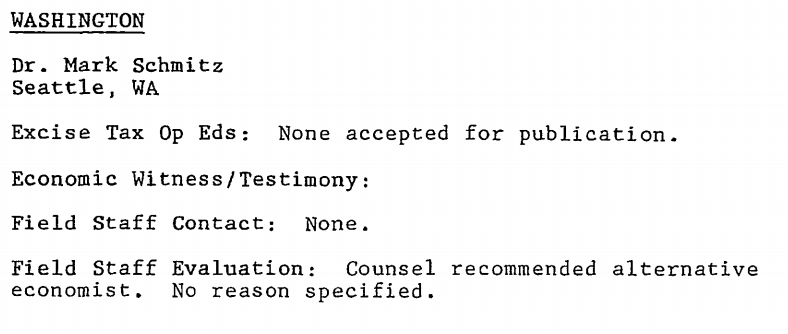
  • Dr Mark Schmitz — "Washington — No"
  • Dr Dennis Chinn — "Washington —Yes, Excellent"


In order to make the most of the new opportunities for the economist network, several factors had to be taken into consideration
(...)

Tuesday, 19 May 2020

The tobacco economists network - or how the Tobacco Institute recruited over 100 American economics professors. Part 15 of many

Overview of previous posts here

Savarese gets audited

The network was led by consultant James M. Savarese and economist Robert D. Tollison.

In 1997 James Savarese wrote he was under a new financial arrangement with the Tobacco Institute. 

The new financial agreement Savarese mentioned arose as result of the Tobacco Institute’s dissatisfaction with the way Savarese wrote his invoices (and maybe other reasons). Savarese nearly always mentioned the economists' names, but even in his correspondence with the Tobacco Institute he withheld two names (no idea why). As proof we are dealing with professionals, the Tobacco Institute in 1987 audited its subcontractor, leading to new arrangements with James Savarese.

The document is interesting because it shows the industry did not search for the economists, this job was left to Savarese. But:

The audit did generate some unfriendly messages within the Tobacco Institute and whatever sparked the dismay, the industry decided it would evaluate the economists themselves. 

Hurst Marshall wrote a letter to all regional VP's asking to fill a questionnaire


The impetus for these unfriendly communications is unclear but a few months earlier Savarese had been ordered to re-contact all the economists he listed

As another result of the audit, the Tobacco Institute seems to have made its own evaluation of the economists
[etc]
Tobacco employee Pete Sparber contacted 40 economists and 3 economists received less favorable reviews


Nevertheless, all three economists above stayed in the network for the next few years and still wrote op-eds (see another blogpost), but perhaps did not appear at any more hearings. The document does not mention why they wanted to replace Cecil Bohanon, but it shows the Tobacco Institute preferred James A. Papke who delivered very effective testimony in 1986

The same document finally solves the mystery why there were almost no women in the network 
Ann Harper-Fender
Thomas Borcherding also received a poor review 

Thomas Borcherding
Gary M. Anderson indeed would enter the network and he had already worked as assistant for Robert Tollison). Nevertheless. Borcherding does not seemed to have been kicked out but in the future would only be asked to write, not to deliver testimony.

The industry in the beginning did not like the newly recruited Gary M. Anderson even though he was a member of the core group. Interestingly in this memorandum Tollison/ Savarese are referred to as his "superiors"

Richard K. Vedder never was asked to testify. Lobbyist Bill Trisler explains
Richard K. Vedder