Thursday, 30 July 2026

Pjotrs Dwarsliggers – of waarom dwarsliggen nog geen wetenschap is

Onlangs verscheen op Dwarsliggers, een website die zichzelf graag profileert als een platform voor "dwarsdenken", het artikel CO₂ als ondergeschikte factor in het klimaatsysteem. Dat het vervolgens vrijwel onmiddellijk werd overgenomen door het nog steeds actieve pseudowetenschappelijke Climategate.nl hoeft dan ook niet te verbazen.

Op het eerste gezicht maakt de tekst indruk op wie niet vertrouwd is met de klimaatfysica. De auteur strooit immers eens niet met politieke slogans of ideologische standpunten, maar met natuurkundige begrippen als de eerste hoofdwet van de thermodynamica, de wet van Henry en de wet van Stefan-Boltzmann. Dat oogt vanop afstand wetenschappelijk.

Maar wie de moeite neemt de argumentatie stap voor stap te volgen, merkt al snel dat er iets begint te wringen. Niet zozeer met de fysica zelf maar met de conclusies die eraan worden verbonden. Telkens weer beschrijft de auteur mechanismen die al decennialang bekend zijn om ze vervolgens voor te stellen alsof ze het broeikaseffect van CO₂ zouden weerleggen. 

En precies daar in die conclusies loopt het compleet mis. De conclusies volgen immers domweg niet uit de beschreven fysica. Bovendien vertrekt de auteur van een fundamenteel misverstand: klimaatfysica bestaat niet uit concurrerende verklaringen waarbij het ene mechanisme het andere uitsluit. Ze draait juist om het samenspel van processen die elkaar voortdurend beïnvloeden.


"CO₂ bevat geen energie en kan dus geen primaire drijver zijn"

De auteur opent met de volgende stelling:

"CO₂ vertegenwoordigt zelf geen energie en kan daarom geen primaire drijver zijn."

Probleem: niemand beweert dat CO₂ energie creëert of zelf de energiebron van het klimaatsysteem is. Hier wordt dus al meteen een stroman opgetrokken.

De zon is en blijft de enige belangrijke energiebron van het klimaatsysteem. De vraag is niet waar de energie vandaan komt, maar hoe snel de aarde die energie opnieuw kwijt raakt. Precies daar grijpt CO₂ in. Niet door energie toe te voegen, maar door de snelheid te beïnvloeden waarmee de aarde warmte uitstraalt naar de ruimte.

Een eenvoudig voorbeeld maakt dat duidelijk. Niemand zal beweren dat een deken warmte produceert. Toch slaap je er warmer onder, niet omdat de deken energie toevoegt, maar omdat je lichaam minder snel warmte verliest.

Met CO₂ gebeurt in wezen hetzelfde. CO₂ verandert niet hoeveel zonnestraling de aarde ontvangt, maar wel hoe efficiënt warmte naar de ruimte ontsnapt. Een deel van de uitgaande infraroodstraling wordt geabsorbeerd en opnieuw uitgezonden, waardoor de effectieve hoogte vanwaar de aarde warmte uitstraalt verschuift. Om opnieuw in energiebalans te komen, moet het aardoppervlak opwarmen.

De eerste hoofdwet van de thermodynamica wordt daarmee niet weerlegd.

Integendeel. Het broeikaseffect is juist een rechtstreeks gevolg van die energiebalans.


Paleoklimaat: temperatuur liep vóór op CO₂

Vervolgens verwijst de auteur naar de Vostok- en EPICA-ijskernen en maakt een denkfout die je regelmtig ziet terugkeren. Omdat in de ijskernen temperatuurstijgingen enkele honderden jaren vóór de stijging van de CO₂-concentratie optreden, concludeert hij dat CO₂ onmogelijk een drijvende kracht achter klimaatverandering kan zijn.

Ook hier ontbreekt opnieuw een essentieel deel van het verhaal. De fout zit in wat hij niet ziet.

Tijdens de overgangen van een ijstijd naar een tussenijstijd was CO₂ namelijk geen forcering, maar een positieve terugkoppeling. De eerste opwarming werd veroorzaakt door veranderingen in de baan van de aarde rond de zon. Pas daarna warmden de oceanen op, waardoor extra CO₂ vrijkwam. Die extra CO₂ versterkte vervolgens de oorspronkelijke opwarming.

De auteur presenteert de vertraging van CO₂ alsof die het broeikaseffect zou weerleggen. In werkelijkheid is die vertraging juist precies wat de klimaatwetenschap al tientallen jaren verwacht én verklaart.

Bovendien zegt dit argument niets over de huidige klimaatverandering. Tijdens de ijstijden volgde de CO₂-concentratie de temperatuur. Vandaag is het precies andersom: de mens verhoogt de CO₂-concentratie rechtstreeks door fossiele brandstoffen te verbranden.

Opnieuw zien we hetzelfde patroon. Een correct beschreven fysisch proces wordt gebruikt om een conclusie te trekken die er niet uit volgt. Dat CO₂ tijdens de ijstijden als feedback werkte, bewijst allerminst dat CO₂ vandaag geen rol kan spelen. Integendeel, het toont juist aan dat veranderingen in de CO₂-concentratie de temperatuur verder kunnen beïnvloeden.

Wie zich verder wil verdiepen in deze kwestie vindt op Skeptical Science een heldere uitleg: CO₂ lags temperature


"Waterdamp is het belangrijkste broeikasgas, dus CO₂ speelt slechts een ondergeschikte rol"

De auteur wijst erop dat waterdamp verantwoordelijk is voor het grootste deel van het natuurlijke broeikaseffect. Daaruit concludeert hij dat CO₂ slechts een ondergeschikte rol kan spelen.

Ook dat klinkt aannemelijk, maar opnieuw volgt de conclusie niet uit de premisse.

Dat waterdamp het belangrijkste broeikasgas is, wordt door niemand betwist. De auteur presenteert dit echter alsof het een argument tégen de rol van CO₂ is, terwijl hij daarmee juist een belangrijk onderdeel van het gangbare klimaatmodel beschrijft.

CO₂ en waterdamp vervullen namelijk verschillende functies. CO₂ zorgt voor de initiële opwarming. Daardoor kan de atmosfeer meer waterdamp bevatten. Die extra waterdamp versterkt vervolgens de oorspronkelijke opwarming.

Met andere woorden: CO₂ is de forcering, waterdamp de positieve terugkoppeling.

De auteur behandelt beide mechanismen echter alsof ze elkaar zouden uitsluiten. Maar zo werkt het klimaatsysteem niet. Het ene mechanisme versterkt juist het andere.

Ironisch genoeg beschrijft de auteur hier dus precies het mechanisme waarop de huidige klimaatmodellen zijn gebaseerd, om vervolgens te concluderen dat datzelfde mechanisme de rol van CO₂ zou weerleggen.

Wie zich verder wil verdiepen in de wisselwerking tussen CO₂ en waterdamp vindt op Skeptical Science een heldere uitleg: Explaininghow the water vapor greenhouse effect works


"De oceaan bepaalt de CO₂-concentratie, niet andersom"

Vervolgens beroept de auteur zich op de wet van Henry. Koud poolwater neemt CO₂ op, warm tropisch water geeft CO₂ af. Daaruit concludeert hij dat de CO₂-concentratie in de atmosfeer in essentie door de temperatuur van de oceanen wordt bepaald.

Opnieuw zien we hetzelfde patroon: Wat de auteur schrijft, is niet fout. Het is alleen niet het hele verhaal. 

Volgens de wet van Henry lost CO₂ inderdaad beter op in koud water dan in warm water. Daarom kan koud zeewater meer CO₂ bevatten. Tot zover is er niets mis.

Alleen houdt de uitleg daar plots op.

De wet van Henry zegt namelijk óók dat de hoeveelheid CO₂ die in zeewater oplost afhangt van de CO₂-concentratie boven het water. Naarmate de atmosferische CO₂-concentratie stijgt, zal ook meer CO₂ door de oceaan worden opgenomen totdat een nieuw evenwicht is bereikt.

En dat is precies wat vandaag gebeurt.

Door de verbranding van fossiele brandstoffen is de atmosferische CO₂-concentratie sterk gestegen. Als gevolg daarvan nemen de oceanen netto enorme hoeveelheden van die extra CO₂ op. Volgens NOAA is die opname in de eerste plaats een fysische reactie op de stijgende atmosferische CO₂-concentratie. Temperatuur en oceaancirculatie spelen uiteraard mee, maar worden niet als de dominante oorzaak beschouwd.

Opnieuw wordt dus slechts de helft van het verhaal verteld. De eerste helft van de wet van Henry wordt uitvoerig besproken, de tweede helft verdwijnt geruisloos uit beeld. Vervolgens wordt uit die onvolledige voorstelling een conclusie getrokken die uit de volledige wet van Henry helemaal niet volgt.


"De polen als radiator van de planeet"

Vanaf dit hoofdstuk begint de argumentatieve structuur van het artikel steeds verder uiteen te vallen.

De auteur bespreekt achtereenvolgens de mondiale energiebalans, warmtetransport via atmosfeer en oceanen, de sterke opwarming van het noordpoolgebied en de opname van CO₂ door de oceanen. Op zichzelf zijn dat allemaal bekende natuurkundige processen. Alleen wordt gaandeweg steeds minder duidelijk welke centrale stelling hij eigenlijk nog probeert te onderbouwen.

De tekst lijkt steeds meer te bestaan uit losse beweringen waarvan de lezer zelf maar moet proberen te achterhalen hoe ze met elkaar samenhangen. De ene zin volgt vaak niet logisch uit de vorige en nieuwe stellingen worden geïntroduceerd zonder dat duidelijk wordt waarom ze relevant zijn voor de conclusie.

Dat wordt vooral duidelijk wanneer de auteur stelt dat de sterke opwarming van het noordpoolgebied uitsluitend het gevolg zou zijn van een toegenomen warmtetransport vanuit lagere breedten.

Zelfs als warmtetransport een belangrijke rol speelt, volgt daaruit nog niet dat CO₂ geen rol speelt. Warmtetransport verplaatst immers energie binnen het klimaatsysteem; het verklaart niet waarom de aarde als geheel meer energie vasthoudt. Dat zijn twee verschillende vragen, die in dit hoofdstuk voortdurend door elkaar lijken te lopen.

Nog opmerkelijker is de slotzin:

"CO₂ speelt hier geen rol want deze is constant over het ganse aardoppervlak."

Waarom uit een vrijwel uniforme CO₂-concentratie zou volgen dat CO₂ geen rol kan spelen bij regionale verschillen in opwarming, wordt nergens uitgelegd. De conclusie verschijnt eenvoudig aan het einde van de paragraaf. De redenering die ertoe zou moeten leiden ontbreekt volledig.


"CO₂ als kleine modulator"

In het volgende hoofdstuk wordt dat probleem alleen maar groter.

De auteur begint met de vaststelling dat extra CO₂ de uitgaande infraroodstraling vermindert en daardoor een kleine positieve stralingsonbalans veroorzaakt. Vervolgens springt de tekst naar waterdamp, convectie en andere natuurlijke energiestromen. Daarna verschijnen plots "sterke negatieve terugkoppelingen", om uiteindelijk te eindigen met de conclusie dat de klimaatgevoeligheid waarschijnlijk veel lager is dan algemeen wordt aangenomen.

Het merkwaardige is dat vrijwel geen van die tussenstappen wordt uitgewerkt. Waarom is de vergelijking met convectie relevant? Welke negatieve terugkoppelingen worden precies bedoeld? Waarom zouden die de opwarming grotendeels compenseren? En vooral: hoe volgt uit dit alles dat de klimaatgevoeligheid laag zou zijn???

Eigenlijk is dat de rode draad: de auteur somt een reeks bekende elementen opop en lijkt vervolgens te veronderstellen dat de rol van CO₂ daarmee automatisch kleiner wordt, zonder zich veel te bekommeren hoe die conclusie volgt uit zijn tekst. Het wààrom ontbreekt. Het bestaan van convectie, waterdamp, oceaanstromingen of warmtetransport zegt op zichzelf niets over de grootte van de bijdrage van CO₂. Daarvoor moeten de verschillende processen worden gekwantificeerd en in hun onderlinge samenhang worden bekeken. Precies dat is wat de moderne klimaatfysica doet en precies die stap ontbreekt volledig.

Tegen dit punt lijkt de tekst nauwelijks nog uit een samenhangende argumentatie. Naar het einde toe bekroop me zelfs de indruk dat sommige zinnen willekeurig naast elkaar zijn gezet in de hoop dat de gewenste conclusie er vanzelf uit zou volgen.

Conclusie 

Uiteindelijk bleef ik me tijdens het lezen één vraag stellen: probeerde de auteur een natuurkundige hypothese te toetsen, of was hij vooral op zoek naar argumenten die zijn vooraf vaststaande conclusie konden ondersteunen? 

Misschien is dat wel het wezenlijke verschil tussen wetenschap en pseudowetenschap. Wetenschap probeert voortdurend haar eigen blinde vlekken op te sporen. Ze toetst elke nieuwe conclusie aan de volledige beschikbare kennis, juist om te ontdekken waar een redenering mogelijk fout loopt. Pseudowetenschap doet vaak het tegenovergestelde. Ze vertrekt vanuit een onvolledig beeld en merkt daardoor niet dat de ontbrekende delen van de wetenschap de eigen conclusie al lang hebben weerlegd.

Dat is precies wat dit artikel zo zwak maakt. De afzonderlijke natuurkundige begrippen zijn grotendeels correct, maar ze worden losgemaakt uit hun context en groter geheel. Daardoor lijken allerlei logische sprongen overtuigend, simpelweg omdat bij de auteur de kennis ontbreekt die laat zien waarom ze niet kunnen kloppen. 

De blinde vlek wordt zo onderdeel van de redenering zelf.

Wat overblijft is geen alternatieve klimaatfysica, maar een reeks conclusies die alleen plausibel lijken zolang een groot deel van de relevante natuurkunde buiten beeld blijft. En dus is dit artikel een schoolvoorbeeld van pseudowetenschap.

Sunday, 23 January 2022

The corrupted tobacco economist network Part 65 - Conclusions

 Overview of previous posts here

It is clear all the economists were fully aware they worked with the Tobacco Institute. Yet still I think it is possible when joining the network, some of the economists presumed they were sought to nothing but expressing their worldview. They were part of one big corporate conspiracy though, even if in the beginning not all of them might not have realized this themselves.

The tobacco industry used and exploited the libertarian bias of the economists. And the industry knew they would write the conclusions wanted by the industryBefore even contacting one, the industry was sure it would find a guy concluding taxes are evil, and that guy would be publishing it in a journal. It's not hard to find out why the industry was so sure: libertarians always conclude there shouldn't be taxes or tax-increases. The industry simply exploited their predictability.

George Berman's testimony in court shows the tobacco industry exploited Robert D. Tollison's libertarian bias to recruit him. The Tobacco Institute never told Tollison he needed to defend the tobacco industry. Instead, they fed him arguments so Tollison would come to that conclusion. in the words of Berman "we had focused a leading economist's mind on this particular problem and he was now able to be a spokesman for the solution he had come up with". Question: independently ? Berman's answer: "independently".

Of course Berman's answer "independently" isn't entirely correct: the industry fed his bias, and by doing so has been able to alter his mindset, picking up the tobacco issue. While Tollison indeed may have concluded for himself taxing is evil, his conclusion wasn't entirely independent.

The extremist worldview of the economists is obvious, and as shown even the industry sometimes had doubts on this worldview, afraid it could harm the industry being associated with people attacking tax-increases with op-eds like the one by Cotton Maher Lindsay titled excisetaxes: fascist finance, effectively comparing tobacco excise taxes to the practices of Italian fascism under dictator Benito Mussolini. A bit far-fetched, no? 

Or what to think about thois one; Tollison and Wagner writing the op-ed scientific integrity consumed by anti-smoking zealotry.  The same year the corrupted Tollison wrote a letter to the editor stating

Do remember this was written by a man heading a corrupted network, earning him well over 1 million dollars. Shameless. 

Yet at the same time, the extreme views are exactly the reason the economists were recruited. As shown, Philip Morris was interested in Dwight R. Lee *because* he was an extremist, writing giving the EPA authority over indoor air "would be likegiving a machine gun to a child".

The industry never asked Lee to take such positions. Whatever a scientific viewpoint is, there will be always be a deluded naysayer. The industry's tactic, seen in all the headhunting documents, is always showing the same pattern; the industry deliberately searches for nutcases, then giving them lots of money and making sure they receive media attention. To the laymen, the illusion then arises these extremists ' viewpoints might mean there actually is a scientific discussion. This is the doubt the industry wanted to create, because many people think when two different opinions exist, both must have some merit; Quod non, one can be completely wrong.

Were the economists corrupt ? Were they lobbyists, or just a pragmatic free-marketeers: was libertarianism the motivation driving the economists ? Or were they really for sale ? The Legacy Tobacco Documents Library doesn't provide a clear answer to these questions. Ultimately, it depends on the definition of corruption: the first thing we think of hearing the word probably will be: people doing or telling things they wouldn't do if not being paid.

Following that definition, it is clear some economists were probably dishonest: they signed things they  knew were flawed (Poulson), or lied being independent citizens (Militello). But this necessarily mean they defended work they did not believe in at all.

There's also another form of corruption: people being paid to tell ... exactly the same thing they would be saying if they would not receive money. In the case of the economists, I think it's clear that if they would not have accepted money from the tobacco industry, they still would be objecting any form of taxation.

This form of corruption isn't so much about whàt they said, but what they did not say. The website ScienceCorruption.com has done a tremendous job looking at the activities of the social cost consultants, giving a chronological order of the documents regarding the individual members. In 2011  Dominick Armentano wrote an error loaded reply (at the bottom of the page) addressing one strawman after another.

I guess the most interesting part in Dominick Armentano's reply, is the mere fact Armentano thinks his actions are defendable.

His answer misses a couple of points. ScienceCorruption's reply summarizes the entire problem with the activities of the network:


And those five points imply that every member of the network who ever delivered any output for the industry was corrupt.

Some economists seem to never have produced anything for the industry. But they accepted to join a network knowing they would be working for the industry. And several economists in the network accepted they would testify if being asked so by the industry. The fact some were never asked to testify, doesn't alter the fact they accepted to deliver testimonials if they would be asked to. It might not have been illegal (I don't know the american legal system), but it is clear there are some moral problems with their activities.


Further Research

Even though this series of blogposts isn't exactly short, there's much more to add to the tale of social cost and the economists network.

I have not fully explored the fact so many economists belonged to just two universities (George Mason University and Clemson University). What exactly was the role of GMU and Clemson ? Were these university aware of their activities ? What's the connection between the think tanks and GMU, the connection with the libertarian foundations, etc.

Another open question is how the economists ended up in think tanks. Did they join voluntarily ? Were they asked ? Is it coincidence they all ended up in the same think tanks, while there are literally dozens of right wing / free market think tanks ? Were some think tanks obliged by the industry to take the economists aboard ?

The 1984 Excise plan indicates the industry did not just want economists, but also wanted to recruit lawyers. We know there were attempts to create the network, but was it ever fully established ?

What was the role of the people "not on PM's list" ? Why does this document carry this strange heading? Were there other fully developed networks ?

We know some economists dropped out the network, but don't always know why. It is clear some were sacked, but were there any network members whose conscience came to play ?

On top of that, I'm pretty sure i did not discover all documents in the LTDL: the documents in the LTDL have been scanned and automatically converted to text, but the conversion sometimes failed, with letters getting switched etc. p. ex. Tollison can be found in the database as Tollison, but also Tol!ison, Toiison, Tollis0n, etc... This makes it difficult to find the right search queries...

One thing is clear: lots of questions remain unanswered...

Sunday, 16 January 2022

The corrupted tobacco economist network Part 64 - Non-tobacco output

Overview of previous posts here

Microsoft

The tobacco industry isn't the only industry using think tanks to manipulate the audience. In 1999, the Independent Institute sponsored a full-page advertisement (Open Letter on Antitrust Protectionism) in the Washington Post and the New York Times, signed by 240 economists.

25 of the people signing were members of the Tobacco Institute's economists network.

The letter sounds familiar, it's just the same old call against regulations. The only real question is: were they following their political beliefs, or was the Independent Institue not anly gaining money from the Tobacco industry, but also from Microsoft ? And is it a coincidence in 1998 tobacco network economists William F. Shughart II and Richard B. McKenzie wrote the piece is Microsoft a monopolist? or where they paid to write it ?
 
Well, you probably already guessed it: According to the NYT in 1999 20% of the Independent Institute's funding came from ... Microsoft: 'Unbiased' Ads for Microsoft Came at a Price

Economists for sale ? Or was it pragmatism, and was the Independent Institute just working together with the industry to reach a libertarian objective ?


Alcohol output

By 1995 the tobacco industry was already working with a lot of think tanks and businesses, trying to attack the government on all sorts of environmental sciences


It may or may not be a coincidence, but in 1997 tobacco economist Richard Wagner wrote a chapter on the social cost of alcohol in a book edited by another network member, William F. Shughart II in the book The Taxation of Alcohol and the Control of Social Cost. In Taxing Choice: The Predatory Politics of Fiscal Discrimination.

But even earlier, in 1987, Robert D. Tollison and Robert B. Ekelund, Jr. wrote Economic effects of Geographic Restraints in the Malt Beverage Industry used by Tollison in a hearing before the Subcommittee on Antitrust, Monopolies, and Business Rights of the Committee on the Judiciary, United States Senate, One Hundredth Congress, first session on S. 567 (August 4, 1987).

And more alcohol output in this one: Temporal regulation and intertemporal substitution: The effect of banning alcohol at college football games. by William J. Boyes and Roger L. Faith

It could be a coincidence the tobacco authors suddenly en messa took such interest in alcohol ?


Petroleum industry

After the  Exxon Valdez oil spill in Alaska (1989) there was serious outrage allover the world. So the industry could use some help, and two tobacco economists stepped in : Alaskas Other Oil Spill. January 1, 1990. Foundation for Economic Education (written by Dwight R. Lee and Stephen L. Jackstadt). 

No, the article is not about oil or protecting the environment. It's the same old story on taxes.

Saturday, 15 January 2022

The corrupted tobacco economist network Part 63 - National Center for Policy Analysis

Overview of previous posts here

The National Center for Policy Analysis was another think tank where the corrupted social cost economist could spread their word


The next battleground: Indoor air

Dwight R. Lee
 in 1992 wrote the NCPA report The next environmental battleground: Indoor Air, opposing any form of regulation of indoor-air quality (IAQ). The report is also one of the first examples of a social cost economist questioning EPA's objectivity and neutrality. 

On top, it is making outrageous claims like government regulations on IAQ would kill 1900 extra people a year [sic]. 

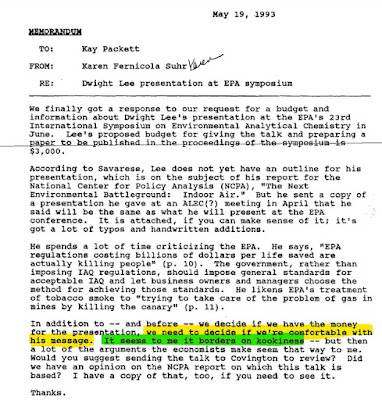
Lee proposed the Tobacco Institute to make a presentation of the report at the EPA's 23rd International Symposium on Environmental Analytical Chemistry. 

Tobacco Institute's Karen Fernicola Suhr wasn't sure what to think of the proposal as she Lee's claims were so ridiculous:


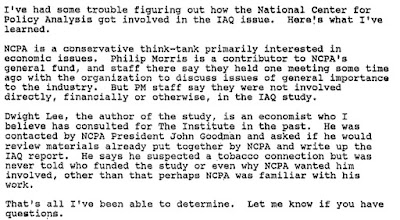
It wasn't the only weird thing about this report. The Tobacco Institute also was wondering why the NCPA cared about Indoor Air Quality at all


The Tobacco Institute in 1992 wasn't really sure why the think tank bothered to write on indoor quality. A 1993 letter sent by Tom Hockaday (of PR-firm APCO Worldwide) to Philip Morris hints the report actually was written on the command of APCO

S. Fred Singer, Dwight R. Lee

Nor Singer (a physicist), nor Lee (an economist) have any qualifications to judge indoor air-quality science.

Meanwhile, the program of the 23rd International Symposium on Environmental Analytical Chemistry shows Lee was one of the speakers, so despite the "cookiness", the Tobacco Institute probably paid him the $9.000 he asked for. Lee wrote an article after the presentation.

It's hard to decide  which my favorite sentence is in the article: "EPA is no better at central planning than the Soviets were" or "Each polluter is better informed than EPA authorities on how to reduce pollution at least cost and is certainly more motivated"

I do understand why Karen Fernicola Suhr staed the tobacco industry had to decide if it felt comfortable with his message. And Why she felt his message borders on kookiness.


Attacking all environmental sciences

But even beofre the 1992 report above,  the National Center for Policy Analysis was already attacking almost all environmental sciences, in the 1991 report Progressive environmentalism: a pro-human, pro-science, pro-free enterprise agenda for change. The head of the taskforce writing the report was Richard L. Stroup, another tobacco economist from the network.

The taskforce consisted of an interesting list of names, besides tobacco economists there are a lot of people listed who would get known as climate skeptics.

Network economists involved in the NCPA environmental task force were (besides Stroup) : Terry L. Anderson, Allen Dalton, Bruce Johnson and of course  Dwight R. Lee

Other tobacco consultants mentioned in this task force were Thomas J. DiLorenzo, Kent Jeffreys, S. Fred Singer and  James H. Miller. And a lot of people from other think tanks, like Joseph Bast (Heartland Institute), Fred L. Smith (Competitive Enterprise Institute), David J. Theroux (Independent Institute).

The reports attacks a wild array of environmental topics. The report might be an early example showing how libertarians started attacking all environmental sciences, not because they have much knowledge on the subject, but rather because it doesn't fit their worldview.

Saturday, 8 January 2022

The corrupted tobacco economist network Part 62 - Atlas Economic Research Foundation

Overview of previous posts here

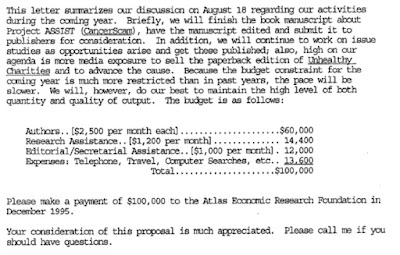
The social cost economists were only one of the networks and tactics used by the industry. An example of other lobbying is found in the work of James T. Bennett and Thomas J. Di Lorenzo for the  Atlas Economic Research Foundation (nowadays the Atlas network)

James T. Bennett, author of CancerScam: The Diversion of Federal Cancer Funds to Politics (co-author: Thomas J. Di Lorenzo) wrote a letter in 1995 to R.J. Reynolds 

James T. Bennett

Again, we see a think tank operating as a front for a tobacco funded book. And while the authors are not part of the social cost economist, just like the economists the authors both are ... libertarians active in numerous think tanks

James T. Bennett is/was associated with the Ludwig von Mises Institute, the Virginia Institute for Public Policy, the John Locke Institute and currently is on the advisory board of the global warming denying Committee for a Constructive Tomorrow

Thomas J. Di Lorenzo from his side has ties with the Independent Institute, Capital Research Center, the Ludwig from Mises Institute, the Property and Freedom Society, the Heartland Institute, the National Center for Policy Analysis, and the Committee for a Constructive Tomorrow

Or in other words: the authors are active in the same kind of thinks as the social cost economists... And both have been working at George Mason University, just like the core-members of the economists network. Something seems rotten there.

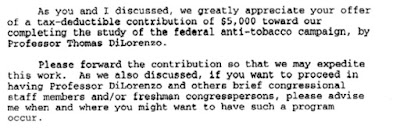
The industry paid the Atlas Economic Association in 1995 for the book CancerScam, but a year before it also paid $5000 to the Independent Institute for work done by Thomas J. Di Lorenzo, as this letter by the its president Donald J.Theroux demonstrates

And this is how think tanks became one blur of economists/lobbyists, the same think tanks that became the ideological basis for a big part of the American GOP in the early 21st century.

Wednesday, 29 December 2021

The corrupted tobacco economist network Part 61 - Heartland Institute

Overview of previous posts here

Best known nowadays for their position on global warming, the Heartland Institute started as a think tank defending the tobacco industry. Former President Joseph L. Bast still minimizes the risks of ETS.

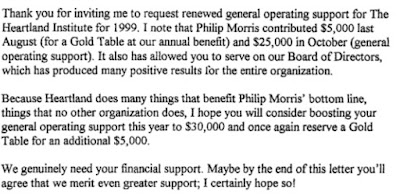
Heartland always had pro-tobacco viewpoints and even invited a tobacco employee (Roy E. Marden) to join its board. In 1999, Heartland president Joseph L. Bast wrote the following letter to Philip Morris:

Joseph L Bast Heartland Institute

At least 20 of the network economists are or have been involved with the Heartland Institute. and in 1999, the year Bast begged for money, 6 tobacco economists were members of the advisory board

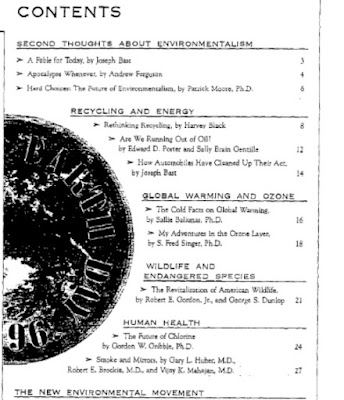
A 1996Heartland report shows something seen in all libertarian think tanks: an attack on a whole bunch of "environmental sciences". It is very unlikely the think tankers actually knew something about the actual state of one scientific field,  let alone a whole series of scientific domains. Ideology, not science, is the source of this kind of output produced by think tanks

Heartland Institute

It's one the first examples how tobacco and global warming (and other environmental/ health sciences) are thrown under the bus in one big effort. This was part of the "APCO" plan.

Author Richard L. Stroup was a member of the economists extended network

Gary L. Huber

Gary L. Huber was a researcher working on the link between tobacco and lung cancer, research sponsored by the tobacco industry. In 1980, Huber (re)discovered the relation by producing emphysema in rabbits.

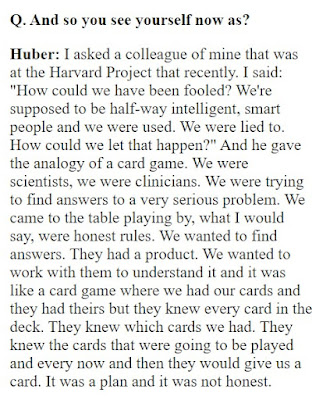
In the prelude to the Tobacco Master Settlement Agreement, he became a whistleblower (in 1997) claiming to be a naïve scientist duped by a broader plan of the tobacco industry. Huber claims in the interview the industry let him though his research on lung cancer, even though they had done the same research before, and already knew the outcome was going to be smoking causes cancer.

 Huber said in an interview

Gary L. Huber

Several sources state Huber was in tears when discovering his entire research was one big waste of time. Most sources feel sorry for the man.

The book Denial: The NFL, Concussions, and the Battle for Truth states Huber promptly lost his grants from the tobacco industry after publishing his results, the industry making clear they weren't too pleased with his work. Huber subsequently moved from Harvard to the University of Kentucky and continued doing research, strangely enough again funded by the tobacco industry. But something had changed: in Kentucky Huber would become accused of manipulating scientific results, sexual harassment and general incompetence. Within a year, he got fired

All this doesn't really explain how Gary L. Huber, then working in Texas, ended up in the 1996 Heartland Earth Day '96 document, writing "In this case, the EPA's risk assessment is built on the manipulation of data, ignores crucial chemical analysis and key epidemiological data, and violates time-honored statistical principles."

I'm not sure what to think about all this, and the supposed knife the industry put in his back

Saturday, 18 December 2021

The corrupted tobacco economist network Part 60 - Alexis de Tocqueville Institution

Overview of previous posts here

The previous blogpost mentioned in 1994 the Independent Institute authored the open letter against the Clinton Health Reform Plan. But the Independent Institute was not the only think tank aiming to work with the tobacco industry. 

The Alexis de Tocqueville Institution invited itself to the industry in this letter to Philip Morris. Was AdTI at this point no pro-tobacco ? Probably not, the letter illustrates it all started with a remarkably one-sided and bit silly opposition against the tax-increase in the health reform plan. Thos one-sided viewpoint ultimately would become disastrous for the think tank. 

Tim Lambert wrote a blogpost in 2004 (The Astroturf de Tocqueville Institute) showing the AdTI indeed started working with the tobacco industry in the 1990's.


The S. Fred Singer report

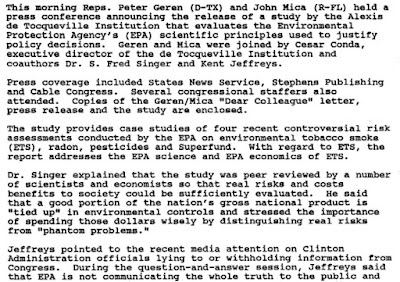
In 1994, late S. Fred Singer, best remembered as climate pseudo-skeptic, authored the Alexis de Tocqueville Institution report Science, Economics, and Environmental Policy: A Critical Examination. This report probably was ordered by the tobacco industry.

Early 1994, Cesar Conda, then president of the Alexis de Tocqueville Institution, had not decided yet who would author the paper (is not it lovely they already know what the report would conclude, without even knowing who would be the author?). Het wrote this remarkable letter


Cesar Conda Alexis de Tocqueville Institution


The letter summarizes the corruption of this think tank: fake report, fake endorsements, wide press circulation. And all that for just $20.000


The letter also shows the focus was no longer only to attack regulations on tobacco, other environmental subjects would be thrown under the bus too. And indeed, it is in the pool of different American extremist conservative industry funded think tanks that organized global warming denial would finds its roots.

The letter summarizes the corruption of this think tank: fake report, fake endorsements, wide press circulation. And all that for just $20.000

A while later, Conda wrote another amazing letter


Clearly: this report was as corrupted as a report can be.

The report contains the following passage:

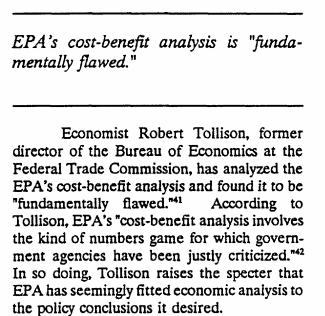
Robert D. Tollison

No, the report does not mention Tollison's connections with the tobacco industry, nor the fact the industry indeed paid the AdTI the $20.000 for the report

No, the report does not mention Tollison's connections with the tobacco industry, nor the fact the industry indeed paid the AdTI the$20.000 for the report. All in all, it's not even that much money and from the industry's point of view, this must have been a bargain to corrupt a think tank for an amount of money lower than an add campaign in a newspaper

In the draft version S. Fred Singer was named the first author and Kent Jeffreys the second author. It is unclear why Singer is listed as the reviewer (and not author) in the final report and why suddely Jeffreys "authored" the report.


The industry wanted to use the report for lobbying, that much is certain

Alexis de Tocqueville Institution


The report had the desired result. Samuel Chilcote, president of the Tobacco Institute reported
S. Fred Singer

Who those "peer reviewers" were is a mystery, but probably the 1994 advisory board of the AdTI gives a clue: with Gary M. Anderson, Jeffrey R. Clark, Robert B. Ekelund, Dwight R. Lee, Mark Thornton, Robert D. Tollison, Richard K. Vedder and Richard E. Wagner, eight of the nineteen board members were members of the economists' network. Probably they were the not so critical reviewers of the report.

In 1995 the AdTI published another excise tax report, this time not by the economists though, but by John E. Berthoud, president of the National Tax Payers Union.

In 1998, the AdTI's draft report Tobacco Smuggling: A Worldwide Phenomenon was sent to the tobacco industry.

This is not the work of an independent think tank.