Overview of previous posts here
Several op-ed rounds
Even though
the network was not complete yet, in a first campaign in 1985 the economists
produced 34 op-eds, 18 being published, earning the authors
$1.000 each
The memorandum
shows that:
- the economists were told what they had to write (at least if they wanted to make money)
- the core members controlled the output. But the memorandum does not mention the op-eds would pass by the Tobacco Institute and their lawyers.
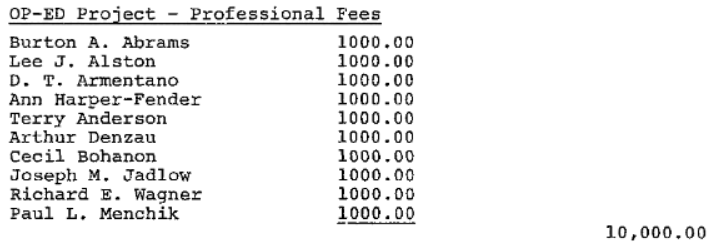
The second billing for the project gives a clue how much the industry
paid for the op-eds
Although Savarese calls the 1987 op-ed round the first one, clearly there were already campaigns in 1985 and 1986, and in 1985 the industry already had a
list of economists willing to appear at hearings.
In 1988 there was the National Economic Commission op-edround and another one dealing with a possible advertisement ban on tobacco. Savarese once again made sure the economists and lawyers knew what they had to
write.
After some examples of arguments, Savarese concludes with a remark showing
something interesting: Anna Tollison, wife
of Robert, was involved in the whole operation
(..)
The
LTDL does not contain the answer to Richards even though a letter from Savarese
shows Staaf must have replied.
Early 1993 EPA released a report stating second
hand smoking indeed kills. The Clinton administration was thinking of
drastically raising excise taxes (aka the monster
tax). The industry answered (among other things) with a new op-ed campaign:
20 economists would be asked to write op-eds, so once again the industry did
not use the entire network. If the op-ed got published, the economist each
would receive $3.000. And again, the industry did closely follow up whichop-eds were (about to get) published:
In the end of 1995, the economists held another op-ed campaign, this
time aimed at the American Food and Drug Administration (FDA) as the
administration wanted further regulations on tobacco products. At least 15 op-eds were published.
In 1988 there would be a last (?)
op-ed round, but by then the LTDL shows major hiatuses, and the documents often
do not any more carry names, making it harder to be sure who was involved.
Again, it is
not clear why the industry usually picked only around 20 economists for these
campaigns. Perhaps some states at the time were not considered a priority.
While superficially it may seem the
op-eds were expensive, the industry wrote a memorandum about an op-ed written
by Robert Tollison, showing the industry thought they were a bargain