Showing posts with label Heartland Institute. Show all posts

Wednesday, 29 December 2021

The corrupted tobacco economist network Part 61 - Heartland Institute

Overview of previous posts here

Best known nowadays for their position on global warming, the Heartland Institute started as a think tank defending the tobacco industry. Former President Joseph L. Bast still minimizes the risks of ETS.

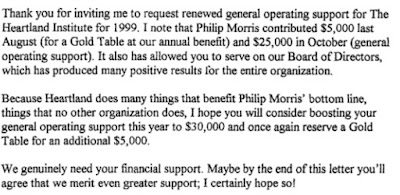
Heartland always had pro-tobacco viewpoints and even invited a tobacco employee (Roy E. Marden) to join its board. In 1999, Heartland president Joseph L. Bast wrote the following letter to Philip Morris:

Joseph L Bast Heartland Institute

At least 20 of the network economists are or have been involved with the Heartland Institute. and in 1999, the year Bast begged for money, 6 tobacco economists were members of the advisory board

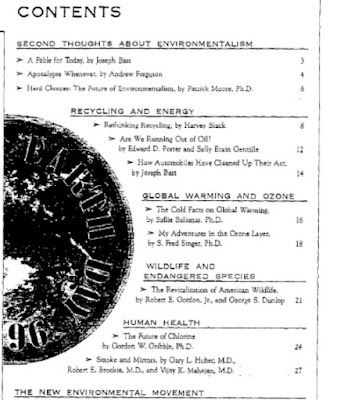
A 1996Heartland report shows something seen in all libertarian think tanks: an attack on a whole bunch of "environmental sciences". It is very unlikely the think tankers actually knew something about the actual state of one scientific field,  let alone a whole series of scientific domains. Ideology, not science, is the source of this kind of output produced by think tanks

Heartland Institute

It's one the first examples how tobacco and global warming (and other environmental/ health sciences) are thrown under the bus in one big effort. This was part of the "APCO" plan.

Author Richard L. Stroup was a member of the economists extended network

Gary L. Huber

Gary L. Huber was a researcher working on the link between tobacco and lung cancer, research sponsored by the tobacco industry. In 1980, Huber (re)discovered the relation by producing emphysema in rabbits.

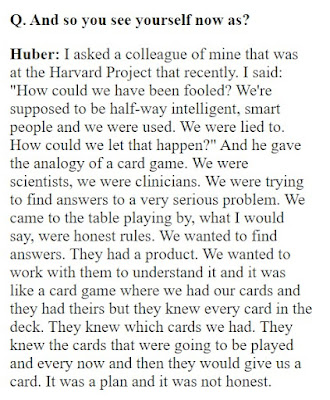
In the prelude to the Tobacco Master Settlement Agreement, he became a whistleblower (in 1997) claiming to be a naïve scientist duped by a broader plan of the tobacco industry. Huber claims in the interview the industry let him though his research on lung cancer, even though they had done the same research before, and already knew the outcome was going to be smoking causes cancer.

 Huber said in an interview

Gary L. Huber

Several sources state Huber was in tears when discovering his entire research was one big waste of time. Most sources feel sorry for the man.

The book Denial: The NFL, Concussions, and the Battle for Truth states Huber promptly lost his grants from the tobacco industry after publishing his results, the industry making clear they weren't too pleased with his work. Huber subsequently moved from Harvard to the University of Kentucky and continued doing research, strangely enough again funded by the tobacco industry. But something had changed: in Kentucky Huber would become accused of manipulating scientific results, sexual harassment and general incompetence. Within a year, he got fired

All this doesn't really explain how Gary L. Huber, then working in Texas, ended up in the 1996 Heartland Earth Day '96 document, writing "In this case, the EPA's risk assessment is built on the manipulation of data, ignores crucial chemical analysis and key epidemiological data, and violates time-honored statistical principles."

I'm not sure what to think about all this, and the supposed knife the industry put in his back

Saturday, 14 November 2020

The corrupted tobacco economist network Part 54 - Working with Think tanks

 Overview of previous posts here

Tobacco Employee Roy Marden was one of the tobacco employees responsible for the communication with think tanks. He wrote the following memo, titled Tobacco Strategy on the think tanks he was responsible for (the industry divided the think tanks between a couple of its employees)

Roy Marden

(...) (the document is 6p. long)

The tobacco industry sought the help of right-wing think tanks to fight excise taxes.

In 1995, the Tobacco Institute sent a memo, mentioning that the economists still were able to provide op-eds in no less than 30 states. The same memo illustrates how the industry worked with the different think tanks


A similar document was written in 1998, most likely by Roy Marden. Notice how long the list is. It no longer only mentions thinks tanks, but many journalists, and even an actor and a magician (???). It's not clear why the document mentions Dwight R. Lee and Walter Williams, but it is possible Marden was not aware of their membership in the social cost economists network. Do also notice he mentions he's on the board of the Heartland Institute. 

[ETC, the list is a couple of pages long]

While there always have been contacts between the industry and think tanks, and they worked together since at least the 1980's, it was only in the 1990's that the industry's involvement would become so pervasive that one could say the industry 'owned' some of these organizations.

In the long run, think tanks probably were much more powerful allies than a secret network of economists ever could have been.

S. Fred Singer wrote his infamous Alexis De Tocqueville Institution's tobacco-paper in 1994 (see further), with Robert D. Tollison helping him. Tobacco economists were working with the Heartland Institute since at least 1991. The Independent Institute was was joined by many members of the economists' network. In 1994, Tollison and Wagner became members of the Independent Institute's advisory board.

Thursday, 2 July 2009

Climate Change is a Religion, not Science

A while ago i already mentioned that the president of the libertarian Mises Youth org, young Vincent de Roeck considers climate change to be nothing but a hoax.

Under the provocative title 'climate change is a religion, not science' De Roeck draws attention to his latest article on the subject. As he's inspired by libertarism, his conclusion is pretty predictable : it's nothing but a worldwide complot.

His piece got quite some attention as it's been published on four libertarian blogs simultaneously. Therefore i suppose it might be useful to have a closer look at what he writes and see if this time he does get any further than just a renewed belief in a conspiracy.
(As usual, my translation)

Climate change is a religion, not science
Last week the British conservative thinkthank "The Bruges Group" published the paper "Cool Thinking On Climate Change". In some 60 pages the author, the British member of the European Parliament Roger Helmer is trying to convince his readers that the alarmism around global warming is based on lies and dishonesty and that the actions proposed are dangerous and counter-productive.

Helmer starts his paper with a prelude titled "The EU: Fully paid-up Climate
Alarmists" (imho a rather amusing title given the fact he's a MEP receiving a very nice salary from this very same EU) in which the key-quote probably is :
Global Warming? The EU needs more control over energy policy, over tax, over emissions, over industry, over everything.
Of course those words immediately point towards the real reason for Helmers skepticism : it's not based on scientific doubts, but it's an expression of a vision rather common in libertarian surroundings by claiming science is part of a complot set up by the government
Yes Helmer may be a politician and not a scientist, and he freely admits this, his findings nevertheless are most valuable. Helmer doesn't bring new arguments into the debate but summarizes the most important climate skeptical arguments and theories in an easy to read paper.
When having a closer look at the arguments used, indeed there's nothing new in what he's saying. He starts with a three page long attack calling "the Warmists" all sorts of names, mostly in the religious spheres.

His attack on "climate science" is nothing more than a copy of some of the same old skeptical arguments again. Arguments which have been debunked a zillion times before. Honestly, it is getting rather boring and i'm not gonna look at them in detail.

Coby Beck has a nice overview of some frequent heared "skeptical arguments" in his How to talk to a climate skeptic guide and i'm pretty sure Coby Beck's list handles almost everything Helmer says. The only thing Helmers proves is that, indeed, he is not a scientist.

More interesting than the rather silly attempt to discredit science is what De Roeck wrote above (Yes Helmer may be a politician and not a scientist, and he freely admits this, his findings nevertheless are most valuable). I don't understand how one can think the opinion of a total layman can be valuable in a scientific debate and find it remarkable that De Roeck doesn't seem to notice this point. I don't know about you people, but i like my house built by an architect who knows how to make sure it doesn't fall down. My medical problems i prefer to be looked onto by a doctor, etc..

The strong anti-governmental discourse which can be found in Helmers's work closely relates to other libertarian or conservative critics. Like p.ex. the op-ed "The Climate Debate: When Science Serves The State" by professor Joseph Potts for the "Ludwig von Mises Institute" in Alabama or the essay "Global Warming Revisited" by professor Michael Heberling for the "Mackinac Center for Public Policy Research" in Michigan.
The Potts op-ed doesn't get much further than nagging "it's a conspiracy" & the second one does copy some of the usual fallacies, both pieces imho aren't much more than an expression of a paranoid vision to the real world.


These authors rightfully point out, contrary to mistaken neo-Keynesians like a Joseph Stiglitz that the governement, just like privacte actors, doesn't have acces to the "perfect information" and that only the market can handle inherent imperfect information. Something which is fully applicable to the enormous role of the government in dealing with the supposed climate change.

As a result of his skepticism De Roeck obviously overstates uncertainties making him miss the point that the information avalaible is srong enough and clearly states humankind is contributing to present day climate change. It's no longer a question of "uncertainties". The remaining question nowadays is whether "to act or not" and in the second case to which extent to act.

Nowhere in his text De Roeck provides a beginning of an answer how "only a free market" can respond to this situation. Which is no surprise, as we've come to the core dogma, and dogma's need no proof.


The libertarian conservative Roger Helmer in his paper also looks back on his long carreer within the climate skeptical movement and gives some ankedotes about his life. December last year, he represented the climate-skeptical movement as an observer at the
UN climate conference in Poznan and in March he was a guest-speaker at the big climate conference of the American Heartland Institute in New York.

The notorious right-wing thinkthank Heartland has been known to give tribune to anyone who wants to say climate change isn't happening. Whether what the person says actually makes sense from the science point of view is less important.


Furthermore, he demolishes the IPCC and proposes alternative theories like the NIPCC by professor S. Fred
Singer (where the 'N' stands for non-governmental. The movie "An Inconvenient Truth" of course gets crushed, while all criticism on the movie "The Great Global Warming Swindle" skillfully is rebutted

Fred Singer is known as one of those people who not only deny almost every possible environmental issue, but who built their career on being a denier. Bart Verheggen has a closer look on his deeply flawed NIPCC report

Some of the most obvious problems with the Great Global Warming swindle have been adressed before on this blog. De Roeck proves to not have the background to detect deliberate flawed lobbywork from actual science.

Roger Helmer's ideas the last couple of weeks get support of quality newspapers liek "The Daily Telegraph" and the "Wall Street Journal". In the first one Christopher Booker calles the idea of "Global warming" and the melting icesheets "the biggest lie ever". In the second one Björn Lomborg could freely present his theory of the climate-industrial complex and the close connection between "big business" and "big government", unhindered by scientific truth.

Booker is one of those people that are so wrong it's painful to watch. Deltoid had it's fun having a closer look at some of the most evident problems in his work. George Mobiot wrote How to disprove Booker in 26 seconds, which shows where much skepticism already fails : checking your own arguments. One of the first things a scientist learns is to be critical towards your own statements and towards your sources.
Lomborgs story would be more interesting if it weren't so deeply flawed as demonstrated on the website Lomborg errors. A shorter look on some of the most obvious problems with Lomborg's work can be found on The Way Things Break.


Libertarians like myself hold their breath seeing the govenrment tendency to spend money in "green" technologies, because probably the American investment-guru Eric Janszen is more than right when he said in "Harper's magazine" that the "green" sector would be the next bubble to burst

I stick to the conclusion i made in my previous post on De Roeck : Young Vincent *really* will need to learn that a right wing think thank is not the place to get your scientific information. May i feel so free to suggest magazines like Nature, Science of GRL instead ?

Young Vincent did nothing more than demonstrating that for a certain type of libertarians, science looses the battle from their free-market fundamentalism.

Tuesday, 20 January 2009

Hans Labohm's continuous dishonesty


Hans Labohm dishonesty manipulatie & leugens
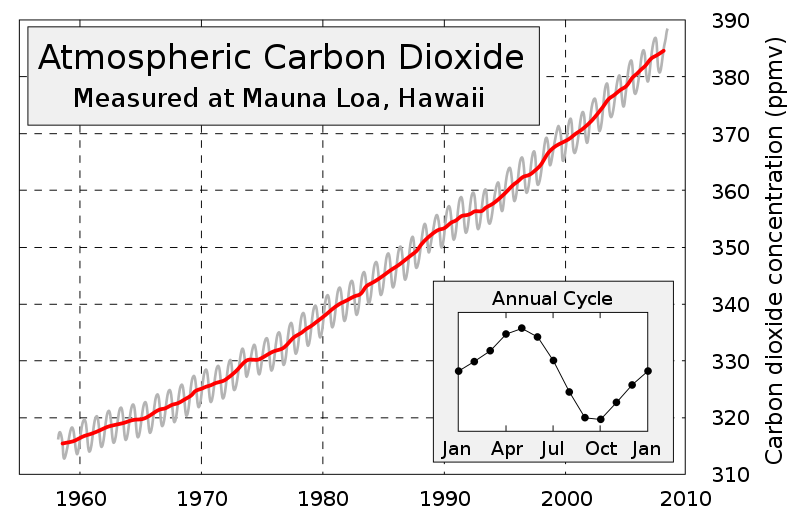
Earlier i've demonstrated that Hans Labohm has been deliberately misleading by choosing a graph that uses a timescale not suited to support his conclusion there's no correlation between CO2 and temperature.

I've also mentioned that after severe criticism on his post, Labohm was forced to write a second article, in which he posted a graph that leaves no doubt there IS a correlation.

He published this extra post on August 25, 2008.

This implies that, as he's proven to be aware of the correlation, Labohm after this date cannot deny this relation any more. Or can he ?

Exactly the same CO2/temp-correlation argument he used in the article I commented on my blog, was repeated in another article that was published in the Dutch JASON-magazine. (the article itself isn't online)

Just as on the vrijspreker website, Labohm received a lot of criticism on his writing. In an 'official' rebuttal in the magazine's next edition by Desi Van de Laar, a student in politicology, presented a graph which clearly demonstrates the correlation.

Hans Labohm has written an answer adressing her remarks which hasn't been published (yet?), but he did sent the draft to his entire mailing list. He did so on January 6, 2009. Or half a year after there has been demonstrated on the vrijspreker website that the CO2-temperature correlation he denied does appear when choosing the correct timescale. Which also was demonstrated by Van de Laar. And again, on my blog on december 26, 2008

Therefore you might assume Labohm would not be using the same debunked graph again to deny the correlation between CO2 & temperature ? Well, here's the funny part ... The answer to Van De Laar he mailed around reads (my translation) :

IPCC-climatologists concluded that man has a substancial influence on the present day warming. Yet the last decade earth has been cooling, despite a CO2 rise. This presumably leads to the conclusion that CO2 isn't such an important factor in determing earth's temperature.
A passage he finishes by presenting ... the very same graph again...
Hans Labohm is a fraud

Given the date he mailed this last text, Hans Labohm is aware that his graphic is misleading.

Hans Labohm is a total fraud.

update : Labohm keeps being dishonest by repeating this same graph over and over and over

Monday, 19 January 2009

Libertarism, climate change and the tobacco lobby

For people new to the climate change debate, at first glimpse it might be strange that so many climate skeptics have a past in which they, one way or another, deny a relationship between tobacco and (second hand) smoking. It's strange, because the two topics are totally unrelated, and it's strange because it is unlikely that a single person is an expert in both a medical topic and one dealing with earth sciences.

Prof Naomi Oreskes in her presentation The American denial of Global Warming seeks where the root of this denialism lays : her conclusion (which I agree with) is that the scientific denialism actually is a consequence of the libertarian hatred against the ‘state’ and where science gets attacked because of the eventual political consequences it might have. When in conflict with the libertarian political-religious dogmatic framework, the scientific information in conflict with the dogma simply has to be wrong…

S. Fred Singer global warming & tobacco
The thought expressed above of course does explain why so many skeptics have a history of denying so many different and independent scientific issues : the infamous skeptic S. Fred Singer has a past of denying aspects in completaly differents domains as the relations between : tobacco & cancer; CFC’s & Ozone-depletion; asbestos & lung cancer; CO2 & global warming...

Singer might be an extreme case, but people like Tim Ball or Richard Lindzen all have expressed their doubts not just on climate change, but also on the tobacco-subject. All those people are linked to right wing libertarian "free-market" thinkthanks. Given the fact it’s often the same names denying scientific findings for both of the subjects, it’s no surprise to find a remarkable similarity in the tactics of the organized denialism on tobacco & global warming.

Global Warming skeptics basically copied the strategy developed by the tobacco industry in the 60’ies which have proven to work back then. And, given the high dose of confusion amongst the public on the field of climate change, there's no doubt the tactics still work.

As a result of a trial on tobacco related illnesses, an American court obliged some tobacco companies to release internal documents. The result is available on the website Tobacco Legacy Documents which gives a clear insight in the tactics useb by the tobacco-lobby. The documents reveal the names of people associated with this lobby, names which all too often sound really familiar for someone following the global warming debate.

When the American government came to the conclusion (1989) that tobacco is just as addictive as heroin or cocaine, the tobacco lobby’s response was (a.o.) to create an Astroturf group called ARISE. This group fabricated the argument that smoking brings pleasure to its users and therefore is a good thing. ARISE states :

The sensory and pharmacological effects of substances such as alcohol, chocolate, coffee, tea and tobacco give pleasure, and so can have beneficial effects on health . They also provide a pharmacologically calming effect, which aids relaxation, and in moderation are also beneficial to health

(..)
Pleasure is a vital component of human life and, amongst other things, can be a positive contributor to living as well as an antidote to negative mood states . Research shows that the human immune system can be enhanced or suppressed on the basis of psychological state . So if pleasurable activity enhances one's mood, then one's health is likely to be affected in a positive way.

The fact smokers are ill more often than their colleagues who don’t smoke was well known already in the nineties, yet still ARISE writes:

The pharmacological effects of coffee, tea and tobacco improve attention and memory and increase achievement at work.
The thing sounding very familiar is this statement by ARISE that clearly sounds very libertarian :
The recent emergence of neo-puritanism whereby people in positions of authority and so-called 'experts' make pronouncements telling us which pleasurable things are permissible and which are not, is at best misguided and at worst, potentially dangerous to our wellbeing.
Another fine example of how the lobby was communicating toward the public is shown in this article published in the Belgian newspaper Het Nieuwsblad (12 okt 1993) some fragments :
“Daily little joys” like coffee or tobacco, indicate humans need pleasure to recuperate from our daily efforts, and they increase our quality of life. A surprising point of view, as it’s expressed by real scientists “The positive effects of such products are often neglected” prof Warburton [founder of ARISE] explains.

The professor works at the university of Reading (UK) The newspaper depicts the lobbygroup as follows : ARISE is an international association conducting research towards the joy that some products can bring.

The remarkable final conclusion reads : Prof Warburton doesn’t have much respect for people that
warn the public for the dangers : today people informing the public for a good cause are the new high priests that control pleasure, with epidemiologists as their oracles.
It’s impossible not to notice it: this phrasing sounds very
familiar for anyone who ever read libertarian/right wing liberal texts

When reading the "freedom"-discours of Warburton, it won't such a big surprise that a Belgian associate to the lobby Group is the aforementioned Belgian philosophy of law professor Frank Van Dun.
Frank van Dun wrote a text called "Pleasure and Political culture" which can be found in the tobacco legacy documents library and which goes as follows :

Frank Van Dun tobacco tabak
Frank Van Dun
Intolerance is back in style, drinkers, smokers, drivers, are depicted as evils to bedealt with severely . Just look at the campaigns involving cancer. The use of political means for the prevention of disease requires totalitarian control over the lives of people . Making such control acceptable is the hidden agenda behind anti-pleasure campaigns . The moral issue is whether the results justify the costs . To live is to make choices . To drink alcohol and coffee, a to smoke are all personal choices
The question of course how this vision on politics and science is combined with scientific reality :

The political question who is to make the choice . The medical and economic arguments against smoking are only of relatively small importance, since they are buried under imponderables which vary from one person to the next, i.e, genetic susceptibility.

Clearly, van Dun mineralizes the negative effects of smoking. In the beginning of the nineties (when this text was written), the effects of active smoking were well known. Above that the question arises whether Van Dun’s (and many other libertarian’s) viewpoint is right that smoking is an individual choice. Given the big budgets the tobacco industry did spent in publicity, the question if a free will is as free as Van Dun claims is one that could be asked. And i think it should be asked, because imho it is answered in an incorrect manner by libertarians, resulting them to make conclusions on society and politics that are just as incorrect ..

Frank van Dun ends his text on tobacco with something that is totally non related to the topic of smoking, and is so general actually it can be “used” as a libertarian conclusion for a whole lot of non-related topics :
Decency moreover dictates that they are not misused to disguise unstated moralistic and political motivations, the craving of tyranny and intolerance of those who can justify their existence only in the control over the lives of others
I have the feeling that this exact same quote could’ve been used to express a libertarian’s feeling when speaking on the subject of climate change. Anything is possible, except a government taking actions that affects individuals. No matter if the subject is smoking, the economy or … climate change

Meanwhile, recently the Dutch government has imposed a ban on smoking in public places. Much to the regret of the liberarian website vrijspreker.nl (the same site where Hans Labohm published his ridiculous article), which in the past years had dozens of articles urging the public to oppose to this unacceptable violation of individual rights the ban in their eyes is.

TICAP The international coalition against prohibition tobacco libertarianism
In their latest post, the website draws the attention to the nice people of TICAP (The International Coalition Against Prohibition), which soon will hold a conference to oppose a smoking ban.

Of course the first thing I did was entering the names of the speakers on the conference in the tobacco legacy documents search string. Even though that database is quite outdated, still most names of speakers on the TICAP-conference can be found in this lobby documents. One example : Barrie Craven turns out to have been a member of the lobbygroup The European Science and Environement Forum or ESEF. When looking at the academic members of ESEF (p31) you can find the names of …. well known climate skeptics like Sallie Baliunas, Robert C Baling, Sonja Boehmer-Christiansen, Fred Singer, Willie Soon and Vincent Gray.

Global warming skepticism cannot be understood without understanding the background of the skeptics, that much is sure. The skepticism in my opinion results from a dogmatic, quasi-religious, belief in the libertarian dogma of free market capitalism without any interference. The fallacies used in climate change discussions remind me to the fallacies made by creationists. Anything is possible, except the dogma to be wrong. If it requires attacking science to save the dogma, science gets attacked ...