Showing posts with label J.J. Boddewyn. Show all posts

Sunday, 16 August 2020

The corrupted tobacco economist network, Part 45 - More tobacco publications.

Overview of previous posts here

Other tobacco publications

There have been more papers and booklets written by the members of the network, probably ordered by the tobacco industry. I didn't explore them because I don't think it will provide much new information and the list is long, very long, starting with:
  • Tollison, R.D., Wagner, R.E. (1983) : WHO: No Rx for a Healthier World. Center for Study of Public Choice, George Mason University, 39 p.
The following two pieces were published in the same volume of the same journal, so there may have been some pal-review:
  • Jackson, J. D., Ekelund, R. D. Jr. (1989) : The Influence of Advertising on Tobacco Consumption: A Debate: Some Problems with Chetwynd et al.'s Analysis, British Journal of Addiction 84 (November 1989), pp. 1247-1250
  • Boddewyn, J. J. (1989) There is No Convincing Evidence for a Relationship Between Cigarette Advertising and Consumption. British Journal of Addiction. Volume 84, Issue 11 (November 1989), pages 1255–1261

Many more papers were published by members of the network, e.g.:
  • Lee, D. R. (1990) : An Economic Analysis of the Economic Burden of Cigarette Smoking in Georgia Journal of the Medical Association of Georgia (March 1990): pp. 161-164.
  • Lee, D. R. (1990) : Social Cost and The Cigarette Excise Tax: A Misguided Rationale for an Inefficient Policy, The Journal of Private Enterprise (Fall 1990): pp. 17-33.
  • Rucker, R. R., Thurman, W. N., Sumner, D. A. (1990) : Production Rights with Limited Transferability: A Case Study of the U.S. Tobacco and Peanut Programs. American Journal of Agricultural Economics, December 1990
  • Ault, R. W., Ekelund, R. B., Jackson, J.D., Saba, R. B., Saurman, D. S., (1991) : Smoking and Absenteeism: An Empirical Study, Applied Economics. 1991, 23, pp. 743-754 .
  • Rucker, R. R., Thurman, W. N., Sumner, D. A., (1991) : An Economic Analysis of the Effects of Eliminating Restrictions on the Transfer of Tobacco Quota. in Current Issues in Tobacco Economics, Vol. 4, Tobacco Merchants Association of the United States, Inc., Princeton, NJ, 1991.
  • Lee, D. R. (1991) : environmental economics and the social cost of smoking. Contemporary Economic Policy, Volume 9, Issue 1, pages 83–92, January 1991
  • Bohanon, C.E, McClure, J.E. (1993) : The Prohibitive Taxation of Cigarettes. Indianapolis Star.
  • Saba, R. at. al. (1995) : The Demand for Cigarette Smuggling, Economic Inquiry.vol. 33, no.-2 (April 1995), pp: 189-202;
  • Coats, R. M. (1995) : A Note on Estimating Cross-Border Effects of State Cigarette Taxes National-Tax Journal, vol. 48, no. 4 (December 1995), pp. 573-84;
  • Rucker, R. R., Thurman, W. N., Sumner, D. A. (1995) : Restricting the Market for Quota: An Analysis of Tobacco Production Rights with Corroboration from Congressional Testimony Journal of Political Economy, 1995, 103(1): 142-175.
  • Boyes, W. J., Marlow, M. L. (1996) : The Public Demand for Smoking Bans, Public Choice, 88: 57-67. (Marlow was not a Savarese-network member, but was working for Philip Morris)
  • Lee, D. R. (1996) : The Turf Fight for Indoor Air Quality Protection. Center for the Study of American Business, Volume 79, May 1996 http://news.heartland.org/sites/all/modules/custom/heartland_migration/files/pdfs/5854.pdf
  • Vedder, R. K. (1997) : Bordering on Chaos; Fiscal Federalism and Excise Taxes in William F. Shughart II, ed., Taxing Choice: The Predatory Politics of Fiscal Discrimination (New Brunswick, NJ: Transaction Publish- ete, 1997)
  • Boyes, W. J., Marlow, M. L. (1997) : The Effects on Businesses of laws Restricting Smoking
  • Lee, D. R. (1997) : Will Government's Crusade Against Tobacco Work ? Center for the Study of American Business, Washington University, Contemporary Issues Series 86 , Jun1997, pp. 2-4
  • Lee, D. R. (1997) : The use and abuse of excise taxes. Tax Foundation, working paper 19, May 1997, 19 p.
  • McCormick, R. E., Tollison, R. D., Wagner, R. E. (1997) : Smoking, insurance and social cost. Regulation : the Cato review of business and government.- Vol. 20.1997, 3, p. 33-37

And then there is the output of other scholars, like this book:
Magda E. Schaler, Jeffrey A. Schaler (eds.) : Smoking, who has the right ? (Prometheus, 1998)

The connection of these authors to the economists network, if any, is not clear, but like the main members of the network, Jeffrey Schaler was working at. . . George Mason University.

The Schaler and Schaler-book contains contributions from George J. Annas, Gary S. Becker, Peter L. Berger, Richard Daynard, Antony Flew, Peter D. Jacobson, Stanton Glantz, Robert E. Goodin, Joseph R. Gusfield, Stephen J. Heishman, Graham E. Kelder, David A. Kessler, Mark Edward Lender, Stephen C. Littlechild, Rajendra Persaud, Robert N. Procter, David Ryder, Robert J. Samuelson, John Slade, Edward L. Sweda Jr, Robert D. Tollison, Richard E. Wagner, Lee S. Weinberg, Walter E. Williams, and Richard Vatz.

Although some were not members of the social cost consultant network, those underlined were people who had worked as consultants for the tobacco industry, via direct evidence in the Tobacco Legacy Documents Library. It raises questions why and how the book was compiled.

Clearly, in the 1980's and 1990's, economists suddenly were very interested in tobacco ...

Monday, 8 June 2020

Corrupted 120+ member tobacco professors network, part 29: embarrassing GSA-letters

Overview of previous posts here

Content of the GSA-letters

John F. Militello

John F. Militello sent his letter July 7, 1986. He wrote
John F. militello


That's not exactly the truth: February 25, 1986 James Savarese sent this letter to the Tobacco Institute during the ongoing Chase op-ed campaign
Jack Militello, James M. Savarese

Millitello's GSA letter was part of an organized campaign. James Savarese wrote a handy overview of theactivities each network economist was involved with until 1986 Militello's activities were listed as follows:
John F. Militello


Clearly, the GSA letter was not an effort of private citizen.

Arthur C. Mead

Arthur C. Mead's letter is somewhat bizarre

Arthur C. Mead

This is embarrassing 

J.J. Boddewyn

J.J. Boddewyn' text is what one would expect to read from a free market professor: freedom, freedom, freedom

J.J. Boddewyn


Boddewyn's last paragraph on enforcement is one-sided: if there would be something like a right to smoke at the work floor, this would imply the need of new regulation to enforce this right. . .

Morgan Reynolds

In 1979 the US Surgeon General concluded ETS is harmful. Reynolds still denied this:


Like all the network economists, Reynolds used one sided arguments like


Reynolds (and all the other economists) ignored facts like buildings will have to be painted less, there will be less economic loss from smoking related illnesses etc. Telling a one sided tale is not typical of economists, the standard description of whom is that there is no such thing as a one handed economist, because they always say on the one hand and on the other.

Reynolds again:
Morgan Reynolds

Following Reynolds logic, employers would not have a problem to pay that extra amount of money as they now could decrease the salary of non-smokers. After all, their workings conditions improved, meaning -following his logic- after a ban they suddenly are being overpaid...

Cecil Bohanon

Cecil Bohanon et al. use a weird analogy

Cecil Bohanon

Five people signed this crap. 

Allen Dalton

Allen Dalton clearly has a full understanding of the word 'addiction', as his letter proves

D. Allen Dalton

(do read his entire letter, it is bewildering)

1.1.1.7     Denying health Risks

Morgan Reynolds was not the only one of the economists to deny the health risks of ETS. S. Charles Maurice et al wrote:
Morgan Reynolds

Tuesday, 2 June 2020

Corrupted tobacco economists network - part 26 : organized op-ed campaigns in newspapers

Overview of previous posts here

Op-ed campaigns

A memorandum written by Tobacco Institute's Fred Panzer explains why the industry launched severalop-ed campaigns.  This memo strongly implies the op-eds were not written whenever the economists felt like writing something.

The campaigns were given different names like Phase II (also involving some "scientific papers").  In 1993 there was the monster op-ed campaign, etc...

The LTDL shows the industry paid a small bonus (900US$ for an Op-ed, only 125 US$ extra for forwarding it) to the economists sent an Op-Ed to their local politician, not just to a newspaper.  The industry specified the recipients. In states where the industry 'owned' more than one economist, they were given different politicians to contact. Panzer wrote
Fred Panzer, Tobacco Institute
The op-eds also proved to be a handy instrument for the field lobbyists

The free-market economists were supposed to write something against excise-taxes, but were not completely free to write anything. The industry dictated that they  had to mention


-         Excise taxes are regressive
-         Excise taxes are fundamentally inequitable
-         Excise taxes are an unfair burden on minorities
-         Government data demonstrates the unfairness of excise taxes.
-         Excise taxes are arbitrary
-         Excise taxes are hidden taxes
-         Excise taxes are an unfair burden on businesses
-         Excise taxes are bad economic policy

-         Excise taxes are historically controversial.

The last bullet refers to the argument "They are simply modern versions of the onerous British taxes which America's founders fought against". That is pure emo-argumentation.

Of course, op-eds had to be cleared by the Tobacco Institute's lawyers


As mentioned before, (at least the 1985) op-eds were also corrected by the PR-firm Ogilvy and Mather before the economists were allowed to send them to newspapers.

Nevertheless, even though the network members weren't free to write what they wanted, the Tobacco Institute did not erase every passage it didn't like. Again, this had a purpose 

James M. Savarese

Still, sometimes letting things the industry didn't like through, did not mean the Tobacco Institute let everything slip through. Fred Panzer of the Tobacco Institute wrote
Fred Panzer

The last line in this memorandum is more important than it may sound: it is the message the tobacco industry used to find business-partners.  The tobacco industry would try to scare other companies telling them something like "if the tobacco industry is going down, you're going to be next"

Again, as with the testimony, the output of the economists was closely monitored by the Tobacco Institute

(...)

The economists must have known it was bit strange they would receive more money if they would write their senator, once again disproving the thought they might have been useful idiots. Not all economists sent a copy of their op-eds to their Senator. Why not all of them tried to earn the extra cash is open to speculation.

Sunday, 17 May 2020

The tobacco economists network - Part 12 - Overview of Testimony of Robert D. Tollison

Overview of previous posts here

Overview of testimony of Robert Tollison

Many of the network economists appeared during legislative hearings. Here we only consider the testimony in hearings attended by Robert Tollison, the others are listed in the appendix which will be publiced in the last blogpost of the series. Of course Tollison received training and he was given some practice questions


Chronology of hearings

Tollison probably got invited after writing a letter to Senator Stevens. Do notice pretends to write on his own behalf. That is a lie.
The report of the hearing by the TI is quite interesting 

We do not know how much Tollison earned for this hearing, but PR-firm Ogilvy and Mather billed the Tobacco Institute a couple ofthousand dollars for the public relations done for the hearing[9]

Do notice the total lack of honesty :

Robert D. Tollison, J.R. Clark, James M. Savarese


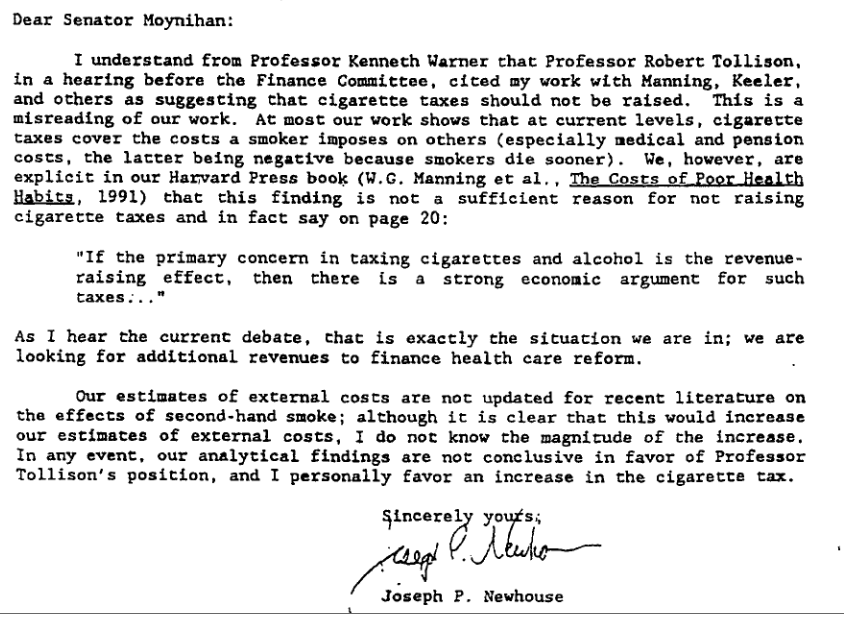
Probably Tollison mentioned in these last three hearings he was asked to testify on behalf of the Tobacco Institute because of the troubles he faced not admitting from the start he was testifying on behalf of the Tobacco Institute during an earlier testimony (see another blogpost). 

Tollison is not just addressing social costs, but spends a great deal denying the health risks of second hand smoking even though his statement was written AFTER the 1993 EPA-report.


The same memo shows Dwight R. Lee appeared during three different hearings that year. I did not find the invoices, but the Tobacco Institute anticipated that he would testify, and the 1994 budget listed


There may have been other times when testimony was offered than those mentioned in the appendix ((not yet published). The industry wrote a yearly overview of activitiesin 1989 and 1990, but overviews for other years could not be located.