Showing posts with label Gary M. Anderson. Show all posts

Sunday, 29 August 2021

The corrupted tobacco economist network Part 59 - The Independent Institute

Overview of previous posts here

The first part of theis blog series explored the activities of the economists network in the 1980's and early 1990's. The second part of the series illustrated the tobacco industry finally would not just attack science, but would try to change the political landscpae by exploiting people's personal beliefs

That's where extremist free-market think tanks come to play.

THE INDEPENDENT INSTITUTE
At least 21 of the network economists have/had connections with the Independent Institute. In 1994, both core members Tollison and Wagner were among the members of the advisory board (Tollison had been on the board since 1986, the year the think tank was founded)


Clinton reform plan (1994)

As a part of the 1993 Clinton health reform plan, there was a suggestion to increase the excise taxes on cigarettes from 24c per pack to 99c, the so called "monster-tax".

The industry answered with the "monster op-ed" round, by setting up PR-firm APCO, and some more activities less relevant for the this story.

There also was an 'open letter' from the Independent Institute. It is not clear who ordered the letter, but no less than 52 economists from the economists' network signed the Open Letter to President Clinton on Healthcare Reform. It won't come as a surprise the letter draws the 'taxes' card. And is quite hysterical.


It may or may not be a coincidence so many of the social cost economists are affiliated one way or another with the Independent Institute. And it may or may not be a coincidence the letter fits the tobacco industry's social cost program. 

One has the impression the Independent Institute acted as a front for a campaign launched by the tobacco industry.


Detaxing America (1995)

In the 1980's and early 1990's, the industry paid economist to appear at economic meetings. It seems later on the industry simply organized its own conferences with think tanks acting as a cover.

In 1995, the Independent Institute organized the conference Detaxing America to promote the forthcoming book written by William F. Shughart II

Following tobacco economists attended the conference:  William Shughart II, Bruce L. Benson, Dwight R. Lee, Robert Ekelund Jr.,  Gary M. Anderson,  Richard Vedder and Mark Thornton

7 of the 17 invited speakers were members of Tollison's illegal social cost network. With several of the 13 other speakers (p. ex. DiLorenzo and Tullock) also being paid by the tobacco industry, but in other lobby-programs.

No, "Independent Institute" doesn't seem the best possible name to describe that think tank.

Books by the Independent Institute

The Independent Institute published several books and reports written by tobacco lobbyists. But even when the tobacco economists weren't the first author of a publication, they still were around.


1994 : William Mitchell and Randy Simmons, Beyond Politics (foreword by Gordon Tullock)

David J. Theroux of the Independent Institute wrote a letter to Tobacco Institute


Quite a strange move for an “Independent” Institute, no ? 


1995: Donald J Boudreaux and Adam Pritchard : Civil Forefeiture As A Tax. The authors thank 6 people for "instructive discussion and comments", four of them being tobacco economists : Bruce Benson, Dwight Lee, William Shughart and Bruce Yandle.

1995: William F. Shughart: The economics of excise taxation

1996 : Richard Vedder and Lowell E. Gallaway : The Melting Pot.

1997: William F. Shughart (ed): Taxing choice: The predatory politics of fiscal discrimination

Including Shughart, at least 7 of the 18 authors have been paid by the Tobacco Institute. Probably not a surprise, as already in 1994 David J. Theroux of the Independent Institute contacted the Tobacco Institute about the book, draft title Sin Taxes

David J. Theroux

(...)
Robert Higgs

Dr. Robert Higgs was one of the people asked by the Tobacco Institute in 1996 to write op-eds against FDA-regulations[11] Shughart was one of the most active members in the network of social cost consultants.

And to promote the book:


2000
: Dominick Armentano: Antitrust and monopoly

2000: Roger Meiners and Bruce Yandle : Regulation and the Reagan Era

The foreword of this book was written by Robert Crandall, another tobacco lobbyist (and then brother in law of S. Fred Singer).

The industry also used think tankers outside the social cost network to work for them. Another Independent Institute economist, Canadian Pierre Lemieux (also involved in the pro-tobacco group FORCES) wrote the book "Smoking and Liberty: Government as a Public Health Problem"and a whole lot of smaller texts, listed on his website on a page he titled Smoking, Liberty and Health Fascism. His extremist titles and views may be a reason the industry didn't use him more often.

This document suggests there also might have been a (small) Canadian network. I did not explore it any further. The John Luik in the document was twice fired from universities for being dishonest. His former Dean stated


John Luik


The Independent Institute is a fine example of tobacco interests and extremist free-market views finding and strenghtening each other, ultimately mingling into one big pseudoscientific mess benefiting the tobacco industry. 

Saturday, 18 July 2020

The tobacco economists network - Part 39 - Indoor Air Quality

Overview of previous posts here

Phase I - II - III

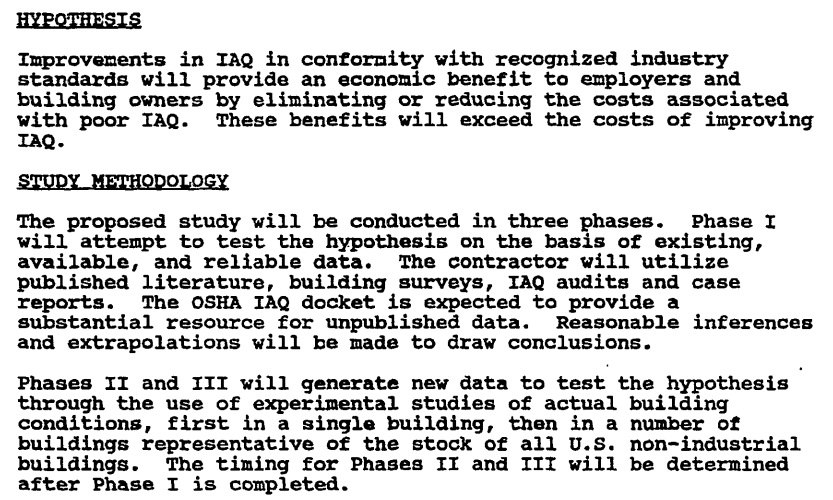
In the early 1990s, the Tobacco Institute wanted to test the following hypothesis on Indoor Air Quality (IAQ)


Searching the LTDL did not yield much about Phases I and III, but the economists were involved in Phase II, and were briefed about the purpose


In 1990, Savarese wrote an overview of the "scientific" output of the economists. Some of these were published to be sure, but were they *really* genuine scientific results? The industry had to approve the papers...


and


And yes, the economists accepted those changes by the Tobacco Institute. Savarese wrote


The paper changed by the TI would also appear as chapter 11 in the 1991 book “The Economics of Smoking”. It is not clear if the industry paid twice for it.

And more proof of interference :


The economists earned a little cash for their "research". Well actually more than a little


The fees for the economists were high, and the industry went over budget


Of course the economists acceptance of changes from the tobacco industry makes it impossible to claim they were independent scientists.

This did not stop Gary M. Anderson from promoting his paper at a convention of the Western Economic Association


Saturday, 27 June 2020

Corrupted tobacco economists network, Part 36: even more pro-tobacco books

Overview of previous posts here

Charging beneficiaries for public services (1989)

Probably the authors liked the money they made writing books and in 1988, Tollison and Wagner proposed writing a book Public Services: User Charges and Earmarked Taxes in Principle and Practice (notice Wagner uses the letterhead of GMU)


Tobacco Institute employee Martin Gleason wrote (May 31, 1989)


In June, Gleason added


And, in an undated memo


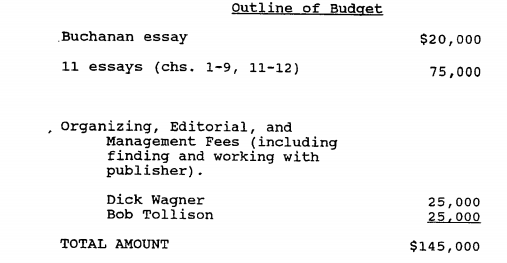
This time Richard Wagner was the lead author, perhaps to give Tollison a bit lower profile as he already led two other tobacco books. Other authors included Gary M Anderson, Bruce Yandle, Dwight R. Lee, Henri Lepage, Mwangi S. Kimenyi, James M. Buchanan and Fred S. McChesney.

The two non-network members are "Nobel Prize" winner James M. Buchanan (his name pops up everywhere in the LTDL, and he was involved in the 1984 workshop leading to the network) and French libertarian economist Henri Lepage (member of several of the same think tanks as the other economists, and a current member of the Global Warming Policy Foundation (GWPF)).

Even though Wagner was the first author, Tollison charged the Tobacco Institute

The fourth invoice also charged $36,250, so probably the industry paid $145,000, exactly the amount the authors proposed


Buchanan must have earned more because he held a Nobel Memorial Prize in Economic Sciences, explaining his high market value: how many politicians would dare to say a Nobel Prize winning economist was wrong on economy ?

It is clear the book was promoted the same way as Smoking and the State
Sunday, 7 June 2020

The corrupted 120+ member tobacco economists network - part 28. Writing "independent" letters to senators.

Overview of previous posts here

Letters to Senators 

The economists were paid if they sent their op-eds to their local congressmen and Senators.


Several of these are not economists, but professors of law. As we will see in another blogpost, the industry also tried setting up a lawyers network. 

The economists and lawyers did not exactly say they were paid by the Tobacco Institute, As an example, Ronald X. Groeber wrote
Ronald X. Groeber

As another example, the letter written by Gary M. Anderson (he sent a copy to the Tobacco Institute and on top wrote sorry for the delay, so the Tobacco Institute probably had asked him to forward it)
Gary M. Anderson

The full list of letters discovered can be found in the appendix which will be published with the last blogpost in the series

Saturday, 30 May 2020

The corrupted 120+ member tobacco economists network. Part 23 of many

Overview of previous posts here

Economic associations meetings


Some of the recruited economists had formal bonds with the Western Economic Association (Gary M. Anderson, Dwight R. Lee, Richard L. Stroup, Thomas Borcherding)

At least five network economists at that point had formal bonds with the Southern Economic Association. Anno 2015, 3 of the 8 officers of the association were members of the Social Cost Consultants network (Peter Boettke, Fred McChesney & Jeffrey Clark). Back in 1985, Robert D. Tollison, ringleader of the economist network, was elected president of the Southern Economic Association. Consultant James Savarese saw the lobbying-potential, and wrote this letter 

James M. Savarese

James M. Savarese

Savarese's letters seem to imply the tobacco industry wrote material subsequently presented by the economists as their original work.

Savarese's plan worked out, and the economists presented their anti-tax (read: pro-tobacco) message during several conferences of economic associations They all knew their mission.
Tobacco Instititute, James M. Savarese, Robert D. Tollison

It is impossible to claim the economists attending these conferences, 'understanding their mission', and submitting their papers to the Tobacco Institute ‘for review in advance’ were useful idiots. They were aware their mission was manipulating the conference attendees.

In 1984, economists received $2,000 for presenting a paper, the chairman and members of the panel got $1,000. In 1991, the economists earned $5.000 per presentation


Friday, 22 May 2020

Corrupted tobacco economists network. Part 18 of many

Overview of previous posts here

Economic experts witness team orientation

Probably still not satisfied with the economists’ performance, the industry set up an economic experts witness team orientation and media training program in 1988, attended by employees of the Tobacco Institute, and by the core members of the economists network

Robert Tollison and James Savarese moderated the session utilization of economic witness team
Tollison and TI-employee Debbie Schoonmaker moderated the session research programs

The following members of the network attended the meeting: Gary M. Anderson, Michael L. Davis, Dwight R. Lee, Anna Tollison  (Robert's wife), Robert D. Tollison, Richard E. Wagner. Or in other words: the core members.

Tuesday, 19 May 2020

The tobacco economists network - or how the Tobacco Institute recruited over 100 American economics professors. Part 15 of many

Overview of previous posts here

Savarese gets audited

The network was led by consultant James M. Savarese and economist Robert D. Tollison.

In 1997 James Savarese wrote he was under a new financial arrangement with the Tobacco Institute. 

The new financial agreement Savarese mentioned arose as result of the Tobacco Institute’s dissatisfaction with the way Savarese wrote his invoices (and maybe other reasons). Savarese nearly always mentioned the economists' names, but even in his correspondence with the Tobacco Institute he withheld two names (no idea why). As proof we are dealing with professionals, the Tobacco Institute in 1987 audited its subcontractor, leading to new arrangements with James Savarese.

The document is interesting because it shows the industry did not search for the economists, this job was left to Savarese. But:

The audit did generate some unfriendly messages within the Tobacco Institute and whatever sparked the dismay, the industry decided it would evaluate the economists themselves. 

Hurst Marshall wrote a letter to all regional VP's asking to fill a questionnaire


The impetus for these unfriendly communications is unclear but a few months earlier Savarese had been ordered to re-contact all the economists he listed

As another result of the audit, the Tobacco Institute seems to have made its own evaluation of the economists
[etc]
Tobacco employee Pete Sparber contacted 40 economists and 3 economists received less favorable reviews


Nevertheless, all three economists above stayed in the network for the next few years and still wrote op-eds (see another blogpost), but perhaps did not appear at any more hearings. The document does not mention why they wanted to replace Cecil Bohanon, but it shows the Tobacco Institute preferred James A. Papke who delivered very effective testimony in 1986

The same document finally solves the mystery why there were almost no women in the network 
Ann Harper-Fender
Thomas Borcherding also received a poor review 

Thomas Borcherding
Gary M. Anderson indeed would enter the network and he had already worked as assistant for Robert Tollison). Nevertheless. Borcherding does not seemed to have been kicked out but in the future would only be asked to write, not to deliver testimony.

The industry in the beginning did not like the newly recruited Gary M. Anderson even though he was a member of the core group. Interestingly in this memorandum Tollison/ Savarese are referred to as his "superiors"

Richard K. Vedder never was asked to testify. Lobbyist Bill Trisler explains
Richard K. Vedder

Friday, 15 May 2020

Tobacco economist professors network, Part 11: independent political testimonies ?

Overview of previous posts here

Political hearings

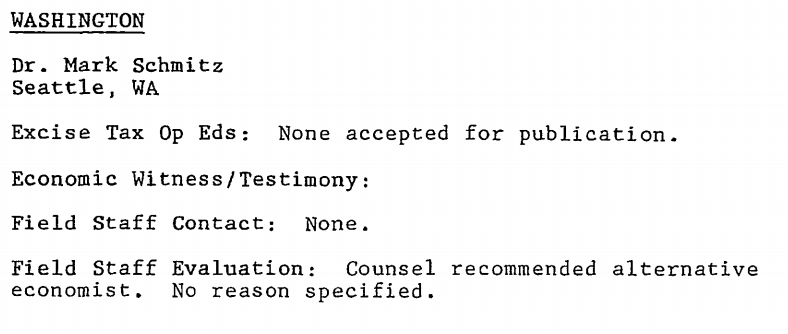
The Tobacco Institute wanted economists to testify for legislators to create the illusion that "the academic world" opposed excise taxes on cigarettes. The August 1986 Field staff evaluation of resources explains why the industry used this form of lobbying

The field staff evaluation also explains why the industry desperately wanted to 'own' an economist in every state

The industry taught the economists how to communicate and frame their message.

As the next blogposts will show, one can question the legitimacy of the testimony, as not all economists were always defending material they wrote, or even believed. At least 27 members of the network participated in hearings


The first hearings

The TI Excise plan is from 1984, and already in the same year the first economists testified. It is not certain how the industry persuaded them, and setting up the 'official' network seems to date from 1985.

The PR-firm Ogilvy and Mather reported


This makes clear the academics worked under a well defined strategy, even though at that point they may not have been aware of this. The Tobacco Institute wrote

Actually this summarizes the entire activities of the network. Even though in the next chapters there are further examples raising questions about the honesty of some network members, it is likely most of the economists never said anything they did not believe.  They were paid to say what they would have said anyway, as they were libertarians opposing any form of taxation in any case.

The problems with the network were:
  • the industry diverting the economists' attention to tobacco
  • the economists forgetting to mention they were being paid
  • the economists giving the industry material for their field lobbyists
This may not seem much of a problem, as the economists might have said the same if they were not paid.

It is not that simple though: by funding the economists, and promoting their output, the economists 1) created much more pro-tobacco output than they would've written if they were not paid 2) received much more attention than they deserved. And this was exactly what the industry needed: the massive output of the economists created a false balance. It was not all that important whether or not the economists' arguments were correct: the mere fact the economists opinions existed was enough to fit the message of doubt the industry wanted, because most people tend to believe when two different opinions exist, both must have some merit. That is incorrect: one of the opinions can be completely wrong. 

Preparing the economists

Ogilvy and Mather's annual report shows the PR-firm identified public smoking and creating doubt as the most important instruments in lobbying. Other LTDL documents show manufacturing doubt on health risks always was the industry's main focus.


The program around taxes emerged as the second most important issue. That's where the economists come into play


Tobacco Institute's lobbyist Dave Krogseng wrote to network economist Raymond Raab explaining to Raab what to say
  
This letter clearly illustrates the economists were not expressing their personal views but were acting as lobbyists. 

During the years to follow, the economists testified at many hearings, often local ones. This was the main reason the TI wanted to recruit an economist in every state, so politicians would not have the feeling some 'corporate scientists' were flown in from some far away metropolis.

Of course the testimonials were not the work of independent academics: the industry was aware in advance of the testimonials’ content. In 1985 Tollison forwarded Thomas Borcherding's draftstatement to the Tobacco Institute after the hearing, but the industry also knew what would've been said in hearings that were cancelled

Telling the tobacco industry what the content of your testimony will be cannot be considered as normal academic behavior. 

It is clear why the industry wanted copies of the statements: testimonials were not just useful on the day of a hearing itself, the industry also wanted to use the statements of the economists after the hearings