Showing posts with label Richard L. Stroup. Show all posts

Saturday, 15 January 2022

The corrupted tobacco economist network Part 63 - National Center for Policy Analysis

Overview of previous posts here

The National Center for Policy Analysis was another think tank where the corrupted social cost economist could spread their word


The next battleground: Indoor air

Dwight R. Lee
 in 1992 wrote the NCPA report The next environmental battleground: Indoor Air, opposing any form of regulation of indoor-air quality (IAQ). The report is also one of the first examples of a social cost economist questioning EPA's objectivity and neutrality. 

On top, it is making outrageous claims like government regulations on IAQ would kill 1900 extra people a year [sic]. 

Lee proposed the Tobacco Institute to make a presentation of the report at the EPA's 23rd International Symposium on Environmental Analytical Chemistry. 

Tobacco Institute's Karen Fernicola Suhr wasn't sure what to think of the proposal as she Lee's claims were so ridiculous:
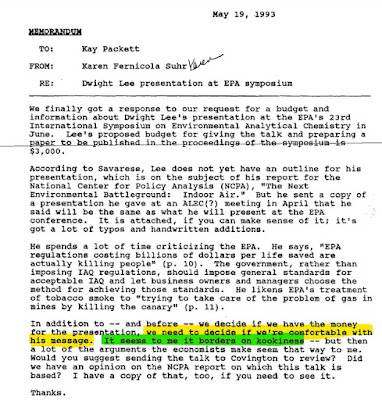

It wasn't the only weird thing about this report. The Tobacco Institute also was wondering why the NCPA cared about Indoor Air Quality at all
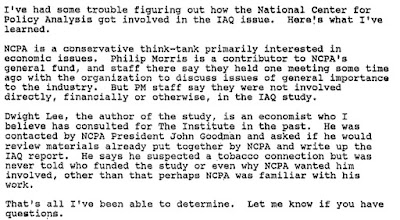

The Tobacco Institute in 1992 wasn't really sure why the think tank bothered to write on indoor quality. A 1993 letter sent by Tom Hockaday (of PR-firm APCO Worldwide) to Philip Morris hints the report actually was written on the command of APCO

S. Fred Singer, Dwight R. Lee

Nor Singer (a physicist), nor Lee (an economist) have any qualifications to judge indoor air-quality science.

Meanwhile, the program of the 23rd International Symposium on Environmental Analytical Chemistry shows Lee was one of the speakers, so despite the "cookiness", the Tobacco Institute probably paid him the $9.000 he asked for. Lee wrote an article after the presentation.

It's hard to decide  which my favorite sentence is in the article: "EPA is no better at central planning than the Soviets were" or "Each polluter is better informed than EPA authorities on how to reduce pollution at least cost and is certainly more motivated"

I do understand why Karen Fernicola Suhr staed the tobacco industry had to decide if it felt comfortable with his message. And Why she felt his message borders on kookiness.


Attacking all environmental sciences

But even beofre the 1992 report above,  the National Center for Policy Analysis was already attacking almost all environmental sciences, in the 1991 report Progressive environmentalism: a pro-human, pro-science, pro-free enterprise agenda for change. The head of the taskforce writing the report was Richard L. Stroup, another tobacco economist from the network.

The taskforce consisted of an interesting list of names, besides tobacco economists there are a lot of people listed who would get known as climate skeptics.

Network economists involved in the NCPA environmental task force were (besides Stroup) : Terry L. Anderson, Allen Dalton, Bruce Johnson and of course  Dwight R. Lee

Other tobacco consultants mentioned in this task force were Thomas J. DiLorenzo, Kent Jeffreys, S. Fred Singer and  James H. Miller. And a lot of people from other think tanks, like Joseph Bast (Heartland Institute), Fred L. Smith (Competitive Enterprise Institute), David J. Theroux (Independent Institute).

The reports attacks a wild array of environmental topics. The report might be an early example showing how libertarians started attacking all environmental sciences, not because they have much knowledge on the subject, but rather because it doesn't fit their worldview.

Wednesday, 29 December 2021

The corrupted tobacco economist network Part 61 - Heartland Institute

Overview of previous posts here

Best known nowadays for their position on global warming, the Heartland Institute started as a think tank defending the tobacco industry. Former President Joseph L. Bast still minimizes the risks of ETS.

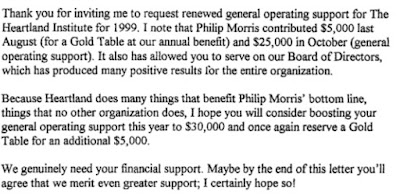
Heartland always had pro-tobacco viewpoints and even invited a tobacco employee (Roy E. Marden) to join its board. In 1999, Heartland president Joseph L. Bast wrote the following letter to Philip Morris:

Joseph L Bast Heartland Institute

At least 20 of the network economists are or have been involved with the Heartland Institute. and in 1999, the year Bast begged for money, 6 tobacco economists were members of the advisory board

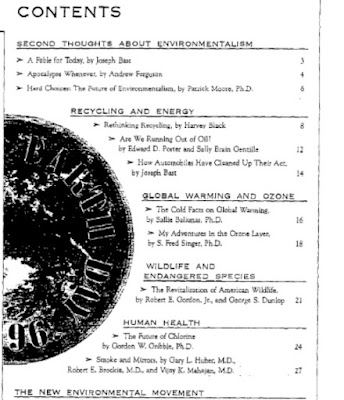
A 1996Heartland report shows something seen in all libertarian think tanks: an attack on a whole bunch of "environmental sciences". It is very unlikely the think tankers actually knew something about the actual state of one scientific field,  let alone a whole series of scientific domains. Ideology, not science, is the source of this kind of output produced by think tanks

Heartland Institute

It's one the first examples how tobacco and global warming (and other environmental/ health sciences) are thrown under the bus in one big effort. This was part of the "APCO" plan.

Author Richard L. Stroup was a member of the economists extended network

Gary L. Huber

Gary L. Huber was a researcher working on the link between tobacco and lung cancer, research sponsored by the tobacco industry. In 1980, Huber (re)discovered the relation by producing emphysema in rabbits.

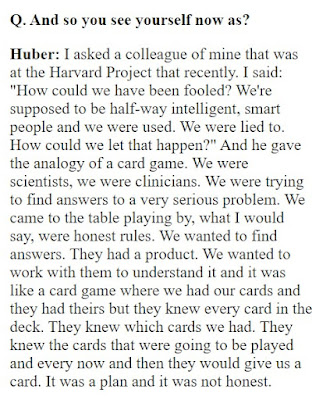
In the prelude to the Tobacco Master Settlement Agreement, he became a whistleblower (in 1997) claiming to be a naïve scientist duped by a broader plan of the tobacco industry. Huber claims in the interview the industry let him though his research on lung cancer, even though they had done the same research before, and already knew the outcome was going to be smoking causes cancer.

 Huber said in an interview

Gary L. Huber

Several sources state Huber was in tears when discovering his entire research was one big waste of time. Most sources feel sorry for the man.

The book Denial: The NFL, Concussions, and the Battle for Truth states Huber promptly lost his grants from the tobacco industry after publishing his results, the industry making clear they weren't too pleased with his work. Huber subsequently moved from Harvard to the University of Kentucky and continued doing research, strangely enough again funded by the tobacco industry. But something had changed: in Kentucky Huber would become accused of manipulating scientific results, sexual harassment and general incompetence. Within a year, he got fired

All this doesn't really explain how Gary L. Huber, then working in Texas, ended up in the 1996 Heartland Earth Day '96 document, writing "In this case, the EPA's risk assessment is built on the manipulation of data, ignores crucial chemical analysis and key epidemiological data, and violates time-honored statistical principles."

I'm not sure what to think about all this, and the supposed knife the industry put in his back

Sunday, 18 July 2021

The corrupted tobacco economist network Part 58 - The role of Terry L. Anderson

Overview of previous posts here

As seen in the previous chapters, in the 1990's think tanks and libertarians started attacking all environmental sciences. The tobacco economists took part in this attack, with Terry L. Anderson playing a key role as an ideologist

Selection of publications:

1991: Terry L. Anderson wrote the book Free Market Environmentalism with Donald R. Leal. It became one of the books laying the grounds for the libertarian ideological attack on all environmental sciences.

Richard Stroup and Terry L. Anderson would become early TASSC's supporters and they were among the people exporting the TASSC-strategy to Europe through the UK based Institute of Economic Affairs. Both also were adjunct scholars at the Cato Institute

1995: Terry L. Anderson wrote a chapter in the book The True State of the Planet, attacking a wide variety of environmental issues. It's one of the first examples where the work of the economists and global warming denialism would emerge on the same surface. 

  • Chapter 1, by Nicholas Eberstadt - Population, Food, and Income: Global Trends in the Twentieth Century
  • Chapter 2, by Dennis Avery - Saving the Planet with Pesticides: Increasing Food Supplies While Preserving the Earth's Biodiversity
  • Chapter 3, by Robert C. Balling, Jr. - Global Warming: Messy Models, Decent Data, and Pointless Policy
  • Chapter 4, by Stephen Moore - The Coming Age of Abundance
  • Chapter 5, by Bruce N. Ames and Lois Swirsky Gold - The Causes and Prevention of Cancer: The Role of Environment
  • Chapter 6, by Roger A. Sedjo - Forests: Conflicting Signals
  • Chapter 7, by Stephen R. Edwards - Conserving Biodiversity: Resources for Our Future
  • Chapter 8, by Terry L. Anderson - Water Options for the Blue Planet
  • Chapter 9, by Kent Jeffreys - Rescuing the Oceans
  • Chapter 10, by Indur M. Goklani - Richer is Cleaner: Long Term Trends in Global Air Quality

Do notice in this book tobacco economist Terry L. Anderson and Kent Jeffreys (another author of a pro-tobacco report), suddenly became "specialists" in water pollution....

1997: (with Donald R. Leal) : Enviro-Capitalists: Doing Good While Doing Well. Hoover Institution. The book received a positive pal-review of fellow tobacco economist Bruce Yandle

1997: Terry L. Anderson and Pamela S. Snyder: Water Markets: Priming the Invisible Pump. Published by the Cato Institute.

2000: The Greening of U.S. Foreign Policy (with Henry I. Miller), published by the Hoover Institution. Anderson stated [2]

The green hand of foreign policy is a threat to national sovereignty without the offsetting benefit of improved environmental quality

2000: editor of Political Environmentalism:Going Behind the Green Curtain. Hoover Institution, also containing a chapter by network economist Bruce Yandle.

2001: Terry L. Anderson & Bruce Yandle were editors of the book Agriculture and the Environment – Searching for Greener Pastures published by the Hoover Institution.

2003: Anderson was editor of You Have to Admit It’s Getting Better—The Environment That is, another book published by the Hoover Institution.   

Tobacco economist Robert E. McCormick wrote the chapter The Relation Between Net Carbon Emissions and Income. While McCormick took no position on the scientific side, was poorly informed, writing "others claim there is no evidence of global warming; some even say the Earth is cooling"

Together Anderson's books (more than listed here) have played an important ideological role. All published by libertarian think tanks, they helped the message the industry and TASSC needed, by stating it would be better for the environment/health issues if there would be no government at all. His books have played an important role in creating a mindset in which the think tanks started drifting away from reality.

These books were highly ideological. Yet it is not impossible the books were commissioned by some industry. As early as 1987, during the "evaluations of economists sessions", the Tobacco Institute already remarked


Terry L. Anderson became George W. Bush's advisor on public lands issues somewhere in the late 1990's.  

In 2014, he wrote an op-ed in the Wall Street Journal defending the Keystone-pipeline. Written on behalf of his oil industry clients?

Tuesday, 30 March 2021

The corrupted tobacco economist network Part 57 - The Advancement of Sound Science Coalition

Overview of previous posts here

The Advancement of Sound Science Coalition (now called the Advancement of Sound Science Center

Early 1993, EPA released the report Respiratory Health Effects of Passive Smoking:Lung Cancer and Other Disorders that was close to a final blow on the ETS issue.  EPA concluded that second hand smoking beyond any scientific doubt indeed was harmful, as had long been suspected.

The tobacco industry knew it was in trouble and launched a full scale counterattack against EPA, especially using the strategy of  manufacturing "scientific doubt". It seems from that point the ‘social cost’ strategy became less important as the EPA report demanded the industry's full attention.

But the industry still needed allies and seemed to have followed two main roads: searching for allies to cast doubt on any environmental subject (asbestos, pesticides, greenhouse gasses, etc.). But on the other hand, to really be able to create a broad coalition, the industry needed to translate the industrial message into something grassroots organizations would pick up. And here, the ‘freedom’ message proved to be key to finding free-market allies. The libertarian tobacco-economists were useful to spread this message. 

To understand how the industry concluded that the best defense was to attack everything EPA does, we have to look at the work of Philip Morris' PR-firm APCO-Associates, which advised the industry to set up


PR-firm APCO created the astroturf organization The Advancement of Sound Science Coalition (TASSC) in 1993 because

But unlike with lobbygroups like the Center for Indoor Air Research, the tobacco industry this time had a bigger plan, as seen in a memorandum probably written by Philip Morris. 


The same document already hinted at the shape of the industry’s ETS-strategy to come


As the industry realized it could not defeat EPA alone, the goals were to


and to

This is taking the lobbying to a new level, and this is where the cunning plan of Tim Hyde fits the bigger picture: the lobbying was no longer focusing on tobacco and its consequences, the lobbying was about creating a new political reality.

One part of the strategy still sounded familiar, as it was about creating scientific doubt

TASSC was no longer an astroturf organization attacking only tobacco issues, the industry wanted a full scale attack, and was thinking about issues like


In 1994 Philip Morris wrote

And Philip Morris director Matt Winokur stated


The plan to built a broad coalition of businesses attacking EPA was a success and APCO reported

To avoid detection, TASSC had to look like a grassroots organization, even though it is clear TASSC never was more than a lobby-tool as can be read in the proposed plan for the public launch of TASSC:


As with the previous economists networks, there would be media training

The training included teaching the spokespeople of PM to answer questions like


The roots of organized denial of global warming would get started in the same circles, and by the same people, as the circles the tobacco industry used. TASSC and the same think tanks working on tobacco, would be the place where fossil fuel companies found a tool, the people (libertarians) and a strategy to attack climate science. And this is why someone running a climate blog has taken a close look at the tobacco strategy.

TASSC was funded by Philip Morris but it also involved companies like Exxon and recruited people who were global warming deniers like S. Fred Singer and Patrick Michaels, in addition to tobacco consultants such as Thomas L. Wyrick and Richard L. Stroup (both in 2015 were members off the Heartland Institute, a think tank denying the health effects of tobacco and man-made global warming).

Using the 'junk science’ label to discredit scientific work was adopted by the tobacco economists, as in an op-ed by Clifford Dobitz from 1998 titled Junk science taints EPA's smoke claims The same Year Robert L. Sexton wrote Did EPA use junk science ? The use of this language is no coïncidence but the result of a group effort.

It was by mingling of 'freedom' with tobacco (and asbestos, greenhouse gasses, etc.), the industry ultimately was able to create a message that indeed found its way into libertarian groups. And through these groups, the doubt and freedom message would become an important political factor in American politics, because the think tank network is huge, extending to many other people, foundations, companies and universities. 

Saturday, 30 May 2020

The corrupted 120+ member tobacco economists network. Part 23 of many

Overview of previous posts here

Economic associations meetings


Some of the recruited economists had formal bonds with the Western Economic Association (Gary M. Anderson, Dwight R. Lee, Richard L. Stroup, Thomas Borcherding)

At least five network economists at that point had formal bonds with the Southern Economic Association. Anno 2015, 3 of the 8 officers of the association were members of the Social Cost Consultants network (Peter Boettke, Fred McChesney & Jeffrey Clark). Back in 1985, Robert D. Tollison, ringleader of the economist network, was elected president of the Southern Economic Association. Consultant James Savarese saw the lobbying-potential, and wrote this letter 

James M. Savarese

James M. Savarese

Savarese's letters seem to imply the tobacco industry wrote material subsequently presented by the economists as their original work.

Savarese's plan worked out, and the economists presented their anti-tax (read: pro-tobacco) message during several conferences of economic associations They all knew their mission.
Tobacco Instititute, James M. Savarese, Robert D. Tollison

It is impossible to claim the economists attending these conferences, 'understanding their mission', and submitting their papers to the Tobacco Institute ‘for review in advance’ were useful idiots. They were aware their mission was manipulating the conference attendees.

In 1984, economists received $2,000 for presenting a paper, the chairman and members of the panel got $1,000. In 1991, the economists earned $5.000 per presentation