Showing posts with label libertarisme. Show all posts

Saturday, 20 December 2014

(Ab)using libertarians as useful idiots

Suppose you're a tobacco lobbyist and you want to attack new anti-smoking laws. How to reach your goal ?

Being a lobbyist for the tobacco industry, it would be a bad idea trying to reach the public by directly contacting the media, as you'll quickly be outed as nothing but an industry's spokesman. Lobbyists need other ways to spread their message. By the late 1970's tobacco lobbyists had a problem though: even though the industry created lots of pseudoscientific documents trying to spread doubt tobacco really causes cancer, the public started to be well aware smoking causes lung-cancer. Trying to attack the science wasn't enough to undermine anti-tobacco laws.

A new strategy was needed. 

The industry wrote:
The only way that the right to smoke can be preserved is to link it up with the freedom of lifestyle position, and with the broader libertarian critique of 'health fascism' and the paternalism and authoritarianism of the medical establishment. Our 'special interest' can only be viably defended as part and parcel of broader coalition. We have to shift the focus of the debate from the enemy's strong ground--health--to our strong ground--freedom of choice and individual liberty.

The only thing tobacco lobbyists needed to do to spread this message was redirecting the bias of libertarians, and changing the libertarian hatred against "regulations" into a hatred against "regulations against smoking". Try opening any random libertarian website and the word 'freedom' will pop up everywhere. To kill anti-smoking laws, tobacco lobbyists started spreading the message in libertarian circles that laws against tobacco were undermining personal freedom. 

To spread the tobacco lobby's message of anti-tobacco laws being an attack on personal freedom, lobbyists needed to get in contact with libertarians stupid enough to buy this message. Using their bias, tobacco lobbyists' objective was turning libertarians into useful idiots, lobbying for the tobacco industry. Without the libertarians even realizing.

This document in the Legacy Tobacco Documents Library illustrates how lobbyists selected their targets:

Private & Confidential
ACADEMIC CONTACT LIST

Professor DAVID MARSLAND
(...)
An ex-member of the Labour Party, a founder member of the S .D .P., and the recipient of the first Thatcher Award, David Marsland is now an out-standing free market sociologist at the West London Institute.
Author of many books, covering issues as diverse as education, health, business and the welfare state, Marsland is a hard-core rebel against the 'health-fascist' establishment. A keen smoker with a hatred of the welfare state, Marsland is an affable and well respected academic who is open to private work and easy to approach.
Have no hesitation mentioning my name.

Professor ANTHONY FLEW
EMERITUS PROFESSOR OF PHILOSOPHY, READING UNIVERSITY
(...)
One of the most prolific and controversial philosophers of his generation, Professor Anthony Flew will go down in history as one of the most outstanding Conservative thinkers of the twentieth century.
Hated by the left, Flew is an avowed anti-statist who is totally opposed to the welfare establishment with all its "modern trendy ideas". Aware that life, and the act of being human, inevitably involves risk, Flew would be a sound friend in the battle against the anti-smoking lobby.
He knows Chris.

Dr.  BILL THOMPSON
SOCIOLOGY LECTURER, READING UNIVERSITY
(...)
An ex-Anarcho-Socialist turned Free Market Libertarian, Bill is a fascinating, young and dynamic lecturer who teaches the Sociology of Morality.
Specialising in such subjects as Society and Pornography, Moral Panics and the Sociology of Belief Systems, Bill is a radical thinker opposed to state intervention - especially on issues of personal morality . A smoker himself, he is ideologically sympathetic to the defence of smoker's rights. Mention my name.

Dr. CHRISTIE DAVIES
HEAD OF SOCIOLOGY, READING UNIVERSITY
(...)
Christie Davis is one of the most senior and well respected right-wing sociologists in the UK. Although he has a broad range of academic interests, he specialises in the sociology of humour and contemporary criminology.
A radical free marketeer he carries sound ideological baggage when it comes issues of risk and personal freedom.

Dr . NIGEL ASHFORD 
SENIOR LECTURER IN POLITICS, STAFFORDSHIRE UNIVERSITY
(...)
Although a hard-core Libertarian activist since his days in Conservative Students, Ashford is nevertheless an eclectic thinker. An ardent free marketeer, he is also unusually an overt proEuropean.
A member of the British Political Science Association, he is a well connected politics lecturer, who is sympathetic to the paradigm of personal liberty.

Professor DAVID GLADSTONE
PROFESSOR OF SOCIAL POLICY, BRISTOL UNIVERSITY
(...)
An outstanding, charismatic and charming public speaker, Davids Gladstone's primary interest is the growth of the welfare state) during the twentieth century . A socially well connected direct descendant of Prime Minister Gladstone, he is sound on the subject of the nanny state, and at one with the Libertarian right on issues of personal freedom.
A very much under used asset on our side - mention, me on introduction.

JIM BOURLET 
LECTURER IN ECONOMICS, LONDON GUILDHALL UNIVERSITY
(...)
A classical liberal in economic and political outlook, Bourlet is a rather quiet and largely unknown academic who has all the right political instincts .
He would be perfect as a 'name' to front projects. Mention me on introduction.


Dr. DENIS O'KEEFFE 
SOCIOLOGY OF EDUCATION LECTURER, UNIVERSITY OF WORTH LONDON
(...)
Although O'Keeffe claims he is a Libertarian, he is more accurately described as a liberal-Conservative . Primarily interested in education and the welfare state, he is a superb writer always willing to undertake projects for private business interests.
With a number of close political contacts in parliament, and particularly the House of Lords, O'Keeffe is a well placed academic with an air of authority . From time to time he appears on TV and always performs well Mention me.

Dr. STEVEN DAVIES
SENIOR LECTURER IN HISTORY, MANCHESTER METROPOLITAN UNIVERSITY .
(...)
A young, but already prolific writer with a superb style, Davies is best described as Britain's foremost Libertarian Historian.
Sound on all economic, social and political issues, his only weakness is that his manner is not particularly well suited for the media . Nevertheless, is a charming man who is always approachable. Mention my name on introduction.
.
SEAN GABB
PART-TIME LECTURER AT A NUMBER OF LONDON UNIVERSITIES SPECIALISING IN HISTORY, LAW, ECONOMIC HISTORY AND POLITICS 
(...)
An academic genius, Gabb is a Libertarian Conservative who has accidentally ended up being born 200 hundred too years latet A character best suited for the Reform Club around 1780 he has an eccentric and endearing manner - and a rapier brain.
A former member of the Lord Chancellor's Department at the Home Office and a special adviser to the Slovak Prime Minister, Gabb is totally sound on matters of personal freedom and is an outstanding candidate to ghost academic material. Mention me.

WALTER ALLAN 
EX-EDITOR OF ECONOMICS AT MACMILLAN, EX-EDITOR AT THE INSTITUTE OF ECONOMIC AFFAIRS AND CURRENTLY A LECTURER AT A NUMBER OF LONDON UNIVERSITIES
(...)
With a sound political outlook and a superb knowledge of economics, Allan is always interested in private commissions which demand a robust defence of the principles of liberty.
A man who "loves to lunch", he is a great networker and has a truly unbelievable range of useful contacts for almost every occasion and operation imaginable.
Mention me.

A quick check learns how succesful the tactic of the industry was: 
Anthony Flew, Bill Thompson, Dennis O'Keeffe, Sean Gabb, Christie Davies & Steven Davies all became active in the Freedom Organisation for the Right to Enjoy Smoking Tobacco, a fake grassroots organisation set up by the tobacco industry.

Sean Gabb describes how he became interested in the subject tobacco:
My interest in tobacco, and in all the news regarding it, stems almost entirely from libertarian principle. I believe that people should have the right to do with themselves as they will, regardless of any possible harm to them.

Feeding their bias, the tobacco industry managed to turn no less than 6 of the 11 libertarians above into useful idiots.

Sunday, 4 November 2012

Brecht Arnaert's Facebookcomments

Brecht Arnaert Klimaatverandering
Dewever en Arnaert
 N-VA-lid Brecht Arnaert, uiteraard weer een libertariër (zucht), postte recent op zijn facebookpagina dat hij niet wakker ligt van klimaatverandering en linkte daarbij naar twee filmpjes op De Groene Rekenkamer van Ton Begemann, die zeker niet foutenvrij zijn en die ik hier en hier al besprak (en waaruit bleek dat Begemann dus niet eens wist waar hij geweest was).

Wat vooral opvalt is echter het gegeven dat Arnaert's comments eerder een "gevoel" uitdrukken dan te getuigen van enige wetenschappelijke benadering. Altijd een slecht idee.
Arnaert: Is het u ook opgevallen dat na de val van de Muur het klimaatverhaal steeds populairder werd? De aarde zou opwarmen door het broeikaseffect, en dus moest de overheid maatregelen nemen om het milieu te beschermen. Moesten we ons niet meer onderwerpen aan het ideaal van de klassenloze samenleving, dan toch wel zeker aan het ideaal van de ongeschonden natuur. Wie kan daar nu tegen zijn?
De eerste experimenten rond warmtestralingen van John Tyndall vonden natuurlijk reeds plaats in het midden van de 19de eeuw, en Arrhenius was de eerste die uit die experimenten afleidde dat er wereldwijde invloed was. Dan zitten we nog steeds in de 19de eeuw.

Uiteraard is de kennis rondom de klimaatwetenschap enkel maar toegenomen, en de groeiende bezorgdheid leidde in 1988, dus nog voor de Val van de Muur, tot de oprichting van het IPCC. De oprichting van dit instituut gebeurde natuurlijk niet plotsklaps uit het niets, maar was een gevolg van een lange wetenschappelijke evolutie, waarbij bv. de conferentie in 1985 in Villach een belangrijke rol speelde in het rijpen van de geesten. Het is belangrijk eraan te herinneren dat de jaren '80 het tijdperk waren waarin de mens voor het eerst op politiek vlak besefte dat de menselijke invloed op de atmosfeer niet te negeren valt. Denk daarbij ook aan de problematiek van de ozonlaag, die in 1987, toevallig of niet, een jaar voor de oprichting van het IPCC leidde tot het akkoord van Montreal.

Al deze akkoorden waren gebaseerd op wetenschappelijke bevindigen, niet op een ecologisch ideaal. Dat is wat veel klimaat-pseudoskeptici wel eens over het hoofd zien: de hele klimaatdiscussie is een wetenschappelijke discussie. De wetten van Stefan-Boltzman of Kirchhoff zouden er heus niet anders uitzien als ze opgesteld werden door een communist of een nazi.

Overigens is het interessant op te merken dat Naomi Oreskes stelt dat klimaat-pseudoskepticisme zich nou net begon te manifesteren na de val van de Muur. De eerste klimaatskeptische artikels zouden de oppervlakte bereiken in 1989. Exact het jaar waarin de muur viel. Oreskes postuleert dat het net de anti-communistische krachten waren die, wegens het plotsklape gebrek aan een vijand, zich meteen stortten op de klimaatwetenschap en alles wat ze, net als Arnaert, als 'groen' percipiëren.
Of zoals de wiki-pagina van het - erg aanbevolen - boek Merchants of Doubt stelt:
The book states that Seitz, Singer, Nierenberg and Robert Jastrow were all fiercely anti-communist and they viewed government regulation as a step towards socialism and communism. With the collapse of the Soviet Union, they looked for another great threat to free market capitalism and found it in environmentalism. They feared that an over-reaction to environmental problems would lead to heavy-handed government intervention in the marketplace and intrusion into people's lives

Arnaert: Prof. Begemann, die mij een eerlijk verhaal lijkt te doen, gelooft er niet in. Hij bezocht het hoge Noorden meermaals, en laat boerenverstand werken waar intellectualisme het heeft laten afweten. De mens is veel minder verantwoordelijk voor mogelijke klimaatwijzigingen dan tot nog toe werd verspreid. In het filmpje legt hij uit waarom. 
Zoals in mijn eerdere artikels al bleek (de foto's zijn helaas verdwenen in cyberspace), heeft Begemann geen enkele kennis van het terrein dat hij bezocht, maakt hij hierbij ronduit absurde claims (eskimo's die aan landbouw doen, alsjeblieft), en cherrypickt (allicht niet doelbewust) hij temperatuurtrends.
Arnaert: Maar wat interessanter is: Begemann vertelt ook waarom zoveel professoren dit zijn gaan beweren.
Begemann's claim dat klimaat-pseudoskeptici hun mond niet kunnen opendoen uit angst hun fondsen te verliezen wordt hier tegengesproken door Bas van Geel. En als je even rondsurft, zal je zien dat veel skeptici rechtstreeks verbonden zijn aan overheidsinstituten.
Arnaert: Sinds duidelijk werd dat de klassenloze samenleving niet kan werken, is er geen groot verhaal meer waaraan we ons allen moeten onderwerpen. Maar het ideaal van de ongeschonden natuur, dat heeft wel nog wervingskracht. Koste wat het kost moet dus bewezen worden dat de mens schuldig is: een verstoorder van een natuurlijk evenwicht. 
Ook hier geeft Arnaert vooral weer te kennen hoe zijn wereldbeeld eruitziet. De klimaatdiscussie gaat niet over het handhaven van evenwichten maar over hoe de wereld eruit zal zien als het huidige, relatief stabiele klimaat in het holoceen, verandert. In feite is het een quasi zuiver economische discussie: hoeveel kost het de mensheid om zich aan te passen aan een veranderend klimaat ? Er komen uiteraard nog een aantal sociale en ecologische factoren bij te pas, maar de hoofdvraag is zuiver economisch, niet meer, niet minder.
Arnaert: Laat u niet vangen: groenen zijn ecologische marxisten. Het zijn meloenen. Groen van buiten en rood van binnen. Met dank aan Peter Visser, die mij attent maakte op het filmpje.
Tenzij Arnaert voluit voor complotdenken gaat en wil beweren dat iedere wetenschappelijke academie ter wereld enkel en alleen maar uit communisten bestaat, geeft deze slogan vooral Arnaert's wereldbeeld bloot. Of dat er toe doet is nog maar de vraag: het is in ieder geval irrelevant voor de klimaatdiscussie, want zoals hoger aangehaald laten wetenschappelijke wetten zich heus niet leiden door ideologie. Het verwerpen ervan, des te meer. Zie ook creationisme.
Arnaert: Wat een arrogantie van de mens om te denken dat hij het klimaat kan beïnvloeden. Klimaten veranderen, punt.
Uiteraard kan de invloed van de mens op de atmosfeer makkelijk gemeten worden, en dan blijkt dat de invloed van de mens duidelijk zichtbaar is :
Emissie broeikasgas 2000 jaar GHG emissions antropogenic
Evolutie van enkele broeikasgassen voorbije 2000 jaar

 Hoe groot onze planeet ook moge wezen, er is dus een duidelijk meetbare invloed op de samenstelling van de atmosfeer t.g.v. menselijke activiteiten. Dat heeft niets met arrogantie te maken, maar met keiharde wetenschap en het registreren van een realiteit.
Arnaert: Ik heb gezegd dat de politiek de wetenschap koloniseert door hun financiering van hen afhankelijk te maken. Prof. Begemann zegt zelf dat vooraanstaande wetenschappers die nu op emeritaat zijn, vrijuit spreken, en verklaren dat heel wat van het onderzoek niet wetenschappelijk is.
Een uitspraak die uiteraard getuigt van de nodige dosis paranoia.
Maar een bewering die je wel vaker hoort in libertarische kringen, maar hoe dat proces dan wel zou spelen heb ik nooit te horen gekregen. Zoals ik al eens opmerkte in mijn post over Frank Van Dun : Hoe het mogelijk is dat libertariërs die de overheid willen wegdenken, toch verbonden kunnen blijven aan overheidsinstellingen en universiteiten ? Dat is toch een zuiver toonbeeld dat er géén kolonossatie van de wetenschap gebeurt, anders waren die personen allang op het budget 'nul' gezet.
Arnaert: Dit is trouwens geen complottheorie: politiek zoekt altijd naar een legitimering van zijn macht. Vroeger was die legitimering het ideaal van de gelijkheid. Toen dat niet bleek te werken, moest een andere legitimering gezocht worden. Wat is hier complottheoretisch aan? Beweer ik dat er geheime genootschappen zijn die de opwarming van de aarde als hoax bekokstoofd hebben? Helemaal niet: deze onzin werd open en bloot verkondigd.
Er zijn genoeg politici die NIET ijveren voor het ideaal van gelijkheid. Basically gaat het hier uiteraard om de spanning tussen liberalisme en socialisme. Dat wetenschappers verschillende politieke strekkingen aanhangen, is iets waar te vaak te snel over wordt heengegaan in bepaalde kringen.
Arnaert: Het incident dat Prof. Begemann aanhaalt in verband met de ijsschots ter grootte van Californië die zogezegd afgekalfd was, en nadien een fout van de satelliet bleek te zijn. Nieuwsfeit één: breed in de media. Nieuwsfeit twee: verzwegen. Als daar geen bias in zit, dan weet ik het niet meer.
De media is bovenal ongeïnformeerd: hoeveel journalisten hebben ook maar enige wetenschappelijke achtergrond ? Juist ja.  Overigens komen klimaat-pseudoskeptici onevenredig vaak aan bod in de mdia, terwijl ze in de wetenschappelijke literatuur vooral uitblinken door afwezigheid.
Die discrepantie toont aan dat de media inderdaad niet neutraal is. In pakweg de Nederlandse krant de Telegraaf zal je niet veel correcte informatie over klimaatverandering vinden, want die krant publiceert quasi enkel pseudoskeptische artikels. Als daar geen bias inzit, weet ik het niet meer. Ik hou Arnaert niet tegen een klachtenbrief naar de Telegraaf te sturen.
Arnaert: Het is best mogelijk dat de mens ecologische veranderingen veroorzaakt, en dus regenval door zijn toedoen op sommige plaatsen kan veranderen. (Zie Aral-meer). Het punt is: waarom zou dat ongerechtvaardigd zijn? Is de natuur iets waar we niet in mogen bewegen? Heeft de natuur, zijnde een omgeving zonder bewustzijn, rechten?

Deze alinea is voornamelijk interessant, omdat ze de hele problematiek van libertarisme en wereldwijde "milieu"problemen. Ik zet milieu tussen aanhalingstekens omdat, zoals hoger aangehaald, de klimaatproblematiek slechts in beperkte mate een milieuprobleem is.

Of natuur rechten heeft is lekker filosofisch interessant (hadden de dieren die in het Aralmeer leefden een bewustzijn? Hoe zit het met de belevingswaarde voor de verschillende indivisuen, elk met hun eigen subjectieve smaken en voorkeuren ?), maar voor de vissers aan het Aral-meer, ooit met 40.000, doet dat natuurlijk weinig ter zake. Die zijn gewoon hun job kwijt. Is dat gerechtvaardigd ? Of hebben ze recht op stabiliteit, met name hun job ?
Arnaert: Ik stelde ettelijke reacties geleden al dat het niet gaat om een complottheorie, maar om de nuchtere vaststelling dat politiek altijd op zoek is naar legitimering. Met de val van de muur kon de legitimering niet meer het grote Gelijkheidsideaal zijn, want dat heeft duidelijk gefaald, en dus moest naar een ander ideaal gezocht worden waar wij ons allen kunnen aan opofferen: het Ongeschondenheidsideaal, wat individuen opnieuw in krak dezelfde ideologische positie plaatst.
Arnaert toont met zijn posts, niet enkel de comments op klimaat, dat hij vooral tegen heel veel zaken tégen is.Neem het negativisme tegen al wat, in zijn ogen, links is weg, en zijn facebookwall is niet half zo vol meer. Misschien komt het Arnaert -cfr. de stelling van Oreskes- wel net goed uit een vijand te hebben waar hij tegen kan ageren ?

Het ongeschondenheidsideaal, dat allicht door bepaalde strekkingen wordt aangehangen, is echter compleet irrelevant voor de werkloze vissers van het Aralmeer. Die zijn gewoon hun job kwijt.
Arnaert: De enigen die hier schuld aan hebben zijn de overheden dat de wetgeving zo organiseren dat het goedkoper wordt om grondstoffen te consumeren, dan de arbeid hier te laten verrichten. Of vind je het normaal dat de garnalen die aan de Vlaamse kust gevangen worden overgevlogen worden naar Marokko, om ze daar te laten pellen, en teruggevlogen worden? Voor elke euro die ik jou zou betalen als werknemer, moet ik er als werkgever nog twee bijleggen. Het laten doen van die arbeid in een lageloonland is dus het meest morele wat je kan doen: het is immoreel om een systeem te voeden dat inherent exploitatief is.
In landen waar nauwelijks belastingen zijn, zijn de leefomstandigheden van arbeiders niet noodzakelijk beter. Werkgevers willen hun winst maximaliseren, punt.
Arnaert: Ja, arbeiders worden uitgebuit in onze samenleving, maar enkel en alleen omdat werkgevers daar door sociale wetgeving toe verplicht worden: pushen ze die arbeiders niet, dan kunnen ze hun belasting niet betalen.
In de vroege industriële revolutie was er géén of nauwelijks een sociale wetgeving. Ik zou het toch niet meteen als voorbeeld durven nemen als maatschappelijk model.
Arnaert: Of dacht je dat men in de horeca niet liever wat MEER personeel in dienst zou nemen?
De horeca wil vooral zijn winst maximaliseren, dus nee, ze gaan niet uit altruïsme meer personeel aanemen.
Arnaert: Dus: check eens hoe wetgeving vervuiling veroorzaakt. Je zult vaststellen dat het altijd neerkomt op een probleem van geschonden eigendomsrechten. Privatiseer de zee, en morgen is ze proper.
Je hoeft het helemaal niet op zee te gaan zoeken, kijk gewoon naar de atmosfeer. Privatiseer de atmosfeer, en ieder industrieel bedrijf moet morgen zijn deuren sluiten, onder druk van de omringende eigenaar die die troep niet in hun licht willen hebbens.

De facto is de atmosfeer boven land echter 'eigendom' van de staat. Maatregelen opgelegd door diezelfde staat, de eigenaar dus, worden echter in bepaalde kringen met hand en tand verworpen. Niet echt consequent me dunkt. En tekenend voor het probleem dat de filosofische stroming libertarisme heeft wanneer ze de toets moet aangaan met de werkelijkheid. Al te vaak wordt de werkelijkheid onder de bus gegooid om de filosofie overeind te houden.

Monday, 15 November 2010

Merchants of doubts : interview with Naomi Oreskes


Naomi Oreskes Eric Conway Merchants of Doubt
Science historian professor Naomi Oreskes just appeared in a radio-interview in Australia to talk about her book Merchants of Doubt. In the interview (and book) she explains how a few people, driven by ideology, started attacking scientific topics they feared would be an attack on freedom. The attack started in the circles around the George C. Marshall Institute and the first scientific topic that was attacked was not climate science but tobacco. With the financial aid of big industrial companies, the strategy used is manufacturing doubt, helped by the philosophical perversity proving something is right isn’t as easy as you might think.
As the strategy is still deployed until today, it is extremely important to both understand the strategy of doubt and to understand the importance of freedom-ideology and the somehow paranoid visions sometimes associated with it. Even though Oreskes talks about the American situation, you can easily compare what Oreskes talks about in the interview and the situation in the Low Countries and you’ll find out there’s a striking resemblance.
The role of ideology in understanding climate scepticism in Holland is pretty obvious. The sceptical website Klimatosoof even explicitly states in its FAQ-section : we suppose members of the Groene Rekenkamer are fighting for maximal personal and economical freedom (…) and belong to the libertarian fraction, a philosophy that wants to decrease the role of the government on every domain.
When you look at the other big climate sceptical webpage in Holland, climategate.nl, you’ll also recognize what Oreskes said. The first sentence in Rypke Zeilmaker’s latest post reads : Many "’scientists’ see global warming as an excellent tool for a socialist reform-agenda. Hajo Smit on the other hand is the perfect example of the role of paranoia in the debate. Hajo Smit often accuses people, without any provocation or apparent reason, that they want to censor or lock up unwanted individuals just like the Nazis and Communists did.
At present, the Dutch doubtmaster is Hans Labohm, an economist. He doesn’t understand climate science and sticks to quoting dubious claims he finds on the internet, even when he knows what he says is wrong or misleading. Once you recognize what he’s doing you’ll see that when he gets challenged about the mistakes in his posts or in the work of people he cites, he shows no interest whatsoever in the content of what he writes or the fact of what he says is correct or not. Instead he’ll give a reply like “…but the important things is to remember the science is not settled !”. He’s not interested in science but in manufacturing doubt. Which is no coincidence: one of the three scientists Oreskes talks about is S. Fred Singer, and it is this very same Singer who has close contacts with Labohm and they frequently show up together all over Europe.
I know what is written in this post is something I've said many times before on this blog, but understanding the role of non-scientific doubt and the important role of bias linked with a person’s ideology is vital in understanding the climate debate. So I will keep on hammering getting that message through.
The WtD-blog has a good post today on how the industry is involved in feeding the "uncertainty-meme" and manipulating the audience : Wolves in sheep's clothing : how big tobacco wanted to mimic the global warming sceptics and establish a "fake" NGO

Tuesday, 8 June 2010

Belgian Scientists Frank van Dun & Claude Javeau were paid by the tobacco lobby

The Belgian newspaper Le Soir today published an article Le lobby du tabac recrutait des profs d’unif (in English : The tobacco lobby recruted university professors) in which Le Soir claims sociologist Claude Javeau of the ULB and philopher of law Frank Van Dun of the UGent were paid by lobby tool ARISE to promote the conclusions of the tobacco lobby.
The tactics used by ARISE was putting tobacco in the same line as ‘daily little joys’ like drinking a cup of coffee or eating chocolate, stating these things increase your happiness in life. Tim Lambert had a closer look at the activities of ARISE in his post Just how many astroturf groups did tobacco fund?
The fact Van Dun was part of ARISE has long been known, Tim mentions him in the post above and i had a closer look at Van Dun’s tobacco activities last year in my post Libertarism, climate change and the tobacco lobby.
The online article of Le Soir is referring to the newspaper itself for the full details and unfortunately i don’t have this paper copy so i’m not really sure if there’s a deeper reason why they are publishing this article exactly today. Nor do i know where they get the information that both professors were paid for their affiliation with ARISE.
I always assumed Frank Van Dun was just a libertarian blinded by bias who got manipulated into the tobacco lobby by agents provocateurs and by not being able to switch of his own superstrong personal libertarian bias. And it’s because of this strong bias libertarians tend to end up in industry-spinned astroturf groups attacking ‘unwanted’ scientific conclusions. The only thing the industrial agents-provocateurs need to do is feed the bias. In case of tobacco subjects, the lobbyists just need to use the word “Freedom”.
They did so in the time of ARISE, and they still do so for the TICAP-conferences which show the symbiosis between libertarism and lobby : the TICAP-conferences were organised by libertarians and I’m actually pretty sure they honestly believe the sloganesque language around freedom that was spoken on that conference.
The only problem with the speakers they invited is that those guys were professional tobacco-lobby spokesman. The agents provocateurs feeding the bias. The i’m talking about lobbyists like John Luik, Gian Turci or Gio Batta Gori.
Unless Le Soir managed to find new information, i think Van Dun, even though he participated in conferences of ARISE, was not a tobacco lobbyist but ‘only’ a libertarian.
.

Le Soir dugg up a text from Javeau from 1994 titled Choix des plaisirs de vivre et de defense de la democratie (in English : “The choice for the pleasures in life and for defending democracy”) [sic]. in this text Javeau is playing with all the well know libertarians fears. An example of a sentence (p2) : Brave New World isn’t far away and we’ll be meeting to play 1984 with some delay.
So again, just like was the case for Van Dun, libertarism might be the real motivator behind Javeau’s actions. But for Javeau there's more. While in Le Soir he claims he was unaware ARISE was funded by the tobacco industry, a draft version of the IARC action plan for Belgium shows Javeau was deeply involved in a broader strategy to influence policy makers.

While I’m willing to give Frank Van Dun benefit of the doubt, things for Claude Javeau look worse. If i were Brussels University, I’d wanna have a chat with the man.

Friday, 7 August 2009

It's a fact. A CFACT.

EIKE Klima CFACT Holger Thuss
Yesterday i pointed out that the EIKE-group which is behind the '60 German scientists dissent over global warming' open letter to Chancellor Angela Merkel has a lot of ties with some well known astroturf groups.

It seems the Committee for a Constructive Tomorrow (CFACT) deserves more attention than i gave it, hence this follow up post.


CFACT lobbying international
Like any normal organisation, CFACT needs some humble money to survive. Luckily for them, the organization did find some sponsors as sourcewatch discloses :

Media Transparency calculates that between 1991 and 2006 CFACT gained $1,280,000 from 18 grants from only two foundations -- the Carthage Foundation and the Sarah Scaife Foundation.

The Carthage Foundation granted $1,105,000 to CFACT between 1991 - 2006, while the Sarah Scaife Foundation sent $175,000 to the group between 1996 - 2001.

(...)

Greenpeace's ExxonSecrets website adds that Exxon has contributed a further $577,000 between 2000 and 2007

While looking at climate skeptics, i often see numbers Exxon is spending on different astroturf groups. $577.000 to one and the same group is a lot. Even for Exxon.

So why is this humble organisation receiving all that money ? The website of CFACT says about how things started :
Holger J. Thuss EIKE CFACT director lobby
Holger Thuss
In 1985, the Committee For A Constructive Tomorrow (CFACT) was founded to promote a positive voice on environment and development issues. Its co-founders, David Rothbard and Craig Rucker, believed very strongly that the power of the market combined with the applications of safe technologies could offer humanity practical solutions to many of the world’s pressing concerns.

Actually CFACT is a free-market tool set up specifically to lobby for libertarian solutions for environmental issues. Therefore, it's not a surprise that the advisory board of CFACT is full of well known climate skeptics like Sallie Baliunas, Pat Michaels, Sherwood Idso & Robert C Balling, who all are connected to free-market thinkthanks.


The Good Dr Thuss
According to his own CV, in 2004 Holger Thuss, a master in history, law & politics founded and became executive director of CFACT-Europe.

As you can see from his CV, Thuss is a man who is in the middle of European politics, serving a.o. the former president of the European Union, Jacques Santer. This probably explains why wikipedia tells us CFACT-Europe "quickly garnered a strong reputation for its public policy work in Europe"


For CFACT, Holger Thuss did what a lobbyist for a free-market group has to do : attack climate science. Thuss, together with the Institute for Free Enterprise, was organising the 2007 Berlin Climate conference where G.E. Beck & lobbyist S. Fred Singer were allowed to present their views.

An event repeated in June 2009, where some more well known skeptics were invited to speak. Well, at least Thuss did what his job-description is telling him to do : try to spread and promote climate-skepticism as much as possible.


EIKE
Now you probably all are wondering : why is Jules wining about CFACT all the time, while the '60+ scientists for Merkel' letter was sent by EIKE, not CFACT.

Well, here's the answer : the president of EIKE is noone else but CFACT-Europe's executive director Holger Thuss. Auch.

So in 2009, still the lobby is using fake grassroots organisations, like EIKE, to pollute the climate change debate.

On the open letter to Angela Merkel, EIKE & CFACT director Holger Thuss is signing as nothing but a "concerned citizen". Yarly


As a little bonus, try looking at lobby-tool EIKE's scientific council and see if you recognize any names of scientists.

Tuesday, 4 August 2009

Prof em. Rob Kouffeld on climate change

Purely coïncidental, two days after i was blogging about Rob Kouffeld, De Groene Rekenkamer on it's Klimatospoof website posted a video message from this very same man who, to refresh the minds, is the president of the Dutch Foundation Nuclear Energy.

The video is in Dutch, but i'll summarize below what Kouffeld has to say and show it's nothing but a bunch of red herrings and low brow misconceptions..


CO2 isn't the most important greenhouse gas

Kouffeld's arguments are old news and have been debunked so many times it is incredible people still use them. Kouffeld isn't really delivering new insights :
CO2 is considered to be the most important greenhouse gas (GHG). This is
incorrect, water vapor is.
Kouffeld immediately starts his video with a strawman argument : scientists don't consider CO2 to be the most important GHG as they are very well aware that water vapor accounts for most of the temperature rise due to GHG's.
In the light of the present discussion, this is rather irelevant though as by no means it implies CO2 is not a GHG.

After the invalid water vapor argument, Kouffeld continues to try to marginalise the role of anthropogenic CO2 even further by saying that methane is a GHG too.

Antropogenic rise of greenhouse gasses CO2 methane N2O
And he finishes by saying that the role of CO2 is minor, and from that CO2, only a limited part is antropogenic as volcanoes and forrest fires are emitting CO2 in the atmosphere too.
As most people know, of course it is true that methane is a GHG too. But Kouffeld fails to mention that in the previous century mankind caused the levels of methane to increase sharply...
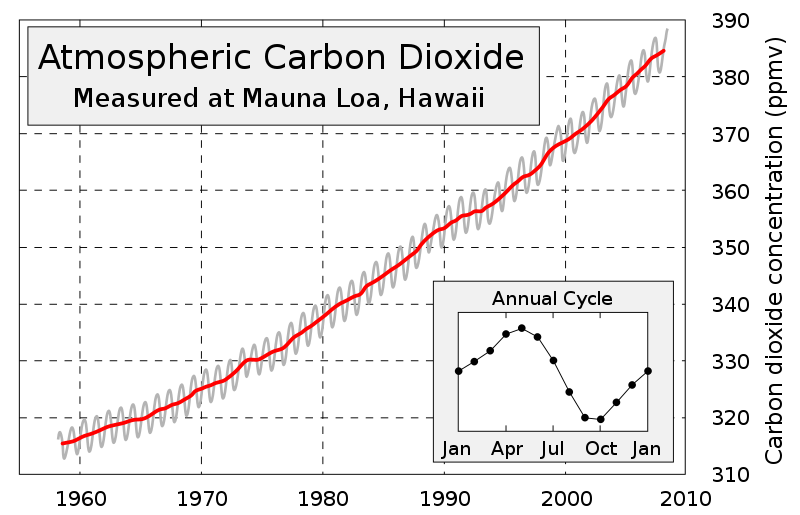
The second part of his argument also isn't telling the complete story : while indeed there's natural CO2 in the air (duh), it isn't so that mankind did not alter the concentrations significantly : in pre-industrial time, CO2-levels were around 280 ppm.

At present they are around 390 ppm, and predictions say levels could rise to 600, 700 ppm or more. In other words : it is very well possible mankind will double the levels of CO2 in the atmosphere. That is significant.

Emission of CO2 from volcanoes is less than 1% of what man pumps in the air annualy.
Temperatures aren't rising
Next, Kouffeld jumps on the train of using short time natural varation in
temperature trends to claim that while CO2 levels are rising, temperature isn't always following. Hence there's no 1:1 relation between CO2 and temperature.
The argument once again is a clear strawman : CO2 is not the only factor with an influence on climate, so naturally one simply does not expect to find a 1:1 relation. Antropogenic climate change comes on top of natural variation.
Kouffeld then continues using the well known claim 'the last ten years, earth hasn't been warming' which Coby Beck adresses here and is a clear cherry-pick as the period to be compared has been carefully selected to fit the conclusion.


Glaciers are meaningless
Kouffeld continues by saying glaciers were melting before man was emitting GHG's, but doens't mention earth was coming out of a little ice-age. And he correctly says the length of a glacier is an equilibrum that doesn't depend solemnly on temperature, but also on precipiation, and claims therefore it is possible to say if glaciers are melting due to a rise in temperature.

In other words, Kouffeld fails to notice we both have thermometers and snow gages, two devices which make it impossible to verify which of the two factors is dominant (temperature for the vast majority of the glaciers).


It's anything but man

Rob Kouffeld De Groene Rekenkamer klimaatverandering
He then continues by adressing the Svensmark cloud theory, which scientist never considered to be proven. Realclimate adresses Svensmark latest publication in their post : still not convincing.

Not very convincing either is his argument the present low activity of the sun is the cause of the present (cherry-picked) cooling period.

He ends his talk by mentioning Al Gore a couple of times. Which obliges me to say Cheers !


Did i mention Rob Kouffeld is part of the "scientific" advisory board of the climate skeptical group De Groene Rekenkamer ?


UPDATE : a reader mailed me Kouffeld is member of the International Climate Science Coalition. A group which received quite some attention lately because of its strong ties with the authors (McLean, de Freitas & Carter) of one of the most deeply flawed papers which appeared in a mighty long time.

Deepclimate has a nice post covering the biggest problems with the McLean, de Freitas & Carter paper and a follow up post which links the New Zealand division of the ICSC with a ... libertarian political party called ACT.

Sunday, 2 August 2009

Roots of the Dutch climate denialists, part 3 : stichting kernvisie

The Stichting Kernvisie (or Foundation Nuclear Energy) was found in 2000 and the president is emeritus Rob Kouffeld, who was working on Energy Technology in the Technical University Delft.

In its newsletter, the Stichting Kernvisie's main focus of course seems to be promoting nuclear energy and it considers Nuclear Power to be one of the answers to the climate change problem.

Even though the reasoning is completely logical, there's something odd going on : De Groene Rekenkamer (DGR) is an organisation of climate skeptics claiming there's basically no man-made climate problem, while Stichting Kernvisie uses this same climate-subject as one of the reasons to be pro nuclear power. Apparantly Stichting Klimaat is satisfied by one side of DGR's story, being their applause for nuclear power.

But there's more going on, as is shown beneath the widget


Rob Kouffeld
On top of the apparant contradiction above, when having a closer look one sees Stichting Kernvisie's president Rob Kouffeld (who is member of the advisory board of DGR) is one of the people signing a letter published in the Dutch newspaper Volkskrant saying man is not altering climate.

So while the Stichting Kernvisie's publications may be accepting manmade climate change, Kouffeld himself clearly does not. How he manages to rhyme those two opinions is something i cannot explain, it looks like the man is playing double game.

As can be seen often in an enviro-skeptical environment, what matters is not the arguments used (they can be excluding each other, it doesn't matter), but what matters is the conclusion. In Kouffeld's case : the promotion of Nuclear Power. And both Stichting Kernvisie and DGR do so.


The S. Fred Singer letter
The letter mentioned above, which has spread widely over the internet, is extremely important as it reads as a "who's who" in Holland. Yet the truly amazing thing with this letter is the appearance of a name of a person without direct connections to Holland. That man is S. Fred Singer, the man who built a career as a lobbyist for anyone who needed an anti-environmentalist viewpoint.

It's the first yet not the last time we'll see Singers name appear in the history of Dutch climate skepticism, as it seems to be S. Fred Singer who seems to have been their most important international contact, and this from the very beginning of the Dutch anti-environmentalism.

Sending letters signed by a bunch of (supposed) experts, as we see here, actually is a tactic which the international climate change denialists have used over and over again. Looks like Singer has been a good teacher to Hans Labohm, the author of the letter. Obviously, there's also a clear connection between the names on that letter and De Groene Rekenkamer, as we will see later on.

Tuesday, 28 July 2009

Dutch climate skeptical organisations pt 2 : De Groene Rekenkamer (intro)

De Groene Rekenkamer libertarisme pseudoskepticisme
The next organisation which deserves some more attention is The Green Court of Audit or in Dutch : De Groene Rekenkamer (DGR).

As we will see, this is the organisation where different kinds of environmental skeptics (not just in the field of climate change) come together. Clearly, as will be explained later on, DGR is an organisation with a clear political focus.

De Algemene Rekenkamer is the Dutch court of auditors which on its website summarizes its task as follows : The Court of Audit checks that the government spends public funds and conducts policy as intended.

Of course it's this Auditing institute which inspired the name Groene Rekenkamer. Clearly, just from the name itself, one can already see what kind of organisation DGR will be. The organisation was found in 2008 by scientists and journalists and in the statutes DGR describes the aim they were formed as follows (§2) :

The aim of DGR is to critically look at the governmental policy on environment, health, technology & related areas and to encourage scientific analysis of risks, cost-effectiveness of the policy and to spread knowledge to a broader audience.
As a little sidenote i can't resist mentioning that, regarding what's to follow, i was surprised to see that under revenues the very first source the organisation sees is "subsidy". I was amused :-)

Before the official start of DGR in 2008, there already was a coöporation between the different groups which ultimately would join DGR, something MeerVrijheid's Theo Richel (as far as i understand, he became an employee of DGR) was already asking for in 2005 on the website libertarian.nl (sic). The groups which ultimately would form De Groene Rekenkamer are :
  • Stichting Kernvisie, ("Foundation Nuclear Energy") which still exists independently.
  • Stichting Heidelberg Appeal Nederland ("Foundation Heidelberg Appeal Holland") which indeed found inspiration for its name in the international Heidelberg Appeal
  • Stichting klimaat ("climate foundation")
  • vzw de Chlorofielen which, as far as i know, was the one-man personal toy of Ferdinand Engelbeen
For a better understanding of what DGR is about, it is useful to have a closer look at the organisations behind DGR. Which will be the topic of the next couple of blogposts.

Sunday, 26 July 2009

Climate change skeptical organisations in the low countries. Part 1 : Stichting Meer Vrijheid

As mentioned many times on this blog, climate skepticism often is associated with libertarian thinkthanks and organisations.

As we will see, this is not only true in the English speaking part of the world, but also in the Low Countries.

There are several organisations denying man-made climate change, but the first one i want to mention is the More Freedom Foundation (in Dutch : Stichting Meer Vrijheid) : The discours used towards environmental issues is just what one would expect to hear from a libertarian movement.

Think of any cliché and it can be found in their environmental statement :

We think the existance of large environmental risks like the greenhouse effect, acid rain or the hole in the ozone layer are exaggerrated.
(...)

We think some environmental regulations are unnecessary and are nothing but a result of a hatred against economical growth & technology.
(...)

MoreFreedom thinks environmental taxes aren't helping the environment, nor are they meant to do so. They are meant to finance the State Treasury; or to manipulate our behavior. (...) MoreFreedom therefore pleads to abandon all environmental taxes.
As seen very often in climate skeptical environments, MeerVrijheid's climate skepticism fits into a broader picture where other environmental issues also are dismissed, and where regulations are seen as an attempt of the state to gain more power or control over citizens. The skepticism isn't scientific, but originates from a paranoid vision twoards anything governmentlike.

Marcel Roele - The secretary
The secretary of MeerVrijheid is Marcel Roele. Roele is a politicologist who is working as a freelance science-journalist.

Roele is a rather controversial figure. To quote the Dutch wikipedia :
In his article "Our own people first"* Roele argues Hitler got his race-theory from the Jewish people. Meaning the Jewish people fell in the hole they dug themselves. Furthermore he claims it has been scientifically proven black people and women are less intelligent; and that handicapped people make mankind ill.

* in dutch it's titled "eigen volk eerst" and is controversial as this very same slogan was used for a long time by the Flemish ultra right-wing party Vlaams Blok (which nowadays is called Vlaams Belang, as the party was forced to change its name after three organisations associated with the party were convicted for violating Belgian law on racism & xenophobia).

Roele claims Africa is such a poor continent because the inhabitants simply have a low iq and that :
the national iq in african countries is 20 iq-points too low to make it possible to create a western style society.
Marcel Roele copies some of the usual arguments about climate change in this article which repeats the "it's the sun" story.

Us knows us
Other people associated with MeerVrijheid are omnipresent Hans Labohm who is part of the foundation's advisory board and who on a regular basis publishes his climate change nonsense on MeerVrijheid's website.

Other articles on environental issues that are published on the website are from the hand of some other people i mentioned before like Vincent De Roeck. The website was one of the four places where his climate change is a religion, not science got published simultaneously.

On the list of authors, we also find the name of climate change skeptics Theo Richel and the names of some people i didn't blog about yet, like Elsevier-journalist Simon Rozendaal who is well known in the low countries also for his skeptical articles and for this book he co-authors with Hans Labohm and Dick Thoenes.

Another new name is Karel Beckman who in 1992 wrote the book "the greenhouse effect doesn't exist"

And then there's Peter van Maanen, who besides MeerVrijheid is associated with the the Belgian libertarian Murray Rothbard Instituut where he's one of the 7 people of the scientific advisory board. Also on this advisory board are two climate change skeptics i adressed before : Jos Verhulst & Frank Van Dun. (to be fair : as far as i know both gentlemen have completely stopped commenting on climate change ever since i mentioned them on my blog.)

The important thing is that we start to see a pattern of, as we say in Dutch : "us knows us". From now on, the same names will keep returning over and over again.

In my opinion, with the MeerVrijheid foundation we are looking at one of the most important branches of Dutch climate change tree, because in almost every other skeptical group we there will appear one of the people mentioned above as we will see in the next parts of this post.

Yet even now my conclusion already is, as you will have already guessed, that in the low countries the same thing is valid as in other parts of the world : climate change skepticism is seldomly scientific, but is usually originating in libertarism. Science gets attacked because it falsifies a polical worldview.

Thursday, 2 July 2009

Climate Change is a Religion, not Science

A while ago i already mentioned that the president of the libertarian Mises Youth org, young Vincent de Roeck considers climate change to be nothing but a hoax.

Under the provocative title 'climate change is a religion, not science' De Roeck draws attention to his latest article on the subject. As he's inspired by libertarism, his conclusion is pretty predictable : it's nothing but a worldwide complot.

His piece got quite some attention as it's been published on four libertarian blogs simultaneously. Therefore i suppose it might be useful to have a closer look at what he writes and see if this time he does get any further than just a renewed belief in a conspiracy.
(As usual, my translation)

Climate change is a religion, not science
Last week the British conservative thinkthank "The Bruges Group" published the paper "Cool Thinking On Climate Change". In some 60 pages the author, the British member of the European Parliament Roger Helmer is trying to convince his readers that the alarmism around global warming is based on lies and dishonesty and that the actions proposed are dangerous and counter-productive.

Helmer starts his paper with a prelude titled "The EU: Fully paid-up Climate
Alarmists" (imho a rather amusing title given the fact he's a MEP receiving a very nice salary from this very same EU) in which the key-quote probably is :
Global Warming? The EU needs more control over energy policy, over tax, over emissions, over industry, over everything.
Of course those words immediately point towards the real reason for Helmers skepticism : it's not based on scientific doubts, but it's an expression of a vision rather common in libertarian surroundings by claiming science is part of a complot set up by the government
Yes Helmer may be a politician and not a scientist, and he freely admits this, his findings nevertheless are most valuable. Helmer doesn't bring new arguments into the debate but summarizes the most important climate skeptical arguments and theories in an easy to read paper.
When having a closer look at the arguments used, indeed there's nothing new in what he's saying. He starts with a three page long attack calling "the Warmists" all sorts of names, mostly in the religious spheres.

His attack on "climate science" is nothing more than a copy of some of the same old skeptical arguments again. Arguments which have been debunked a zillion times before. Honestly, it is getting rather boring and i'm not gonna look at them in detail.

Coby Beck has a nice overview of some frequent heared "skeptical arguments" in his How to talk to a climate skeptic guide and i'm pretty sure Coby Beck's list handles almost everything Helmer says. The only thing Helmers proves is that, indeed, he is not a scientist.

More interesting than the rather silly attempt to discredit science is what De Roeck wrote above (Yes Helmer may be a politician and not a scientist, and he freely admits this, his findings nevertheless are most valuable). I don't understand how one can think the opinion of a total layman can be valuable in a scientific debate and find it remarkable that De Roeck doesn't seem to notice this point. I don't know about you people, but i like my house built by an architect who knows how to make sure it doesn't fall down. My medical problems i prefer to be looked onto by a doctor, etc..

The strong anti-governmental discourse which can be found in Helmers's work closely relates to other libertarian or conservative critics. Like p.ex. the op-ed "The Climate Debate: When Science Serves The State" by professor Joseph Potts for the "Ludwig von Mises Institute" in Alabama or the essay "Global Warming Revisited" by professor Michael Heberling for the "Mackinac Center for Public Policy Research" in Michigan.
The Potts op-ed doesn't get much further than nagging "it's a conspiracy" & the second one does copy some of the usual fallacies, both pieces imho aren't much more than an expression of a paranoid vision to the real world.


These authors rightfully point out, contrary to mistaken neo-Keynesians like a Joseph Stiglitz that the governement, just like privacte actors, doesn't have acces to the "perfect information" and that only the market can handle inherent imperfect information. Something which is fully applicable to the enormous role of the government in dealing with the supposed climate change.

As a result of his skepticism De Roeck obviously overstates uncertainties making him miss the point that the information avalaible is srong enough and clearly states humankind is contributing to present day climate change. It's no longer a question of "uncertainties". The remaining question nowadays is whether "to act or not" and in the second case to which extent to act.

Nowhere in his text De Roeck provides a beginning of an answer how "only a free market" can respond to this situation. Which is no surprise, as we've come to the core dogma, and dogma's need no proof.


The libertarian conservative Roger Helmer in his paper also looks back on his long carreer within the climate skeptical movement and gives some ankedotes about his life. December last year, he represented the climate-skeptical movement as an observer at the
UN climate conference in Poznan and in March he was a guest-speaker at the big climate conference of the American Heartland Institute in New York.

The notorious right-wing thinkthank Heartland has been known to give tribune to anyone who wants to say climate change isn't happening. Whether what the person says actually makes sense from the science point of view is less important.


Furthermore, he demolishes the IPCC and proposes alternative theories like the NIPCC by professor S. Fred
Singer (where the 'N' stands for non-governmental. The movie "An Inconvenient Truth" of course gets crushed, while all criticism on the movie "The Great Global Warming Swindle" skillfully is rebutted

Fred Singer is known as one of those people who not only deny almost every possible environmental issue, but who built their career on being a denier. Bart Verheggen has a closer look on his deeply flawed NIPCC report

Some of the most obvious problems with the Great Global Warming swindle have been adressed before on this blog. De Roeck proves to not have the background to detect deliberate flawed lobbywork from actual science.

Roger Helmer's ideas the last couple of weeks get support of quality newspapers liek "The Daily Telegraph" and the "Wall Street Journal". In the first one Christopher Booker calles the idea of "Global warming" and the melting icesheets "the biggest lie ever". In the second one Björn Lomborg could freely present his theory of the climate-industrial complex and the close connection between "big business" and "big government", unhindered by scientific truth.

Booker is one of those people that are so wrong it's painful to watch. Deltoid had it's fun having a closer look at some of the most evident problems in his work. George Mobiot wrote How to disprove Booker in 26 seconds, which shows where much skepticism already fails : checking your own arguments. One of the first things a scientist learns is to be critical towards your own statements and towards your sources.
Lomborgs story would be more interesting if it weren't so deeply flawed as demonstrated on the website Lomborg errors. A shorter look on some of the most obvious problems with Lomborg's work can be found on The Way Things Break.


Libertarians like myself hold their breath seeing the govenrment tendency to spend money in "green" technologies, because probably the American investment-guru Eric Janszen is more than right when he said in "Harper's magazine" that the "green" sector would be the next bubble to burst

I stick to the conclusion i made in my previous post on De Roeck : Young Vincent *really* will need to learn that a right wing think thank is not the place to get your scientific information. May i feel so free to suggest magazines like Nature, Science of GRL instead ?

Young Vincent did nothing more than demonstrating that for a certain type of libertarians, science looses the battle from their free-market fundamentalism.

Friday, 23 January 2009

Libertarism, climate change and tobacco part II : Vincent De Roeck is unhappy

Earlier i reported the Dutch libertarian website vrijspreker.nl, besides denying man's role in the present global warming, also has been heavily opposing a ban imposed by the Dutch government on smoking in public places.

On their website, they promoted the TICAP-conference with close connections to the tobacco-lobby to oppose such prohibitions.

Vrijspreker today announced that the conference has been cancelled by the EU. Apparantly the reason for this is a violation in the EU rules. The person they got the news from is someone with a very familiar sounding name ... young Vincent De Roeck whoms vision on global warming already has been adressed.

Vincent De Roeck is unhappy he's not going to be able to be fooled by the tobacco-lobby conference dressed up as a freedom of speech conference (my translation):

Vincent De Roeck Margareth Thatcher Global Warming klimaatverandering
Vincent De Roeck and the Iron Lady
it's a scandal. I was inscribed for a anti-prohibition conference next week in the European Parliament. Today i discover the bureau of the EP has prohibited it. Freedom of speech ? A typical deed from that disguisitng EUSSR.

An article with some more background on the TICAP-conference and the interesting career of Dr Gio Gori (whom was gonna give the talk "The passive smoking fraud") can be found in the article Parliament acts against commercial interests in the EPOnce again we can see the close ties between libertarians and an industrial lobby, probably because the industry is drawing the card of using the libertarian bias towards "freedom without government intervention" as it seems to be the ways to get libertarian support : somehow there grows a situation where libertarians will claim there's no need to act on ... [insert scientific subject], while the industry is willingly giving them plenty of financial means to spread the viewpoint there's no need for government action on the subject.

People with a firm biological background would call this the perfect symbiosis !