Showing posts with label De Groene Rekenkamer. Show all posts

Sunday, 5 May 2013

De Groene Rekenkamer - oude wijn in nieuwe zakken

De Groene Rekenkamer is een organisatie die zichzelf onterecht een onafhankelijke kritische auditor van ecologisch getinte onderwerpen noemt, maar in realiteit een organisatie is die vooral overal tegen is, omdat het niet past binnen een politieke ideologie. De organisatie heeft een lange geschiedenis van het publiceren van ronduit belabberde wetenschappelijke onzin (één voorbeeld uit een lange reeks),

De Groene Rekenkamer lanceerde recent een nieuwe website. Tijd om eens te kijken of dit betekent of de organisatie ondertussen al wat meer kaas heeft gegeten van wetenschap.

De nieuwe website oogt visueel beter. Maar daar houdt het goede nieuws helaas meteen op.
De sectie over klimaat toont vooral nog steeds aan dat De Groene Rekenkamer nog steeds geen ernstig
verhaal weet te brengen. Laten we eens een snelle blik werpen op de klimaatpagina's:

Invloed van de zon
Op talloze pseudoskeptische websites tracht men de invloed van de zon op het klimaat te overroepen. Dat er een invloed is, is nogal evident (duh), maar de meetgegevens tonen aan dat de zon de afgelopen 50 jaar vooral redelijk stabiel is geweest, terwijl de temperatuur op aarde in dezelfde periode toenam
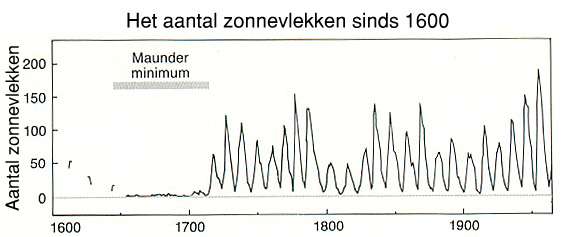
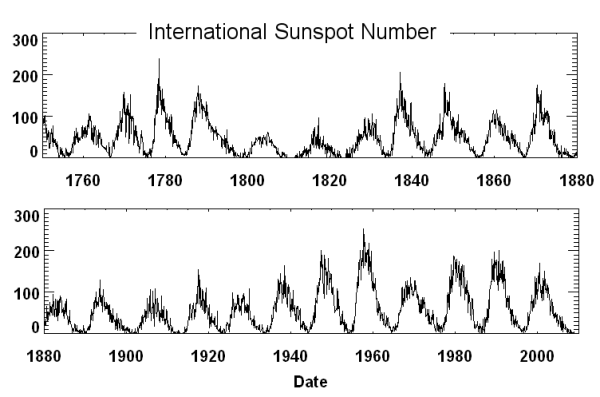
eerst toont De Groene Rekenkamer een grafiek die het aantal zonnevlekken toont. Er is echter iets merkwaardigs aan de hand.

Hieronder presenteer ik eerst de grafiek met het aantal sunspots tot 2010, en erna de grafiek op de site van De Groene Rekenkamer.


En de grafiek van De Groene Rekenkamer:


Merk op hoe de gafiek op De Groene Rekenkamer stopt omstreeks 1950, zodat de indruk gewekt wordt dat de zonne-activiteit de afgelopen tijden enkel maar toenam. De daling van na 1950 wordt "verzwegen". Dit is een schoolvoorbeeld van een cherrypick : een deel van de data wordt bewust achtergehouden  om een misleidend beeld op te wekken. Dat is niet erg netjes.

Vervolgens post de Groene Rekenkamer een grafiek die een verder rechtstreeks sterk verband moet suggereren tussen de zonne-activiteit en de temperatuur.

De juiste vergelijking tussen beiden wordt weergegeven in de eerste onderstaande figuur  (bron: skeptical science):


In plaats van dit globaal beeld te presenteren, tracht De Groene Rekenkamer een andere indruk te wekken door middel van een grafiek afkomstig van Willie Soon, een man met een bedenkelijke reputatie op het creëren van misleidende wetenschappelijke nonsens.

Dit is het beeld dat ze presenteren:


Het verschil met de grafiek die ik hierboven heb gepost ?
De eerste grafiek hierboven vergelijkt de invloed van de zon en de temperatuur op aarde.
De grafiek van Soon vergelijk de invloed van de zon op het temperatuursgradiënt tussen noordpool en evenaar. En zegt niets over de relatie tussen de gemiddelde temperatuur en aarde en de zon.
Weerom wordt getracht een misleidend beeld op te roepen.

Klimaatgevoeligheid
De Groene Rekenkamer betwist dat de klimaatgevoeligheid en verwerpt de gevestigde orde door het citeren van één paper, zonder aan te halen waar de andere studies foutief zouden zijn.

De paper (On the Misdiagnosis of Surface Temperature Feedbacks from Variations in Earth’s Radiant Energy Balance) van Spencer en Braswell was zo ondermaats dat dat hij nooit gepubliceerd had mogen worden. Wat editor-in-chief Wolfgang Wagner ook erkende, waarop hij prompt zijn ontslag indiende. Wagner schreef:
Peer-reviewed journals are a pillar of modern science. Their aim is to achieve highest scientific standards by carrying out a rigorous peer review that is, as a minimum requirement, supposed to be able to identify fundamental methodological errors or false claims. Unfortunately, as many climate researchers and engaged observers of the climate change debate pointed out in various internet discussion fora, the paper by Spencer and Braswell [1] that was recently published in Remote Sensing is most likely problematic in both aspects and should therefore not have been published.
After having become aware of the situation, and studying the various pro and contra arguments, I agree with the critics of the paper. Therefore, I would like to take the responsibility for this editorial decision and, as a result, step down as Editor-in-Chief of the journal Remote Sensing.
Hij vervolgt:
With this step I would also like to personally protest against how the authors and like-minded climate sceptics have much exaggerated the paper's conclusions in public statements, e.g., in a press release of The University of Alabama in Huntsville from 27 July 2011, the main author's personal homepage, the story "New NASA data blow gaping hole in global warming alarmism" published by Forbes, and the story "Does NASA data show global warming lost in space?" published by Fox News, to name just a few.
Uiteraard vertelt De Groene Rekenkamer de kritiek op de paper er niet bij.

De conclusie is duidelijk: de vernieuwde website van de Groene Rekenkamer bestaat uit oude wijn in nieuwe zakken. Voor accurate informatie over klimaatwetenschap moet je echter nog steeds niet bij deze lobbygroep zijn.

Niet verwonderlijk, omdat De Groene Rekenkamer nog steeds een organisatie is die vooral tracht wetenschap te politiseren. De oude website bevatte niet toevallig volgende passage:


Monday, 12 November 2012

De uitlopers van de motie Neppérus

Motie Neppérus


De VVD wil onafhankelijk onderzoek naar de opwarming van de aarde, nu ons land al weken in de ban is van de vrieskou. “We moeten weten hoe het echt zit, zeker met dit weer”, aldus VVD-Kamerlid Neppérus.

Neppérus kent zoals wel meer leken het verschil tussen 'weer' en 'klimaat' niet. Ze deed deze verklaring een maand na het climategate (non?)-schandaal, terwijl ook de tikfouten in het IPCC AR4-rapport in de media kwamen. Reden genoeg voor Neppérus om in het parlement een motie te vragen, en ook nog eens te krijgen, die een politieke bemoeienis in de wetenschap betracht die niet onmiddellijk tot voorbeeld strekt.

De motie had drie eisen:
  • dat de aanbevelingen van de IAC voortvarend worden uitgevoerd. 
  • dat klimaatsceptici bij toekomstige rapporten van het Intergovernmental Panel on Climate Change (IPCC) zullen worden betrokken. 
  • te reageren op het verslag van een bijeenkomst georganiseerd door de Groene Rekenkamer over een brochure opgesteld door de Koninklijke Nederlandse Akademie van Wetenschappen (KNAW).
De eerste opmerking betreft een procesmatige screening van het IAC over de werking van het IPCC, en bevat een aantal aanbevelingen om dit proces te verbeteren. Wat uiteraard lovenswaardig is. 

De twee andere punten zijn echter een heel stuk problematischer. IPCC vat de peer review literatuur samen, en als er relevante sceptische wetenschap is of zou zijn, wordt die in de rapporten uiteraard meegenomen. Peer review is nog altijd de plek waar wetenschap wordt bedreven. Stellinkjes geponeerd op het internet vallen uitdrukkelijk niet onder wetenschap. Het pseudoskeptische geneuzel op heel wat blogs wordt daarom uiteraard, en volkomen terecht, niet weerhouden bij het opmaken van ernstige wetenschappelijke rapporten. 

En daar zit net de knel: ofwel weten sceptici wetenschappelijk gefundeerde kritieken te produceren en worden ze reeds gehoord in het IPCC proces, ofwel publiceren ze niets, en is er geen wetenschappelijke grond om ze te horen. Immers, als ze hun internetstukjes hard zouden kunnen maken, zouden ze die ook tot in de peer review literatuur hard kunnen maken, quod non. 

Merk ook op dat bij bv. scepticus Richard Lindzen, een van de weinige sceptici die ooit peer review klimaatliteratuur produceerden, een duidelijke discrepantie aanwezig is in zijn stukken. Er is een duidelijk verschil tussen zijn wetenschappelijk werk en zijn opniestukken. Hij schrijft talloze opiniestukjes waarin hij de klimaatwetenschap aanvalt, maar als je naar de peer review literatuur van zijn hand kijkt krijg je een heel ander beeld, en zorgt zijn werk absoluut niet voor het onderuithalen van de klimaatwetenschap en is zijn werk behoorlijk mainstream te noemen. Hij weet met andere woorden zijn harde taal in zijn opiniestukken niet te vertalen naar wetenschappelijke gefundeerde stellingen. Het blijft bij zéggen dat de klimaatwetenschap faalt, zonder daar wetenschappelijke onderbouwing voor te kunnen geven. En Lindzen is allesbehalve de enige scepticus bij wie dat proces opduikt.

Het ontbreken van wetenschappelijk onderbouwd klimaatscepticisme leidde dan ook niet-verrassend tot volgend antwoord van Joop Atsma op Neppérus' motie:
Het belangrijkste argument dat wordt gebruikt om geen aandacht te besteden in IPCC-rapporten aan de wetenschappelijke argumenten die sceptici gebruiken, is dat er geen peer-reviewde literatuur over beschikbaar is.
Of met andere woorden: dat er geen wetenschappelijk gefundeerde kritiek is die de grondslagen van de klimaatwetenschap onderuit haalt. Veel woorden hoeven er daarom verder niet aan vuil gemaakt te worden zou je daarom denken.

Merkwaardig is daarom het vervolg van Atsma's antwoord:
KNMI, ECN en PBL werken daarom samen aan een artikel dat de belangrijkste argumenten beschrijft en analyseert, en dat komende zomer zal verschijnen in een wetenschappelijk tijdschrift. 
Kortom, Atsma geeft de vermelde instellingen de opdracht niet-wetenschappelijke stellingen samen te vatten en op de keper beschouwd bestaat de opdracht er dan ook uit aan te halen waarom ze niet meer wetenschappelijke aandacht krijgen. Een redelijk nutteloze opgave me dunkt. Immers, zoals hierboven aangehaald: als die sceptische stellingen hard te maken zouden zijn, zouden ze wel in de peer review literatuur verschijnen. Het niet-verschijnen in peer review literatuur houdt immers impliciet in dat de stellingen de wetenschappelijke toetsing niet doorstaan.

Atsma vervolgt:
Een Nederlandse scepticus is gevraagd substantieel tijd te besteden aan het leveren van commentaar op het komende IPCC-rapport over het klimaatsysteem (Werkgroep 1). Ik heb hem gevraagd te luisteren naar suggesties van andere sceptici.
Weerom een bijzonder opmerkelijke stelling. Zou een politicus ooit een astroloog aanstellen als evenwaardig partner in de sterrenkunde? Erg onwaarschijnlijk. Zou een politicus het ooit in zijn hoofd halen een creationist overheidsgeld toe te stoppen om de evolutietheorie te beoordelen? Dacht het niet. 

Zou een politicus ooit een journalist zonder wetenschappelijke publicaties aanstellen om de klimaatwetenschap te beoordelen. Ja dus.

Die scepticus is Marcel Crok, een journalist die aan de klimaatoppervlakte verscheen toen hij in Natuurwetenschap & Techniek een artikel schreef over de hockeystick dat uit niet meer bestond dan het vertalen van het werk van McIntyre en McKitrick, zonder daarbij enige kritische noot te plaatsen. Crok verwarde toen reeds "tégen zijn" met "sceptisch zijn". 

Enige jaren later was hij mede-oprichter van het vuilbekblog Climategate.nl, waar wetenschap verworpen wordt met rechts-libertarische kretologie die niet verder reikt dan de hele wetenschappelijke wereld communistisch te noemen. Iedere wetenschapper die zo naïef is te denken dat een beschaafd gesprek op die plek mogelijk is en een comment durft te posten op dat blog wordt enkel maar op een hoop gescheld onthaald. Het pleit allerminst voor Crok dat hij er niet in slaagt om dat soort niet-wetenschappelijk geblèr te onderscheiden van reëel sceptisch denken. En doet in ieder geval vragen rijzen over zijn wetenschappelijk beoordelingsvermogen.


Het derde punt uit de motie Neppérus is zo mogelijk nog problematischer. Om niet te zeggen onaanvaardbaar. Het betreft het ernstig nemen van het werk van de Groene Rekenkamer, een organisatie die zowat ieder milieu gerelateerd wetenschappelijk onderwerp verwerpt of minimaliseert omwille van politieke motieven. De Website van de Groene Rekenkamer maakt op dat vlak al enorm veel duidelijk:

De Groene Rekenkamer pseudowetenschap pseudoskepticisme

Als De Groene Rekenkamer werkelijk een gezonde milieukritische organisatie zou zijn, zou dergelijke passage natuurlijk nooit of te nimmer op de website geplaatst worden. De Groene Rekenkamer politiseert de wetenschap, en verwerpt ze enkel en alleen omwille van politieke motieven. 

De Groene Rekenkamer komt voor ieder milieugerelateerd onderwerp waar ze ook maar enigszins aan kon denken tot dezelfde conclusie: er is niets aan de hand en de overheid heeft geen reden om op te treden. Dat laatste is uiteraard de kern van het libertarisme, en de werkelijke reden voor het aanvallenvan de wetenschap. Bij de botsing van de ideologie met de realiteit, wordt de realiteit door De Groene Rekenkamer zonder aarzelen onder de bus gegooid.

Het niveau van de stukken op De Groene Rekenkamer is, ik druk me zacht uit, om te huilen. Ik heb op dit blog al eerder enkele ontstellend belabberberde stukken van die site behandeld (o.a. hier). 

Opgemerkt kan worden dat Theo Richel zonder het zelf te beseffen in wezen zelf stelde dat de organisatie geen enkele wetenschappelijke relevantie heeft. Ja, nogmaals, dat is het niveau van die organisatie. 

Dat een dergelijke organisatie door zoveel VVD-politici au sérieux wordt genomen is dan ook schrijnend. 

Dat De Groene Rekenkamer ook de klimaatbrochure van de KNAW zou verwerpen is allerminst een verrassing, maar is net zoals de hele organisatie compleet irelevant. Ja ik ben me er van bewust dat voorgaande zin bij een buitenstaander tot gefrons zal leiden. 

Gelukkig is het antwoord van Atsma bevredigend omdat hij hier wél stelt dat wetenschappelijke onafhankelijkheid niet beknot mag worden door politiek of een organisatie van pseudosceptici:
De  KNAW is volledig autonoom en gaat zelf over z’n eigen publicaties. Dat is goed en moet ook beslist zo blijven. 


Climate Dialogue
Atsma antwoordde in opvolging van de Motie Neppérus ook nog het volgende:
Ik heb het KNMI en PBL verzocht een inhoudelijke en zakelijke discussie op het internet te organiseren. Hierbij wordt telkens een door sceptici gebruikt argument uitgelicht door enkele uitgenodigde deskundigen aan weerszijde van het spectrum. Anderen zullen hierop alleen kunnen reageren via een moderator om de discussie overzichtelijk te houden en er zeker van te zijn dat deze ook professioneel blijft. Uiteindelijk zal een samenvatting worden gemaakt van alle discussies, met nadruk op waarover men het eens is, waarover niet, en wat de achterliggende oorzaak daarvan is. De uitkomsten van deze vijf activiteiten zal Nederland gebruiken wanneer ook de lidstaten van IPCC in oktober en november van dit jaar het tweede concept van het rapport kunnen becommentariëren.
Naar aanleiding van dit antwoord wordt door PBL en KNMI dinsdag aanstaande de website Climate Dialogue gelanceerd.

Positief is dat de discussie enkel en alleen gevoerd wordt door mensen die peer review hebben gepubliceerd. 

Maar voor de rest vind ik het een bijzonder merkwaardig initiatief: het blogscepticisme zal niet aan bod komen omdat het nergens op stoelt, en de wetenschappelijke discussie wordt reeds in de literatuur gevoerd, waardoor de site op dit vlak weinig zal bijdragen.

Het is me dan ook niet helemaal duidelijk wat de Nederlandse overheid met dit initiatief wil bereiken. Het lijkt erop dat een hoop overheidsgeld wordt gespendeerd om de Neppérussen van deze wereld tevreden te houden, zonder dat die investering ook maar tot enige wetenschappelijke vooruitgang, of tot enig nieuw maatschappelijk inzicht zal leiden. De leek zal niet begrijpen wat er bediscussieerd wordt. Hooguit kan je verwachten dat klimaatsceptici de discussies over de minor-discussion points zullen uitvergroten in een poging daarmee de wetenschappelijke zekerheden waarover géén discussie bestaat mee te versmachten. Wat ze nu ook al doen, dus op dit vlak ook niets nieuws. Nogmaals: ik vind het een bijzonder merkwaardig initiatief.


Climate Dialogue in De Volkskrant
Maarten Keulemans schreef dit weekend een artikel (achter paywall) in de Volkskrant waarin de start van Climate Dialogue wordt aangekondigd. Het moet gezegd, het is een merkwaardig stukje. 

Laten we even voorbijgaan aan de eigenaardigheid dat hij -om een project aan te kondigen dat een dialoog tussen wetenschappers en sceptici moet betekenen- hij enkel een klimaatscepticus (Marcel Crok) aan het woord laat, en daarbij ook nog eens foutief stelt dat de site mede een initiatief is van Crok (zoals hoger vermeld is het een initiatief van PBL en het KNMI). 

Laten we ook maar even voorbij gaan aan het feit dat hij wél schrijft dat Marcel Crok's boek stelt dat er nog veel onzeker is over de oorzaak, omvang en de gevolgen van de klimaatverandering, maar daar niet bij aanvult dat Crok's boek één lange eenzijdige benadering is die bulkt van de cherrypicks, halve waarheden en regelrechte fouten (ja Marcel, ik heb je boek ondertussen gelezen), en zonder hierbij één woord te zeggen over de nochtans 40 pagina lange reeks kritische opmerkingen die het PBL dan ook had op het boek: Achtergrondinformatie bij De Staat van het Klimaat 2010
Hierdoor geeft Keulemans (hopelijk ongewild) Crok meer gewicht dan hij wetenschappelijk verdient. Het is heus geen toeval dat Crok niet één wetenschappelijk artikel heeft geschreven. Maar bon.

Het echte probleem in het artikel zit m.i. de opsommingen onder het kopje 'splijtzwammen',  waar hij een opsomming geeft van stellingen waar "sceptici" en "opwarmers" lijnrecht tegenover elkaar staan. Keulemans doet geen enkele poging om hierbij de correcte wetenschappelijke stand van zaken weer te geven, maar beperkt zich in zijn stuk enkel op een bijzonder merkwaardige vorm van "woord" en "wederwoord", wat uiteraard een belangrijk journalistiek basisprincipe is. Maar wel tevens een punt waar tegenwoordig al te veel journalisten halt houden, onder het mom 'we hebben toch lekker een debat gehad' (nee, ik verwijs hierbij niet expliciet naar Keulemans). 

Woord en wederwoord mag dan wel een belangrijk journalistiek principe zijn, de échte taak van een journalist is natuurlijk om de lezer juiste informatie voor te schotelen, en daar schort het in dit stuk aan. Ophouden met te stellen dat Suske 'wiet' roept, en Wiske 'woe' roept mag geen eindpunt zijn. Een journalist heeft m.i. vervolgens de taak uit te vogelen wie het bij het rechte eind heeft. De lezer heeft m.i. het recht volledig en juist geïnformeerd te worden. 

Maarten Keulemans IPCC skeptici oversimplificatie

Keulemans geeft er in zijn stukje, en op Twitter, nochtans blijk van zich ervan bewust te zijn dat het klimaatdebat meer stellingen zijn dan de in het kaderstuk voorkomende simplistische opdeling in voor- en tegenstanders. En dat hij zich ervan bewust is dat de waarheid noch zwart noch wit is, maar dat wetenschappelijke realiteit zich op een ander vlak bevindt dan beide extremen. Het is een gemiste kans dat hij dat niet duidelijker in zijn stukje weergaf, want nu wekt hij de indruk dat er een discussie is op punten waar de wetenschap zelf robuust is, en waar de discussie zich ergens achter de komma bevindt.

Als ik eindredacteur van de Volkskrant was, had ik Keulemans zijn stukje terug naar afzender gestuurd met de opdracht het huiswerk volledig te maken, en zin van onzin te onderscheiden, zodat de lezer volledig geïnformeerd wordt en weet wat de wetenschap over de aangehaalde tegenstellingen zegt. Aangezien dat niet gebeurde, blijft een stukje over waarin de lezer op het verkeerde been wordt gezet en de wetenschap de verliezer is. 

En dat vind ik jammer.
Monday, 15 November 2010

Merchants of doubts : interview with Naomi Oreskes


Naomi Oreskes Eric Conway Merchants of Doubt
Science historian professor Naomi Oreskes just appeared in a radio-interview in Australia to talk about her book Merchants of Doubt. In the interview (and book) she explains how a few people, driven by ideology, started attacking scientific topics they feared would be an attack on freedom. The attack started in the circles around the George C. Marshall Institute and the first scientific topic that was attacked was not climate science but tobacco. With the financial aid of big industrial companies, the strategy used is manufacturing doubt, helped by the philosophical perversity proving something is right isn’t as easy as you might think.
As the strategy is still deployed until today, it is extremely important to both understand the strategy of doubt and to understand the importance of freedom-ideology and the somehow paranoid visions sometimes associated with it. Even though Oreskes talks about the American situation, you can easily compare what Oreskes talks about in the interview and the situation in the Low Countries and you’ll find out there’s a striking resemblance.
The role of ideology in understanding climate scepticism in Holland is pretty obvious. The sceptical website Klimatosoof even explicitly states in its FAQ-section : we suppose members of the Groene Rekenkamer are fighting for maximal personal and economical freedom (…) and belong to the libertarian fraction, a philosophy that wants to decrease the role of the government on every domain.
When you look at the other big climate sceptical webpage in Holland, climategate.nl, you’ll also recognize what Oreskes said. The first sentence in Rypke Zeilmaker’s latest post reads : Many "’scientists’ see global warming as an excellent tool for a socialist reform-agenda. Hajo Smit on the other hand is the perfect example of the role of paranoia in the debate. Hajo Smit often accuses people, without any provocation or apparent reason, that they want to censor or lock up unwanted individuals just like the Nazis and Communists did.
At present, the Dutch doubtmaster is Hans Labohm, an economist. He doesn’t understand climate science and sticks to quoting dubious claims he finds on the internet, even when he knows what he says is wrong or misleading. Once you recognize what he’s doing you’ll see that when he gets challenged about the mistakes in his posts or in the work of people he cites, he shows no interest whatsoever in the content of what he writes or the fact of what he says is correct or not. Instead he’ll give a reply like “…but the important things is to remember the science is not settled !”. He’s not interested in science but in manufacturing doubt. Which is no coincidence: one of the three scientists Oreskes talks about is S. Fred Singer, and it is this very same Singer who has close contacts with Labohm and they frequently show up together all over Europe.
I know what is written in this post is something I've said many times before on this blog, but understanding the role of non-scientific doubt and the important role of bias linked with a person’s ideology is vital in understanding the climate debate. So I will keep on hammering getting that message through.
The WtD-blog has a good post today on how the industry is involved in feeding the "uncertainty-meme" and manipulating the audience : Wolves in sheep's clothing : how big tobacco wanted to mimic the global warming sceptics and establish a "fake" NGO

Saturday, 13 February 2010

The inconsistency in the response of the Klimatosoof’s Theo Richel to the Open Letter of 55 Dutch Scientists

Theo Richel Klimatosoof Lord Monckton global warming nonsense statement
Theo Richel and Christopher Monckton
On the Klimatosoof-website DGR’s Theo Richel complains that the “55 Dutch scientists open letter” published on SENSE contains a lot of “non-climate scientists” like biologists. He writes a whole paragraph to say he thinks biologists aren’t able to understand the complex physical processes of climate science. He also wonders about the fact there are economists, politicologists, mathematicians on the list. He concludes :
On the grounds of their education only a minority of all signers is able to judge whether IPCC’s claims on anthropogenic climate change are true.
According to a comment of Bart Verheggen (link in Dutch) most of the names he recognizes actually do work in a domain related with climate research
But given Richel’s argumentation it might be fun to have a little closer look at the people who wrote (or were interviewed) on the Klimatosoof website the past half a year or so :
  • Bas Van Geel is a biologist
  • Theo Richel himself is a man who apparently has no education after high school
  • Hans Labohm is an economist
  • Benny Peiser is an anthropologist
  • Lord Monckton is a man with no scientific training whatsoever
  • Arthur Rörsch was a professor teaching genetics
And of course in the entire advisory board of the Klimatosoof there’s no-one who ever worked in a field even remotely close to climate science.
I think Theo Richel just disqualified his entire website :)

Saturday, 19 September 2009

The Climate Foundation

Roots of the Dutch Climate Scepticism series, part 7
Before looking at the Heidelberg Appeal Nederland, i want to have a look at another organisation that ultimately would join the DGR-coalition : the Climate Foundation (in Dutch : Stichting Klimaat).

J.T. ‘Hans’ Grashoff

The climate foundation was an organisation with a clear vision : the only reliable sources of energy are oil and nuclear power. Any other alternative (wind, hydrogen) is dismissed.
The President of the Climate Foundation was J.T. Grashoff. This very same man also is president of the Foundation Pro Automobiles. Seriously.
The environmental views of Pro Auto are exactly the ones you would imagine. An example is their comment on a news article on new techniques to reduce CO2, on which they add themselves :
Comment of Pro Auto : the environmental mafia still did not proof that CO2 is the cause of climate change.
Globally, only 1 to 4% of CO2 is anthropogenic, therefore it’s terribly arrogant to claim this limited percentage is responsible for such a big phenomena.
[they fail to notice we ADD this percentage annualy, resulting in a rise from 280 ppm (1850) to 385 nowadays]
Former Dutch State Secretary Van Geel, while looking how the The Netherlands could reach their Kyoto-targets and reducing CO2-emissions, launched ideas like limiting the maximum speed for cars and by building more windmills. In a response, Pro Auto & Stichting Klimaat in 1993 organised a seminar with he aim of presenting the “real” facts about climate change.

Adriaan Broere


The Climate Foundation was found in 2001, and besides Grashoff one of the more vocal founding members was Adriaan Broere, a man who often described as a geophysic even though actually he only has the bachelor degree. He spent most of his professional career in the US, and returned to Holland after his retirement and started calling himself a climate researcher. Which he is not, nor has he ever been one.
The level of his criticism isn’t very impressive. An article on his visions (and the ones of Arthur Rörsch) starts as follows :
They can’t even predict the weather of tomorrow, and yet they say in a hundred years we all permanently will have to walk around in our swimming pants !
More interesting is a text Broere wrote himself. He drops a lot of red herrings and makes plenty of errors like stating “most of the 120.000 glaciers are actually growing”. The only thing to remember from his entire text is the name of a person Broere explicitly calls his mentor : S. Fred Singer. Once again there’s a clear connection between Dutch climate sceptics and Singer
Since the Climate Foundation joined the DGR-coalition, their website is no longer online, which is a pity. It used to contain prominent links to websites like Pro Auto and Libertarian.nl …

Friday, 18 September 2009

The Heidelberg Appeal

Roots of Dutch Climate scepticism series, part 6
A whole lotta astroturf groups
Before continuing the journey through Dutch climate scepticism, it is necessary to make a little side trip outside the country. In my post on Frits Böttcher, i mentioned the existence of an astroturf group called ESEF, which is considered to be the European counterpart of another astroturf group called The Advancement of Sound Science Coalition. This seems to have been the mothership.
But as seen many times when looking at the work of the industry, several small astroturf groups were founded. One of them is the International Centre for a Scientific Ecology (ICSE) which despites it’s name had very little to do with science. Sourcewatch describes it this way :
This organisation purported to be a grassroots scientific think-tank, but it was actually a scientific lobbyshop funded by a coalition of tobacco, asbestos, oil, coal and energy interests. For this reason it is often referred to as the "Heidelberg coalition" or "Heidelberg organisation" in the literature.
ICSE was ran by Michel Salomon and was working closely with S. Fred Singer’s personal toy Science and Environmental Policy Project (or SEPP). Salomon eventually would join SEPP. Both men also were member of the advisory board of ESEF, while ESEF’s Böttcher was part of the SEPP advisory board. All over, there are very close connections between the several astroturf organisations.
The Heidelberg Appeal
Michel Salomon is the man who wrote the text of The Heidelberg Appeal as a response to the 1992 Earth Summit in Rio de Janeiro
The Appeal stated that its signers "share the objectives of the 'Earth Summit'" but advised "the authorities in charge of our planet's destiny against decisions which are supported by pseudo-scientific arguments or false and non-relevant data. ... The greatest evils which stalk our Earth are ignorance and oppression, and not Science, Technology and Industry."
The Heidelberg Appeal was signed by a lot of scientist, including many Noble Prize Winners. The text nowhere mentions climate change, but remains vague all over. Nevertheless, with some bending and twisting, the lobby was able to make it look as if it did conclude there’s no consensus on the subject.
As stated many times before on this blog, the industry understood perfectly well that when someone is already biased against something, that person does not need to be convinced by proving science to be wrong, it's sufficient to create doubt that science is right, and this nothing but another example of how they are trying to create confusion.
Remarkably, the spreading of the document mostly went via … the tobacco industry.
Tobacco industry & Heidelberg appeal
This document and this one which were made public in the Tobacco Legacy Documents library leave no doubt about the roots of the Heidelberg Appeal. I’ve mentioned before that when the science was leaving less and less doubt that second-hand tobacco smoke indeed IS harmful; the tobacco industry in the 80’ies & beginning of the 90’ies was looking for a allies to form a broader coalition to attack science. this document by tobacco industry law firm APCO provides a brilliant insight in what the industry wanted :
As we stated during our meeting in London, we believe that a TASSC-like group can succeed in Europe. European policymakers place a significant amount of importance on objective research - particularly as it relates to technical issues. TASSC, if created properly, can become a credible commentator to complement or spearhead business objections to unfair public policies and pronouncements.
TASSC climate lobby tobacco astroturfing
Moreover, by creating a coalition that is dedicated over the long run to speak out on issues relating to scientific integrity, TASSC can become a frequent, consistent source of information for media, conferences, etc. - in essence a "watchdog group" that wants scientific facts, not emotional reactions, to determine public policy. When considering the formation of a TASSC-like group in Europe, we think it is important to begin where we started in the United States by identifying some key objectives Specifically, we recommend that a European TASSC be formulated to do the following:
  • Preempt unilateral action against industry. .
  • Associate anti-industry "scientific" studies-with broader questions about government research and regulations.
  • Link the tobacco issue with other more "politically correct" products.
  • Have non-industry messengers provide reasons for legislators, business executives and media to view policies drawn from unreliable scientific studies with extreme caution.
To achieve those objectives, we encourage a TASSC group in Europe to focus on a few key messages, such as: (i) science should never be corrupted to achieve political ends; (ii) economic growth cannot afford to be held hostage to paternalistic, overregulation; and (iii) improving indoor air quality is a laudable goal that will never be accomplished as long as tobacco smoke is the sole focus of regulators. Obviously, each of the messages needs to be modified to be useful in each of the European nations.

INTEREST AND SUPPORT IN EUROPE FOR THE ISSUE OF SOUND SCIENCE
Already, there are several opportunities to establish TASSC in Europe. We have had extensive conversations with our Grey/GCI network in Europe, which encompasses offices in 33 cities and 19 countries. They also are confident that scientists and businesses can be attracted to the group if it is positioned in a credible manner
As a starting point, we can identify key issues requiring sound scientific research and scientists that may have an interest in them. Some issues our European colleagues suggest include:
  • Global warming
  • Nuclear waste disposal
  • Diseases and pests in agricultural products for transborder trade
  • Biotechnology
  • Eco-labelling for EC products
  • Food processing and packaging
In each of these issues, there has been considerable discussion as to whether sound science is being used as a basis for these decisions. The diversity of these issues, and their tremendous impact upon business and industry, provides an excellent "tie-in" to the work TASSC is currently undertaking in the United States.
The document leaves no doubt : global warming scepticism was nothing but one of the many issues the tobacco industry hoped to use in a broad attack on science. It also explains why so many leading climate sceptics (Singer, Milloy, …) have their toots in the tobacco industry. The effort to create a European branch of TASSC finally would result in the ESEF organisation of Frits Böttcher. It is in this circle of lobby groups the Heidelberg Appeal has its roots.
In 1993 in Holland an organisation was found called Foundation Heidelberg Appeal Netherlands (HAN), and which would quickly work together with Böttchers Global Institute. HAN would later on become one of the organisations to form De Groene Rekenkamer, therefore i’m going to spent some more time on them in another post.

Wednesday, 12 August 2009

Frits Böttcher

Roots of Dutch climate skepticism series, part 5
Next in the history of Dutch climate skeptics series is a man with an extraordinary CV : Carl Johan Friedrich (Frits) Böttcher.

After WW2, Böttcher (1915-2008) was a professor at Leiden University where he was teaching the remarkable combination of Chemistry and Graphology.

He had to give up the latter though around 1960 because by then the pressure of the academic world, considering graphology to be pseudo-scientific nonsense, became too big.

Somewhere in the 50's Böttcher also found the time to become a part-time scientific advisor for Shell. A position he'd keep for the next 30 years.


European Science and Environement Forum Frits Böttcher
European Science and Environment Forum
The Club of Rome
In 1963 Böttcher, having professional contacts with the Dutch ministry of education, told them he was surprised there was so little interest in the forthcoming conference of the just found OECD. This ultimately resulted in the ministry asking him to lead the delegation.

By that time he also became the first president of the Dutch Advisory Board for Science-Policy. In this position, he and some delegation- leaders from other countries were invited by the OECD to a conference on the results of population growth.

As a result of this involvement, Böttcher would become one of the founding fathers of the resulting Club of Rome, which in 1972 would publish the famous Limiths to Growth report.

It's considered to be one of the world's first expressions of a serious ecological concerns towards the future. It would also be one of the first to be attacked by environmental skeptics :-)


The quote
When his membership of the Dutch scientific board ended (1976), Böttcher started The Global Institute for the Study of Natural Resources. The financial resources for the institute were Shell and the automobile industry.

In the beginning of the 90's, Böttcher became a vocal climate skeptic. After a TV-debate in which Böttcher declared there's no CO2-problem, Lucas Reijnders said to Frits Böttcher : "You know very well yourself what you said is incorrect" to which Böttcher gave the legendary answer "yeah i know, but i'm against nuclear energy"


Big Tobacco Lobby
In 1994 (at age 79 !) Böttcher started the European Science and Environment Forum (ESEF), together with Roger Bate and John Emsley. ESEF declared that, in order to remain independent, it would only accept funding from the sales of its publications. Two years later, Roger Bate would ask Philip Morris for a £50,000 grant.

ESEF is linked, via shared staff (Julian Morris and Roger Bate) and a shared web server, to the International Policy Network and the Sustainable Development Network.

ESEF can be considered as a European version of Steve Milloy's The Advancement of Sound Science Coalition (TASSC). The aim of the now defunct ESEF was to bring tobacco advocacy into a larger field of environmental issues, like the ban on growth hormone for livestock (in Europe, it's illegal), restrictions on pesticides, etc.

In 1998, the academic members of lobby tool ESEF contained a lot of well known climate skeptics. Read and weep : Sallie Baliunas, Robert C. Balling, Sherwood Idso, Patrick J. Michaels, Harry N.A. Priem, Michel Salomon (the author of the Heidelberg appeal), S. Fred Singer, Willie Soon, Gerd-Rainer Weber, while Richard S. Courtney was listed as a bussiness member.

Böttcher in his turn would become a member of the advisory board of S. Fred Singers Science and Environmental Policy Project (SEPP)

Böittcher would publish two books on the subject of climate change :

  • Science and fiction of the greenhouse effect and carbon dioxide, The Global Institute for the Study of Natural Resources, 1992,
  • CO2, Klimabedrohung oder Politik? (in English : CO2, climate fraud or politics?), samen met H. Metzner, Paul Haupt, 1994
Böttcher called global warming a conspiracy involving a few hundreds of scientists and politicians.


The Heidelberg Appeal
It is in this environment of Big Tobacco lobbygroups like ESEF & TASSC that the Heidelberg Appeal would arise. Which is material for the next episode in the series.

The Heidelberg Appeal would lead into a Dutch division called Stichting Heidelberg Appeal Nederland (stichting HAN) which would become one of Hollands prominent anti-environmental groups.

HAN soon start to coöperate with Böttchers aforementioned private tool The Global Institute for the Study of Natural Resources and in 1997 they would start the Science and Society Forum (SSF). In a 2007 interview Böttcher stated the global institute still existed on it's own with one employee.

Frits Böttcher passed away on november 23, 2008.

Tuesday, 4 August 2009

Prof em. Rob Kouffeld on climate change

Purely coïncidental, two days after i was blogging about Rob Kouffeld, De Groene Rekenkamer on it's Klimatospoof website posted a video message from this very same man who, to refresh the minds, is the president of the Dutch Foundation Nuclear Energy.

The video is in Dutch, but i'll summarize below what Kouffeld has to say and show it's nothing but a bunch of red herrings and low brow misconceptions..


CO2 isn't the most important greenhouse gas

Kouffeld's arguments are old news and have been debunked so many times it is incredible people still use them. Kouffeld isn't really delivering new insights :
CO2 is considered to be the most important greenhouse gas (GHG). This is
incorrect, water vapor is.
Kouffeld immediately starts his video with a strawman argument : scientists don't consider CO2 to be the most important GHG as they are very well aware that water vapor accounts for most of the temperature rise due to GHG's.
In the light of the present discussion, this is rather irelevant though as by no means it implies CO2 is not a GHG.

After the invalid water vapor argument, Kouffeld continues to try to marginalise the role of anthropogenic CO2 even further by saying that methane is a GHG too.

Antropogenic rise of greenhouse gasses CO2 methane N2O
And he finishes by saying that the role of CO2 is minor, and from that CO2, only a limited part is antropogenic as volcanoes and forrest fires are emitting CO2 in the atmosphere too.
As most people know, of course it is true that methane is a GHG too. But Kouffeld fails to mention that in the previous century mankind caused the levels of methane to increase sharply...
The second part of his argument also isn't telling the complete story : while indeed there's natural CO2 in the air (duh), it isn't so that mankind did not alter the concentrations significantly : in pre-industrial time, CO2-levels were around 280 ppm.

At present they are around 390 ppm, and predictions say levels could rise to 600, 700 ppm or more. In other words : it is very well possible mankind will double the levels of CO2 in the atmosphere. That is significant.

Emission of CO2 from volcanoes is less than 1% of what man pumps in the air annualy.
Temperatures aren't rising
Next, Kouffeld jumps on the train of using short time natural varation in
temperature trends to claim that while CO2 levels are rising, temperature isn't always following. Hence there's no 1:1 relation between CO2 and temperature.
The argument once again is a clear strawman : CO2 is not the only factor with an influence on climate, so naturally one simply does not expect to find a 1:1 relation. Antropogenic climate change comes on top of natural variation.
Kouffeld then continues using the well known claim 'the last ten years, earth hasn't been warming' which Coby Beck adresses here and is a clear cherry-pick as the period to be compared has been carefully selected to fit the conclusion.


Glaciers are meaningless
Kouffeld continues by saying glaciers were melting before man was emitting GHG's, but doens't mention earth was coming out of a little ice-age. And he correctly says the length of a glacier is an equilibrum that doesn't depend solemnly on temperature, but also on precipiation, and claims therefore it is possible to say if glaciers are melting due to a rise in temperature.

In other words, Kouffeld fails to notice we both have thermometers and snow gages, two devices which make it impossible to verify which of the two factors is dominant (temperature for the vast majority of the glaciers).


It's anything but man

Rob Kouffeld De Groene Rekenkamer klimaatverandering
He then continues by adressing the Svensmark cloud theory, which scientist never considered to be proven. Realclimate adresses Svensmark latest publication in their post : still not convincing.

Not very convincing either is his argument the present low activity of the sun is the cause of the present (cherry-picked) cooling period.

He ends his talk by mentioning Al Gore a couple of times. Which obliges me to say Cheers !


Did i mention Rob Kouffeld is part of the "scientific" advisory board of the climate skeptical group De Groene Rekenkamer ?


UPDATE : a reader mailed me Kouffeld is member of the International Climate Science Coalition. A group which received quite some attention lately because of its strong ties with the authors (McLean, de Freitas & Carter) of one of the most deeply flawed papers which appeared in a mighty long time.

Deepclimate has a nice post covering the biggest problems with the McLean, de Freitas & Carter paper and a follow up post which links the New Zealand division of the ICSC with a ... libertarian political party called ACT.

Sunday, 2 August 2009

Roots of the Dutch climate denialists, part 3 : stichting kernvisie

The Stichting Kernvisie (or Foundation Nuclear Energy) was found in 2000 and the president is emeritus Rob Kouffeld, who was working on Energy Technology in the Technical University Delft.

In its newsletter, the Stichting Kernvisie's main focus of course seems to be promoting nuclear energy and it considers Nuclear Power to be one of the answers to the climate change problem.

Even though the reasoning is completely logical, there's something odd going on : De Groene Rekenkamer (DGR) is an organisation of climate skeptics claiming there's basically no man-made climate problem, while Stichting Kernvisie uses this same climate-subject as one of the reasons to be pro nuclear power. Apparantly Stichting Klimaat is satisfied by one side of DGR's story, being their applause for nuclear power.

But there's more going on, as is shown beneath the widget


Rob Kouffeld
On top of the apparant contradiction above, when having a closer look one sees Stichting Kernvisie's president Rob Kouffeld (who is member of the advisory board of DGR) is one of the people signing a letter published in the Dutch newspaper Volkskrant saying man is not altering climate.

So while the Stichting Kernvisie's publications may be accepting manmade climate change, Kouffeld himself clearly does not. How he manages to rhyme those two opinions is something i cannot explain, it looks like the man is playing double game.

As can be seen often in an enviro-skeptical environment, what matters is not the arguments used (they can be excluding each other, it doesn't matter), but what matters is the conclusion. In Kouffeld's case : the promotion of Nuclear Power. And both Stichting Kernvisie and DGR do so.


The S. Fred Singer letter
The letter mentioned above, which has spread widely over the internet, is extremely important as it reads as a "who's who" in Holland. Yet the truly amazing thing with this letter is the appearance of a name of a person without direct connections to Holland. That man is S. Fred Singer, the man who built a career as a lobbyist for anyone who needed an anti-environmentalist viewpoint.

It's the first yet not the last time we'll see Singers name appear in the history of Dutch climate skepticism, as it seems to be S. Fred Singer who seems to have been their most important international contact, and this from the very beginning of the Dutch anti-environmentalism.

Sending letters signed by a bunch of (supposed) experts, as we see here, actually is a tactic which the international climate change denialists have used over and over again. Looks like Singer has been a good teacher to Hans Labohm, the author of the letter. Obviously, there's also a clear connection between the names on that letter and De Groene Rekenkamer, as we will see later on.

Tuesday, 28 July 2009

Dutch climate skeptical organisations pt 2 : De Groene Rekenkamer (intro)

De Groene Rekenkamer libertarisme pseudoskepticisme
The next organisation which deserves some more attention is The Green Court of Audit or in Dutch : De Groene Rekenkamer (DGR).

As we will see, this is the organisation where different kinds of environmental skeptics (not just in the field of climate change) come together. Clearly, as will be explained later on, DGR is an organisation with a clear political focus.

De Algemene Rekenkamer is the Dutch court of auditors which on its website summarizes its task as follows : The Court of Audit checks that the government spends public funds and conducts policy as intended.

Of course it's this Auditing institute which inspired the name Groene Rekenkamer. Clearly, just from the name itself, one can already see what kind of organisation DGR will be. The organisation was found in 2008 by scientists and journalists and in the statutes DGR describes the aim they were formed as follows (§2) :

The aim of DGR is to critically look at the governmental policy on environment, health, technology & related areas and to encourage scientific analysis of risks, cost-effectiveness of the policy and to spread knowledge to a broader audience.
As a little sidenote i can't resist mentioning that, regarding what's to follow, i was surprised to see that under revenues the very first source the organisation sees is "subsidy". I was amused :-)

Before the official start of DGR in 2008, there already was a coöporation between the different groups which ultimately would join DGR, something MeerVrijheid's Theo Richel (as far as i understand, he became an employee of DGR) was already asking for in 2005 on the website libertarian.nl (sic). The groups which ultimately would form De Groene Rekenkamer are :
  • Stichting Kernvisie, ("Foundation Nuclear Energy") which still exists independently.
  • Stichting Heidelberg Appeal Nederland ("Foundation Heidelberg Appeal Holland") which indeed found inspiration for its name in the international Heidelberg Appeal
  • Stichting klimaat ("climate foundation")
  • vzw de Chlorofielen which, as far as i know, was the one-man personal toy of Ferdinand Engelbeen
For a better understanding of what DGR is about, it is useful to have a closer look at the organisations behind DGR. Which will be the topic of the next couple of blogposts.

Sunday, 26 July 2009

Climate change skeptical organisations in the low countries. Part 1 : Stichting Meer Vrijheid

As mentioned many times on this blog, climate skepticism often is associated with libertarian thinkthanks and organisations.

As we will see, this is not only true in the English speaking part of the world, but also in the Low Countries.

There are several organisations denying man-made climate change, but the first one i want to mention is the More Freedom Foundation (in Dutch : Stichting Meer Vrijheid) : The discours used towards environmental issues is just what one would expect to hear from a libertarian movement.

Think of any cliché and it can be found in their environmental statement :

We think the existance of large environmental risks like the greenhouse effect, acid rain or the hole in the ozone layer are exaggerrated.
(...)

We think some environmental regulations are unnecessary and are nothing but a result of a hatred against economical growth & technology.
(...)

MoreFreedom thinks environmental taxes aren't helping the environment, nor are they meant to do so. They are meant to finance the State Treasury; or to manipulate our behavior. (...) MoreFreedom therefore pleads to abandon all environmental taxes.
As seen very often in climate skeptical environments, MeerVrijheid's climate skepticism fits into a broader picture where other environmental issues also are dismissed, and where regulations are seen as an attempt of the state to gain more power or control over citizens. The skepticism isn't scientific, but originates from a paranoid vision twoards anything governmentlike.

Marcel Roele - The secretary
The secretary of MeerVrijheid is Marcel Roele. Roele is a politicologist who is working as a freelance science-journalist.

Roele is a rather controversial figure. To quote the Dutch wikipedia :
In his article "Our own people first"* Roele argues Hitler got his race-theory from the Jewish people. Meaning the Jewish people fell in the hole they dug themselves. Furthermore he claims it has been scientifically proven black people and women are less intelligent; and that handicapped people make mankind ill.

* in dutch it's titled "eigen volk eerst" and is controversial as this very same slogan was used for a long time by the Flemish ultra right-wing party Vlaams Blok (which nowadays is called Vlaams Belang, as the party was forced to change its name after three organisations associated with the party were convicted for violating Belgian law on racism & xenophobia).

Roele claims Africa is such a poor continent because the inhabitants simply have a low iq and that :
the national iq in african countries is 20 iq-points too low to make it possible to create a western style society.
Marcel Roele copies some of the usual arguments about climate change in this article which repeats the "it's the sun" story.

Us knows us
Other people associated with MeerVrijheid are omnipresent Hans Labohm who is part of the foundation's advisory board and who on a regular basis publishes his climate change nonsense on MeerVrijheid's website.

Other articles on environental issues that are published on the website are from the hand of some other people i mentioned before like Vincent De Roeck. The website was one of the four places where his climate change is a religion, not science got published simultaneously.

On the list of authors, we also find the name of climate change skeptics Theo Richel and the names of some people i didn't blog about yet, like Elsevier-journalist Simon Rozendaal who is well known in the low countries also for his skeptical articles and for this book he co-authors with Hans Labohm and Dick Thoenes.

Another new name is Karel Beckman who in 1992 wrote the book "the greenhouse effect doesn't exist"

And then there's Peter van Maanen, who besides MeerVrijheid is associated with the the Belgian libertarian Murray Rothbard Instituut where he's one of the 7 people of the scientific advisory board. Also on this advisory board are two climate change skeptics i adressed before : Jos Verhulst & Frank Van Dun. (to be fair : as far as i know both gentlemen have completely stopped commenting on climate change ever since i mentioned them on my blog.)

The important thing is that we start to see a pattern of, as we say in Dutch : "us knows us". From now on, the same names will keep returning over and over again.

In my opinion, with the MeerVrijheid foundation we are looking at one of the most important branches of Dutch climate change tree, because in almost every other skeptical group we there will appear one of the people mentioned above as we will see in the next parts of this post.

Yet even now my conclusion already is, as you will have already guessed, that in the low countries the same thing is valid as in other parts of the world : climate change skepticism is seldomly scientific, but is usually originating in libertarism. Science gets attacked because it falsifies a polical worldview.

Tuesday, 21 April 2009

Arthur Rörsch's bizarre ideas on cherry-picking


I know i've been absent from blogging for a while but my job, involving real science, still has priority.

Yet simply have to mention this post by Hans Labohm published on Theo Richels website Klimatosoof which presents a paper written by Prof. dr. ir. Arthur Rörsch (a 75 year old emeritus in biochemistry actually, but that's qualifications enough to be a prominent climate skeptic nowadays) in which he summarizes some of his objections towards climate science (my translation, my emphasis) :

Arthur Rörsch
Arthur Rörsch
Observations show that CO2-concentrations since the beginning of the century has risen some 5,5% while there was no worldwide temperature rise. There are even some indications since 2006 temperatures have been decreasing, and this trend will continue in the next decade.

The article on the Klimatosoof was written in responce to the Dutch PCCC-report.

PCCC stands for Platform, Communication on Climate Change and is a collaboration of several Dutch scientific research centres. Recently PCCC presented the brochure 'de staat van het klimaatonderzoek 2008' (Dutch only, the title means 'climate research roundup 2008')

Amusingly, given the quote above using a three year temperature trend, Rörsch (or Labohm ?) accuses PCCC of cherry-picking : he complains "PCCC presents a misleading graph" for the time period 1900-2008 which could make the people think earth has been warming as "it gives an impression of a continuous rise".

So, if i may believe the Klimatosoof article presenting the entire available data set that is available (1900-2008) is called "cherry-picking", while isolating 3 single years out of that very same dataset is called "science".

The PCCC-graph which gets attacked looks similar like this one from NASA:
Earth Temperature


Rörsch/Labohm, instead of using all those data in the graph ditch all data that doesn't fit their predesigned conclusion. Instead of using this 100 years-timescale they present a graph which looks amazingly familiar as it's Labohm's well known misleading graph of the past decade:
Arthur Rörsch carbon dioxide temperature cherrypick on El Nino La Nina


A. Rörsch has bewildering ideas on science.
Hans Labohm remains a fraud.


Actually Rörsch presents the graph in a context that CO2-levels in the atmosphere don't correlate all that much with temperature. I believe i linked to it before, but this post on More grumbine Science is a must read on the correlation between the two.

UPDATE : Do also read Rörsch' mind numbing post in the comments section of the article