Showing posts with label Walter Williams. Show all posts

Saturday, 14 November 2020

The corrupted tobacco economist network Part 54 - Working with Think tanks

 Overview of previous posts here

Tobacco Employee Roy Marden was one of the tobacco employees responsible for the communication with think tanks. He wrote the following memo, titled Tobacco Strategy on the think tanks he was responsible for (the industry divided the think tanks between a couple of its employees)

Roy Marden

(...) (the document is 6p. long)

The tobacco industry sought the help of right-wing think tanks to fight excise taxes.

In 1995, the Tobacco Institute sent a memo, mentioning that the economists still were able to provide op-eds in no less than 30 states. The same memo illustrates how the industry worked with the different think tanks


A similar document was written in 1998, most likely by Roy Marden. Notice how long the list is. It no longer only mentions thinks tanks, but many journalists, and even an actor and a magician (???). It's not clear why the document mentions Dwight R. Lee and Walter Williams, but it is possible Marden was not aware of their membership in the social cost economists network. Do also notice he mentions he's on the board of the Heartland Institute. 

[ETC, the list is a couple of pages long]

While there always have been contacts between the industry and think tanks, and they worked together since at least the 1980's, it was only in the 1990's that the industry's involvement would become so pervasive that one could say the industry 'owned' some of these organizations.

In the long run, think tanks probably were much more powerful allies than a secret network of economists ever could have been.

S. Fred Singer wrote his infamous Alexis De Tocqueville Institution's tobacco-paper in 1994 (see further), with Robert D. Tollison helping him. Tobacco economists were working with the Heartland Institute since at least 1991. The Independent Institute was was joined by many members of the economists' network. In 1994, Tollison and Wagner became members of the Independent Institute's advisory board.

Thursday, 20 August 2020

The corrupted tobacco economist network, Part 46 - towards the end of the network.

Overview of previous posts here

Towards the end of the network

The industry kept working with economists throughout the 1990's. The same activities as explored iextensively in previous blogposts continued: attending conferences, writing op-eds, appearing at testimony, etc. As there's not much new too learn, I will not go into detail.

Until roughly 1992 the LTDL documents many activities. After that, it becomes increasingly difficult to find anything substantial, and many network members suddenly disappeared from the files. One is money (we'll another reason at the end of this post)

In 1991 the Tobacco Institute faced a budget cut of 1.1 million US$, so one reason is the institute had to downsize certain activities:


(...)


The summary of a June 26, 1991 meeting are revealing the industry did not just improvise and the "that the heart of the current program is the consulting economists who produce the studies, get them published and promote them in academic circles"


(...)

Also in 1991, Tollison and Wagner published their last tobacco book The Economics of Smoking. It is clear the budget did not increase


The same document shows that year the industry had already spent $16,290 and only had a budget of $19,710 left. In the late 1980's the industry had paid the tobacco economists $15,500 to appear at one convention, so the 1992 budget in comparison was minimal. 


Further, around that time, the Tobacco Institute wrote many memoranda complaining about 'going over budget' (not just for the social cost economists), showing the budget cut must have really hurt the Institute. From 1985 to 1991 the economists appeared at economic conferences, but not afterwards.

Many of the original members were dropped around 1991/1992, leaving only an ever smaller core group. The "tax hearing witnesses" list was decreased from an economist in every state to just three economists: Robert D. Tollison, Richard A. Wagner and Dwight R. Lee

In 1993, the Tobacco Institute still suffered from the decreased budget, leading to the Tobacco Institute demanding a new contract with James Savarese


James M. Savarese


Even though the network kept delivering material until at least 1998, this letter probably marked the final turning point in the functioning of the network. The letter to Savarese was written on the same day as a document announcing the Tobacco Institute's 1994 budget would decrease another 62%

Some members of the network started working for the individual tobacco companies, such as Philip Morris (e.g. Walter E. Williams), R. J. Reynolds (Richard Wagner, from 1994). Tollison on his side started working for British American Tobacco in 1993. The economists may have been too expensive for the reduced budget

Dwight R. Lee

Still, in 1994 the Tobacco Institute budgeted $102,000 - $194,000 for the activities of Tollison, Wagner and Lee

From about 1993, the industry shifted to using think tanks (especially the Independent Institute - this will be explored in future blogposts) instead of directly ordering reports from the economists. But it was not the end of the network yet, as the economists still wrote op-eds, and Tollison and Lee still appeared at hearings.

The Tobacco Institute sent a memo in 1995 mentioning that the economic consultants still were able to provide op-eds in no less than 30 states and effectively the economists started organizing an op-ed campaign against FDA-regulations, with 17 economists trying to get published, including a new names (Lowell Gallaway). The industry once again pressed its agenda, and suggested to write on

Lowell Gallaway


In 1996, not 17 but 20 op-eds were sent to newspapers. In 1998 the last new name that could be found appears: Gary D. Ferrier wrote an op-ed that year, but there is no indication he ever was formally recruited. His name appears in exactly five documents.

Yet still, despite this last joined effort in 1995 and continued recruitment of new authors, the impression remains after 1992/1993 things went steeply downhill. The sparse documents show a network with less coordination

After some years of legal actions, in 1998, the US government reached the Tobacco Master Settlement Agreement. More and more whistleblowers were explaining industry methods, the industry realized it would face trial long before 1998, and knew the authorities would be uncovering the lobbying-tactics and people used by the industry.

It is nearly impossible to find anything relevant to the economists network in the LTDL from 1995 onwards and the documents often stopped giving names. The first attempts to hide names started around 1995, until the 1998 Settlement, after which the industry systematically stopped using names. From that point on, it is impossible to trace the network. In 1995 Savarese and Tollison wrote another proposal for the Tobacco Institute though, proposing several studies, op-eds etc. Amongst the proposals was a $27,500 report that would conclude that a Rand Corporation study in JAMA overestimated the social cost of tobacco. Of course, they knew their conclusion before actually conducting the research.

The early documents always carried the names of the economic consultants and overview of whose op-eds were published, but in 1998 James Savarese simply wrote "payment of $22,000 for "Consulting Services - Op-Ed Project - 1st of 2 payments".

Unlike the documents from the 1980's the invoice does not mention a single name. While the document overviews the published op-eds, it does not mention the names of the authors, only the university where the op-ed was written. Only through the older documents is it still possible at times to link the university with the author. Yet it is clear the Savarese memo differed strongly from those from the 1980's. Remember the 1987 audit, and the industry complaining Savarese withheld some names from the industry? The industry was aware it was under scrutiny in and started culling names...

Even though the network of economic consultants vanished from the LTDL, it seems it did not really cease to exist, but rather the industry adapted communications to the new reality after the Tobacco Masters Settlement Agreement. Thus, it is not possible to detect if the network really ceased to exist or not. The correct title of this chapter therefore perhaps should have been: the end of the traceable network.

Yet another possible reason the industry stopped working with the economists is that it seems people like Tollison and Wagner became very radical, and started writing op-eds with titles like Scientific integrity consumed by anti-smoking zealotry. DEspite this ectreme title, it was cleared by the Tobacco Institute. The same year they wrote a letter tot the editor, stating

Robert D. Tollison

In 1999, only a handful of the social consultants signed an open letter to the US Attorney General, defending the tobacco industry. It contained the standard free-market reasoning, wans was signed by 5 network members (Bruce L. Benson, Robert B. Ekelund, Lowell Gallaway, William F. Shughart, II and Walter E. Williams) and some 37 other economists, all of them known for their strong free-market views. By that time (1999), the role of the economists network had already been replaced by tobacco-friendly think tanks, and this letter probably originated somewhere in a think tank, not the Tobacco Institute's economists network.

Sunday, 16 August 2020

The corrupted tobacco economist network, Part 45 - More tobacco publications.

Overview of previous posts here

Other tobacco publications

There have been more papers and booklets written by the members of the network, probably ordered by the tobacco industry. I didn't explore them because I don't think it will provide much new information and the list is long, very long, starting with:
  • Tollison, R.D., Wagner, R.E. (1983) : WHO: No Rx for a Healthier World. Center for Study of Public Choice, George Mason University, 39 p.
The following two pieces were published in the same volume of the same journal, so there may have been some pal-review:
  • Jackson, J. D., Ekelund, R. D. Jr. (1989) : The Influence of Advertising on Tobacco Consumption: A Debate: Some Problems with Chetwynd et al.'s Analysis, British Journal of Addiction 84 (November 1989), pp. 1247-1250
  • Boddewyn, J. J. (1989) There is No Convincing Evidence for a Relationship Between Cigarette Advertising and Consumption. British Journal of Addiction. Volume 84, Issue 11 (November 1989), pages 1255–1261

Many more papers were published by members of the network, e.g.:
  • Lee, D. R. (1990) : An Economic Analysis of the Economic Burden of Cigarette Smoking in Georgia Journal of the Medical Association of Georgia (March 1990): pp. 161-164.
  • Lee, D. R. (1990) : Social Cost and The Cigarette Excise Tax: A Misguided Rationale for an Inefficient Policy, The Journal of Private Enterprise (Fall 1990): pp. 17-33.
  • Rucker, R. R., Thurman, W. N., Sumner, D. A. (1990) : Production Rights with Limited Transferability: A Case Study of the U.S. Tobacco and Peanut Programs. American Journal of Agricultural Economics, December 1990
  • Ault, R. W., Ekelund, R. B., Jackson, J.D., Saba, R. B., Saurman, D. S., (1991) : Smoking and Absenteeism: An Empirical Study, Applied Economics. 1991, 23, pp. 743-754 .
  • Rucker, R. R., Thurman, W. N., Sumner, D. A., (1991) : An Economic Analysis of the Effects of Eliminating Restrictions on the Transfer of Tobacco Quota. in Current Issues in Tobacco Economics, Vol. 4, Tobacco Merchants Association of the United States, Inc., Princeton, NJ, 1991.
  • Lee, D. R. (1991) : environmental economics and the social cost of smoking. Contemporary Economic Policy, Volume 9, Issue 1, pages 83–92, January 1991
  • Bohanon, C.E, McClure, J.E. (1993) : The Prohibitive Taxation of Cigarettes. Indianapolis Star.
  • Saba, R. at. al. (1995) : The Demand for Cigarette Smuggling, Economic Inquiry.vol. 33, no.-2 (April 1995), pp: 189-202;
  • Coats, R. M. (1995) : A Note on Estimating Cross-Border Effects of State Cigarette Taxes National-Tax Journal, vol. 48, no. 4 (December 1995), pp. 573-84;
  • Rucker, R. R., Thurman, W. N., Sumner, D. A. (1995) : Restricting the Market for Quota: An Analysis of Tobacco Production Rights with Corroboration from Congressional Testimony Journal of Political Economy, 1995, 103(1): 142-175.
  • Boyes, W. J., Marlow, M. L. (1996) : The Public Demand for Smoking Bans, Public Choice, 88: 57-67. (Marlow was not a Savarese-network member, but was working for Philip Morris)
  • Lee, D. R. (1996) : The Turf Fight for Indoor Air Quality Protection. Center for the Study of American Business, Volume 79, May 1996 http://news.heartland.org/sites/all/modules/custom/heartland_migration/files/pdfs/5854.pdf
  • Vedder, R. K. (1997) : Bordering on Chaos; Fiscal Federalism and Excise Taxes in William F. Shughart II, ed., Taxing Choice: The Predatory Politics of Fiscal Discrimination (New Brunswick, NJ: Transaction Publish- ete, 1997)
  • Boyes, W. J., Marlow, M. L. (1997) : The Effects on Businesses of laws Restricting Smoking
  • Lee, D. R. (1997) : Will Government's Crusade Against Tobacco Work ? Center for the Study of American Business, Washington University, Contemporary Issues Series 86 , Jun1997, pp. 2-4
  • Lee, D. R. (1997) : The use and abuse of excise taxes. Tax Foundation, working paper 19, May 1997, 19 p.
  • McCormick, R. E., Tollison, R. D., Wagner, R. E. (1997) : Smoking, insurance and social cost. Regulation : the Cato review of business and government.- Vol. 20.1997, 3, p. 33-37

And then there is the output of other scholars, like this book:
Magda E. Schaler, Jeffrey A. Schaler (eds.) : Smoking, who has the right ? (Prometheus, 1998)

The connection of these authors to the economists network, if any, is not clear, but like the main members of the network, Jeffrey Schaler was working at. . . George Mason University.

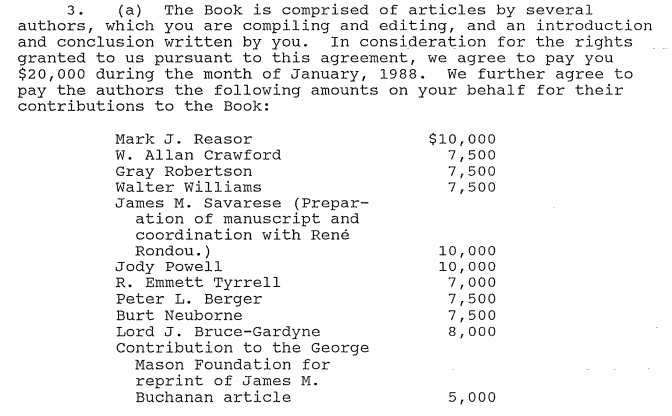
The Schaler and Schaler-book contains contributions from George J. Annas, Gary S. Becker, Peter L. Berger, Richard Daynard, Antony Flew, Peter D. Jacobson, Stanton Glantz, Robert E. Goodin, Joseph R. Gusfield, Stephen J. Heishman, Graham E. Kelder, David A. Kessler, Mark Edward Lender, Stephen C. Littlechild, Rajendra Persaud, Robert N. Procter, David Ryder, Robert J. Samuelson, John Slade, Edward L. Sweda Jr, Robert D. Tollison, Richard E. Wagner, Lee S. Weinberg, Walter E. Williams, and Richard Vatz.

Although some were not members of the social cost consultant network, those underlined were people who had worked as consultants for the tobacco industry, via direct evidence in the Tobacco Legacy Documents Library. It raises questions why and how the book was compiled.

Clearly, in the 1980's and 1990's, economists suddenly were very interested in tobacco ...

Sunday, 14 June 2020

The corrupted tobacco economists network Part 32 - Robert D. Tollison writes pro-tobaccco books (bis)

Overview of previous posts here

Robert D. Tollison writes pro-tobaccco books, part II

Clearing the air (1988)

Clearing the Air: Perspectives on Environmental Tobacco Smoke was presented as a book written by concerned scientists. It is the odd one out, as it was ordered by Philip Morris for their own unstated purposes, not the Tobacco Institute.

Andrew Whist, Senior Vice-president of Philip Morris, wrote this letter on January 7, 1988 to Robert Tollison


Of course Tollison was not an employee, he was an outside consultant. Technically, this makes a difference but at this point Tollison had already received a great deal of money from the Tobacco Institute.

Philip Morris supported the book by handing out some money (same letter)


Even though the book acknowledges it was supported by the industry, when interviewed on television Tollison and Wagner did not exactly mention their connections with the industry.

Video Tollison being interviewed: Video Wagner being interviewed:

Monday, 11 May 2020

The tobacco economists network - or how the Tobacco Institute recruited over 100 American economics professors. Part 6 of many

overview of previous posts here

An operational social cost strategy

While still researching the social cost issue, the industry already started planning how to implement the "counterattack". In 1983, the first communications plan emerged, in 1984 a full excise tax plan.

In 1983 a prelimanary draft communication plan emerged. It is an important step toward the industry setting up a secret network of economists. The industry wanted  
Several lobbying-programs were selected  like p.ex. a "youth program" . For this series blogseries following domain matters


The suggested tactics included:


(...)

The goal to recruit economists in every state may be a result of an idea launched in 1983 by Brown & Williamson

No matter where they got the idea, by 1984 the Tobacco Institute wanted to set up a network of economic consultants, shown by the first draft of their full-grown Cigarette Excise Tax Plan. It is 109 pages long and gives a brilliant insight on how the industry operated (titles aside, all emphasis are mine)

Again, the industry selected some domains


The tactics for the business coalition now mentions the economists network


(...)


 (...)


At the time, the budget was still moderate


Thus, at the time (1984) the industry already had the idea to use economists, but the industry was still headhunting. The last page of the Excise Plan is wondering who to hire


Ed Battison from his side was also headhunting, and his report of the 1984 workshop carries an addendum with potential witnesses
-   GLEN LOURY, economist, Northwestern U., belongs to the group, Council For A Black Economic Agenda
-   WALTER WILLIAMS, George Mason U., professor, Center for Study of Public Choice, I.R.E.T. board member, against excise taxes.
-   AMITAI ETZIONI, sociology professor, George Washington U., has written on Role of Self-Discipline; and Education For Mutuality & Civility (in Futurist, 1982); Government Of Laws— Congress Excepted, 1979; Social Science vs Government—Standoff at Policy Gap, 1978 He is likely to be for individual freedom of smokers--ask Fred Panzer.
-   ROBERT D. TOLLISON, economist, George Mason U., Center For Study of Public Choice, has written on tax reform, social costs of the cigarette excise. Disinterest In Deregulation in the American Economic Review, 1984; Economic Regulation, Competitive Government, Specialized Resources; Instead of Regulation--Alternatives to ...; Rent Seeking, A Survey; F.T.C. Since 1970--Economic Regulation & Bureaucratic Behavior, 1982; Rational Choice & The Taxation Of Sin-a Reply by Grain, Deaton, Holcombe, & Tollison in Jour.of Public Econ.,v.16,1981. He is an authority on the economic inefficiency of excise taxes by his study of their higher than expected social costs.
-   RICHARD E. WAGNER, economist Florida State TJ, has written two papers on the irrationality of earmarking cigarette & alcohol excise taxes for Medicare and Medicaid, one for the recent association seminar and one for the TI; among his several books and articles is a recent text on taxation; articles on Government Spending, Trends and Issues by Beck and Wagner in SEJ, 1982; and Wagner's Law, Fiscal Institutions, and Growth of Government in National Tax Journal, v.30, 1977; he would testify against earmarking excises for public medical programs.
-   D.R LEE, George Mason U., Rent-Seeking & Its Implication for Pollution Taxation in SEJ, v.51, 1984; the Economics of Enforcing Pollution Taxation in Journal of Envir. Sc. & Manag., v.11,1984; Tax Rate & Tax Revenues In Political Equilibrium, by Buchanan & Lee, 1982; he is similar in his views and expertise to Tollison who is a colleague, but he is more inclined to take the inefficiency argument only and is a specialist in pollution problems.
-   PETER BLAU, social psychologist, has testified in the 1970's and has written Behavioral Sociology Or Behavioral Sociology in the American Sociologist, 1981; he is apparently for freedom of choice. 
-   TERRY ANDERSON, economics professor at Montana State IK, has written Who Cares About Efficiency in Cato Journal, 1982; he has seen limited service in helping state issues xn WA state. 
-   P. L. BERGER, Boston U., sociologist, has written among other articles, Democracy For Everyone in Commentary, vol.76, 1983. He is apparently for freedom from individual social restrictions. 
-   TED STERLING, Simon Fraser U., has written extensively as a contrarian. Among these are: Filtering Information About Occupation, Smoking & Disease in Jour. of Chronic Disease, 1984; Does Smoking Kill Workers Or Working Kill Smokers?—mutual relationship among smoking, occupation, and respiratory disease in International Journal' of Health Services, vol.8, 1978; Smoking & Cancer in American Journal of Public Health, vol.66, 1976; Critical Reassessment of Evidence Bearing On Smoking As a Cause of Lung Cancer, American Journal of Public Health, vol. 65, 1975; Review Of Claim That Excess Morbidity & Disability Can Be Ascribed to Smoking (Rejoinder) in Journal of American Statistical Assoc., vol. 68, 1973.
Other persons have been identified, but at present, it is not known clearly what their positions on the issues or on testimony are.
Battison's document makes clear that the industry was searching amongst the people already holding views that suited the industry’s purposes, and this indeed would become key in setting up the network: directing people's biases towards the tobacco industry’s ends.

Robert Tollison eventually would become a key person in setting up the social cost consultants. Other future members of the network of economists already mentioned on these lists are Thomas Borcherding, Fred McChesney, James Heins, David Klingaman, Richard Wagner, Walter Williams, Terry Anderson, Dwight R. Lee and S. Charles Maurice.

Did the industry know these guys probably would be corrupt? Not very likely. They knew they were libertarians, and that's why they were selected.

Refining the social cost strategy

The 1984 Tobacco Institute's Excise Tax Plan became more concrete in the version of July 11, 1984. 

Even though it would only be in the 1990's that the tobacco industry launched a full scale attack on EPA, far beyond tobacco related topics, hoping the public would start to have a general mistrust in science, the seeds of this action plan are already in the document of 1984.


The document show the industry was willing to pay external partners to work on topics not relevant for the tobacco industry, as long as those external partners also engaged in activities beneficial for the industry.

(...)


The work of the economists is mentioned:


And

and

In other words, setting up the economists network was part of well-defined strategy. And the goal was not to produce academic material.
It is clear the industry did not contact just any economist though. It is equally clear the recruited economists knew they would be working with the Tobacco Institute as this was explicitly mentioned to them (the underlining is in the original 1987 memorandum)


The first network activities appear to date from 1985, or two years before the note above was written. Several LTDL documents suggest the tobacco industry had difficulties finding an economist in every state and it was only in 1987 that Savarese completed the lists. As the industry dumped economists (see further), throughout the existence of the network new economists were recruited