Showing posts with label Philip Morris. Show all posts

Saturday, 15 January 2022

The corrupted tobacco economist network Part 63 - National Center for Policy Analysis

Overview of previous posts here

The National Center for Policy Analysis was another think tank where the corrupted social cost economist could spread their word


The next battleground: Indoor air

Dwight R. Lee
 in 1992 wrote the NCPA report The next environmental battleground: Indoor Air, opposing any form of regulation of indoor-air quality (IAQ). The report is also one of the first examples of a social cost economist questioning EPA's objectivity and neutrality. 

On top, it is making outrageous claims like government regulations on IAQ would kill 1900 extra people a year [sic]. 

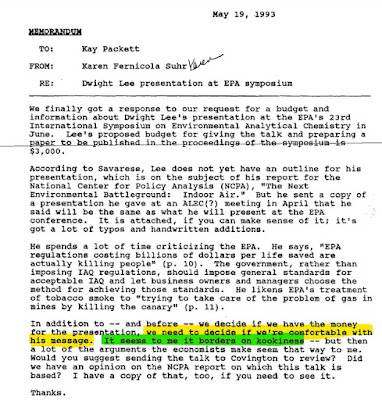
Lee proposed the Tobacco Institute to make a presentation of the report at the EPA's 23rd International Symposium on Environmental Analytical Chemistry. 

Tobacco Institute's Karen Fernicola Suhr wasn't sure what to think of the proposal as she Lee's claims were so ridiculous:


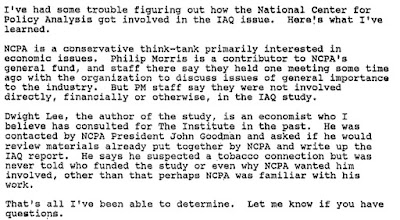
It wasn't the only weird thing about this report. The Tobacco Institute also was wondering why the NCPA cared about Indoor Air Quality at all


The Tobacco Institute in 1992 wasn't really sure why the think tank bothered to write on indoor quality. A 1993 letter sent by Tom Hockaday (of PR-firm APCO Worldwide) to Philip Morris hints the report actually was written on the command of APCO

S. Fred Singer, Dwight R. Lee

Nor Singer (a physicist), nor Lee (an economist) have any qualifications to judge indoor air-quality science.

Meanwhile, the program of the 23rd International Symposium on Environmental Analytical Chemistry shows Lee was one of the speakers, so despite the "cookiness", the Tobacco Institute probably paid him the $9.000 he asked for. Lee wrote an article after the presentation.

It's hard to decide  which my favorite sentence is in the article: "EPA is no better at central planning than the Soviets were" or "Each polluter is better informed than EPA authorities on how to reduce pollution at least cost and is certainly more motivated"

I do understand why Karen Fernicola Suhr staed the tobacco industry had to decide if it felt comfortable with his message. And Why she felt his message borders on kookiness.


Attacking all environmental sciences

But even beofre the 1992 report above,  the National Center for Policy Analysis was already attacking almost all environmental sciences, in the 1991 report Progressive environmentalism: a pro-human, pro-science, pro-free enterprise agenda for change. The head of the taskforce writing the report was Richard L. Stroup, another tobacco economist from the network.

The taskforce consisted of an interesting list of names, besides tobacco economists there are a lot of people listed who would get known as climate skeptics.

Network economists involved in the NCPA environmental task force were (besides Stroup) : Terry L. Anderson, Allen Dalton, Bruce Johnson and of course  Dwight R. Lee

Other tobacco consultants mentioned in this task force were Thomas J. DiLorenzo, Kent Jeffreys, S. Fred Singer and  James H. Miller. And a lot of people from other think tanks, like Joseph Bast (Heartland Institute), Fred L. Smith (Competitive Enterprise Institute), David J. Theroux (Independent Institute).

The reports attacks a wild array of environmental topics. The report might be an early example showing how libertarians started attacking all environmental sciences, not because they have much knowledge on the subject, but rather because it doesn't fit their worldview.

Tuesday, 30 March 2021

The corrupted tobacco economist network Part 57 - The Advancement of Sound Science Coalition

Overview of previous posts here

The Advancement of Sound Science Coalition (now called the Advancement of Sound Science Center

Early 1993, EPA released the report Respiratory Health Effects of Passive Smoking:Lung Cancer and Other Disorders that was close to a final blow on the ETS issue.  EPA concluded that second hand smoking beyond any scientific doubt indeed was harmful, as had long been suspected.

The tobacco industry knew it was in trouble and launched a full scale counterattack against EPA, especially using the strategy of  manufacturing "scientific doubt". It seems from that point the ‘social cost’ strategy became less important as the EPA report demanded the industry's full attention.

But the industry still needed allies and seemed to have followed two main roads: searching for allies to cast doubt on any environmental subject (asbestos, pesticides, greenhouse gasses, etc.). But on the other hand, to really be able to create a broad coalition, the industry needed to translate the industrial message into something grassroots organizations would pick up. And here, the ‘freedom’ message proved to be key to finding free-market allies. The libertarian tobacco-economists were useful to spread this message. 

To understand how the industry concluded that the best defense was to attack everything EPA does, we have to look at the work of Philip Morris' PR-firm APCO-Associates, which advised the industry to set up


PR-firm APCO created the astroturf organization The Advancement of Sound Science Coalition (TASSC) in 1993 because

But unlike with lobbygroups like the Center for Indoor Air Research, the tobacco industry this time had a bigger plan, as seen in a memorandum probably written by Philip Morris. 


The same document already hinted at the shape of the industry’s ETS-strategy to come


As the industry realized it could not defeat EPA alone, the goals were to


and to

This is taking the lobbying to a new level, and this is where the cunning plan of Tim Hyde fits the bigger picture: the lobbying was no longer focusing on tobacco and its consequences, the lobbying was about creating a new political reality.

One part of the strategy still sounded familiar, as it was about creating scientific doubt

TASSC was no longer an astroturf organization attacking only tobacco issues, the industry wanted a full scale attack, and was thinking about issues like


In 1994 Philip Morris wrote

And Philip Morris director Matt Winokur stated


The plan to built a broad coalition of businesses attacking EPA was a success and APCO reported

To avoid detection, TASSC had to look like a grassroots organization, even though it is clear TASSC never was more than a lobby-tool as can be read in the proposed plan for the public launch of TASSC:


As with the previous economists networks, there would be media training

The training included teaching the spokespeople of PM to answer questions like


The roots of organized denial of global warming would get started in the same circles, and by the same people, as the circles the tobacco industry used. TASSC and the same think tanks working on tobacco, would be the place where fossil fuel companies found a tool, the people (libertarians) and a strategy to attack climate science. And this is why someone running a climate blog has taken a close look at the tobacco strategy.

TASSC was funded by Philip Morris but it also involved companies like Exxon and recruited people who were global warming deniers like S. Fred Singer and Patrick Michaels, in addition to tobacco consultants such as Thomas L. Wyrick and Richard L. Stroup (both in 2015 were members off the Heartland Institute, a think tank denying the health effects of tobacco and man-made global warming).

Using the 'junk science’ label to discredit scientific work was adopted by the tobacco economists, as in an op-ed by Clifford Dobitz from 1998 titled Junk science taints EPA's smoke claims The same Year Robert L. Sexton wrote Did EPA use junk science ? The use of this language is no coïncidence but the result of a group effort.

It was by mingling of 'freedom' with tobacco (and asbestos, greenhouse gasses, etc.), the industry ultimately was able to create a message that indeed found its way into libertarian groups. And through these groups, the doubt and freedom message would become an important political factor in American politics, because the think tank network is huge, extending to many other people, foundations, companies and universities. 

Thursday, 31 December 2020

The corrupted tobacco economist network Part 56 - Philip Morris broadens the attack

Overview of previous posts here

In 1991, even before the EPA report stating second hand smoking kills, Philip Morris circulated a list of scientists the industry thought would be willing to attack EPA. 

It's no longer about tobacco alone The list is 45 members long and it shows how the industry recruited their 'contrarians': the industry carefully looked for any person, sane or not, contesting the current status of scientific knowledge.


(...)

and one of the more active members in the tobacco economists network with one of his well known unnuanced views:

Dwight R. Lee

Dwight Lee Says giving the EPA authority over indoor air "would be like giving a machine gun to a child" is not regarded by the industry as an utterly bonkers viewpoint, but as an actual possibility: the document showed PM was looking for any contrarians and/or extremists who might be useful to implement the tobacco industry's attack on EPA. Sane or not. 

(do notice the list also mentions well known early climate pseudoskeptics S. Fred Singer and Patrick Michaels). 

Tuesday, 1 September 2020

The corrupted tobacco economist network Part 51. Robert D. Tollison working for Philip Morris

Overview of previous posts here

Tollison working for Philip Morris

In 1988 Tollison wrote the book Clearing the Air for Philip Morris. How he was recruited has not been discovered.

On top of that, in 1994 Tollison also started testifying for Philip Morris (WRO = Washington Relations Office)
Robert D. Tollison

In 1997, Tollison agreed to write a rebuttal to a study on the economic effects of a smoking ban in Hungary

All this on top of his work for the Tobacco Institute, British American Tobacco, other industries, and of course his regular job.

Sunday, 23 August 2020

The corrupted tobacco economist network Part 49. Or the one with a secret network of lawyers. Different people, same dishonesty.

Overview of previous posts here

Lawyers network

As mentioned in the first chapters, the 1984 social cost excise plan did not just aim for an economist in every state, the tobacco industry also wanted to set up a network of lawyers.

In 1986, James Savarese sent Fred Panzer of the Tobacco Institute a very interesting letter

Savarese was paid $11,400 to set up the network and from Savarese's billing, we know the reason the network was created


The members can be found in the appendix (to be published at the end of the blogseries).

Savarese's wrote small remarks next to some of their names,illustrating the layers werevery well aware why they were recruited
  • Anthony Wiener - Tony will be out of the country during August. He was very enthusiastic about the free speech arguments. Harvard J.D., with strong economic emphasis in his teaching and research.
  • George M. Sullivan - George would like to see a legal brief on the subject he is arguing.
  • William Mitchell  - Bill will be in Washington in late August for the American Political Science Association meetings. He would like to go to lunch with us on August 28. I did not make any commitments. 
  • John Bagby - John is a business law professor at Penn State, which is about halfway between Pittsburg and Philadelphia.
  • Professor J[ames].R. Kearl - Jim is Mormon, so he has a problem with most Tobacco Institute issues; however, he says he would probably be comfortable with a 1st Amendment op-ed on the advertising ban.
Savarese charged $3.000 for producing 3 op-eds on the topic of ad bans. With titles like "The censorship nightmare" and "Freedom of speech" should just mean that there should be little doubt the lawyers were libertarians too.

Savarese reported and proves again the industry was rewriting the so-called work of 'independent' academics.


Another document shows Savarese seemed to be less in touch with the lawyers than the economists, a message such as this seems unlikely in the economists network


It may be the use of layers was a one time thing. Neither Google nor the LTDL reveal much more activity than listed here. Whatever happened to the network, in 1989 Savarese forwarded to the Tobacco Institute the letters sent by the lawyers to their local congressman.

We know Marshall A. Leaffer sent a letter to Senator John Glen, probably including his op-ed on a possible tobacco advertisement ban


Philip Morris Network
Another document in the LTDL hints there must have been several networks, not just the one's ran by the Tobacco Institute.

The documents carries the remark "not on Philip Morris List", suggesting there may have existed similar networks to the network described in this paper. This has not been explored.

Saturday, 22 August 2020

The corrupted tobacco economist network, Part 47 - Post 1998 tobacco output

Overview of previous posts here

Post 1998 output and Richard Wagner's zealotry

Not all economists disappear from the files completely after 1998, but as a part of the Tobacco Master Settlement Agreement the Tobacco Institute was dismantled. Some economists must have started working for the other tobacco companies.

In 2000, R. Morris Coats provided testimony similar to that the network had provided. Coats by that time already was working for Philip Morris. At least Coats acknowledged this in his curriculum vitae (no longer online, Coats deceased in 2015), while most of the economists don't mention their work for the tobacco industry. Remarkably Coats' c.v. also notes that his paper A Note on Estimating Cross-Border Effects of State Cigarette Taxes was "Used in testimony before legislatures in New York, West Virginia and Louisiana--based on phone conversations with Tobacco Institute"

William F. Shughart II kept writing op-eds until at least 2010.


An incomplete list of publications written after the Tobacco Master Settlement Agreement include:
  • Sexton R. (1999): Political Science and Secondhand Smoke, Investor's Business Daily (Feb . 2, 1999)
  • Ault, R. Ekelund, R. B., Jackson, J., Saba, R. (2004) : Smokeless tobacco, smoking cessation and harm reduction: an economic analysis, Applied Economics
  • Ault, R. W., Beard, T., Jackson, J., Saba, R. (2005) : On the (mis)use of cross-price effects to gauge the effectiveness of smokeless tobacco in smoking cessation, The European Journal of Health Economics 34 (November 2006), pp. 712–730
  • Lucassen, R. A., Coats, R. M., Karahan, G. (2005) : Cigarette smuggling mitigates the public health benefits of cigarette taxes. Applied Economics Letters, Taylor and Francis Journals, vol. 12(12)
  • Ault, R. W., Jackson, J. D., Saba, R., Ekelund, R. B. (2006) : Smoking cessation, weight gain, and nicotine substitutes : the economics of reducing harm. The southern business & economic journal Vol. 29.2006, 3/4, p. 34-49
  • Brown, B. A., Rucker, R. R., Thurman, W. N. (2007) : The End of the Federal Tobacco Program: Economic Impacts of the Deregulation of U.S. Tobacco Production. Review of Agricultural Economics, Winter 2007, 29(4): 635-655. http://www.jstor.org/stable/i412804
  • Shughart W. F. (2010) : Tobacco Settlements, in Roger Chapman (ed.), Culture Wars: An Encyclopedia of Issues, Voices, and Viewpoints, vol. 2, Armonk, NY and London: ME Sharpe, 2010
Richard A Wagner's output

Richard E. Wagner provided the most post-1998 output. In 1999 he wrote the article The State as a Partisan Plaintiff: Reflection on the Tobacco Settlement. He also wrote The Tobacco Settlement, as Refracted through the Economics of Litigation, which seems to have been the draft version

A rewritten (?) version of The State as a Partisan Plaintiff: Reflection on the Tobacco Settlement was published in 2000 by the Public Interest Institute (no longer online). It is an example of his extreme viewpoints:
What is a defendant to do when confronted with a subsidized political plaintiff driven by partisan interests and ideological zealotry? The defendant faces an adversary that calculates differently than commercial plaintiffs. A private plaintiff might think in terms of possible excess medical costs imposed by smokers. For a political plaintiff, however, those claims are secondary, a smoke screen to provide cover as it were, for the pursuit of an ideology animated by a vision of a smoke-free America. For the ideological plaintiff, the desired objective is not to offset some (non-existent) drain on state treasuries attributed to smokers, but rather is to degrade the commercial value of tobacco companies. 
One might reasonably wonder why the tobacco companies might have capitulated when the claims lodged against them were so patently false. A man sitting on an iceberg in the North Atlantic as it floats south will recognize his ultimate fate, and yet be thankful when clouds obscure the sun. It is perhaps similar with the tobacco companies. The famous "problem of the gambler’s ruin" from probability theory tells us that in a fair game of chance, the player with the smaller fortune will eventually be ruined by the player with the larger fortune. In ordinary games, of course, play is voluntary, and either party can terminate the play at will. But the state can command participation, and it can exhaust the fortune of anyone against whom it plays. A wise person would not continuously play a fair game of chance against a much wealthier adversary, and similarly would not want to play continuously against a zealous, interest-driven political plaintiff. Settlement is perhaps like that welcome cloud in the North Atlantic. It brings respite to a weary soul, but it does not give peace of mind. 
The general theme illustrated by the tobacco settlement is the danger of being on the opposite side of the partisan use of state power to advance a private interest agenda at public expense. Eternal vigilance is the price of liberty, as Patrick Henry noted. And the state is potentially the biggest threat of all. We may well fault the tobacco companies for capitulating against the onslaught of state power. For if everyone did, this liberty would perish. Yet the state as a partisan plaintiff can pursue a strategy of divide-and-conquer against its potential defendants, which may render some such capitulation understandable, even if it can never render it admirable.

In 2004, Wagner wrote Meddlesome Preferences and Rent Extraction: The Tobacco Shakedown, continuing the same themes as above. In 2005, he wrote State Excise Taxation:Horse-and-Buggy Taxes In an Electronic Age, both still attacking excise taxes.


There is no evidence to know if the tobacco industry was still paying Wagner to write these articles, or they were merely expressing his worldview.

Even though he's 79 years old, Richard E. Wagner still is working at George Mason University

Sunday, 14 June 2020

The corrupted tobacco economists network Part 32 - Robert D. Tollison writes pro-tobaccco books (bis)

Overview of previous posts here

Robert D. Tollison writes pro-tobaccco books, part II

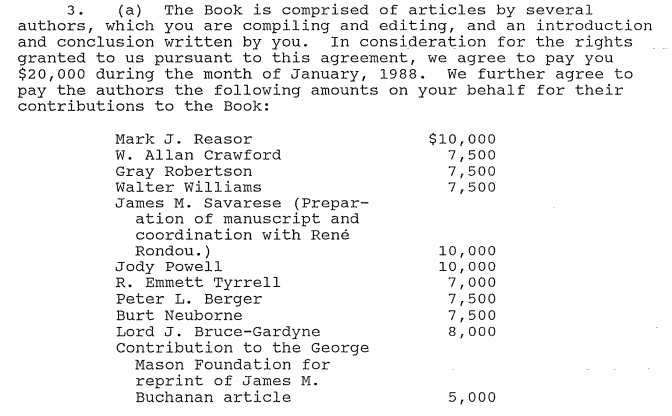
Clearing the air (1988)

Clearing the Air: Perspectives on Environmental Tobacco Smoke was presented as a book written by concerned scientists. It is the odd one out, as it was ordered by Philip Morris for their own unstated purposes, not the Tobacco Institute.

Andrew Whist, Senior Vice-president of Philip Morris, wrote this letter on January 7, 1988 to Robert Tollison


Of course Tollison was not an employee, he was an outside consultant. Technically, this makes a difference but at this point Tollison had already received a great deal of money from the Tobacco Institute.

Philip Morris supported the book by handing out some money (same letter)


Even though the book acknowledges it was supported by the industry, when interviewed on television Tollison and Wagner did not exactly mention their connections with the industry.

Video Tollison being interviewed: Video Wagner being interviewed:

Sunday, 3 May 2020

The tobacco economists network - or how the Tobacco Institute recruited over 100 American economics professors. Part 4 of many

Overview of the previous chapters here

The path to the social cost strategy

Ultimately, the goal of the research done by the consultants was to provide ammunition for the tobacco industry facing the social cost issue.

This 1979 memorandum by Ernest Pepples (vice-president of Brown & Williamson)  shows the tobacco industry realised something important
Instead of trying to argue that it is not 90,000 hospital beds which are attributable to cigarettes but only some figure less than 90,000, the better attack is to take the adversary onto higher conceptual ground. It is also important, of course, to identify and critique the errors of the attacking papers and do a solid professional job of exposing the flaws in them.
Even if the tobacco industry would be able to prove science was wrong and smoking 'only' results in 40.000 hospital beds instead of 90.000, it would still imply the industry admitting smoking is harmfull,. This still would be a marketing disaster.

The industry realized this would be a dead end. A different strategy was needed, one that couldn't backfire. 

In 1984, the industry implemented the lobbying strategy it had developed on social cost. But this attack did not appear out of nowhere, and the Tobacco Institute had been working on the subject since at least 1979, the time of the Berman memo. Before launching the lobbying strategy the industry wanted to know which aspects of the broad domain of social cost could be attacked.

The first research on social cost consisted of :
1.     identifying key issues that could move public opinion on the social acceptability and social costs of smoking,
2.     testing possible countermeasures that could alter public opinion in favor of the industry
3.     exploring the feasibility of creating an intensive, long-term, industry-wide effort to improve public opinion and tolerance of smoking


In order to identify key issues suitable for lobbying, the industry hired several consultants, the 1979-memo from above also mentions the head consultants at the time: 
It shows the industry was investigating different scientific fields related to social cost, and had several other scientific fileds in mind like actuarila science, statistics, social psychology, ...

Most of the consultants are known for their strong libertarian viewpoints. It will become clear this is no coincidence.

Tobacco consultant George R. Berman (Philip Morris) wrote a long text in September 1979 explaining why the industry sponsored work in such a variety of scientific domains
When this research is completed we will have a foundation for dealing with the social cost issue. We will have attacked its economic reasoning. We will have looked at the dark side of its philosophy, and related that philosophy to the larger motives of the anti-smoking leadership. We will have explored the social benefits of smoking, and the social costs of smoking restrictions. Hopefully, we will be able to stop this attack before it stops us.

Berman proposed an attack using four themes
  1. These social cost concepts are bad economics
  2. They do not fit into a philosophy of personal freedom and civil liberty
  3. Smoking benefits society and its members in many complex ways
  4. Anti-smoking programs and groups are harmful to our society
  5. Thus, our project is concerned with both social costs and social values.
Interestingly the four points listed by Berman show he did not simply want an attack on social cost science. There is also a part showing the industry wanted to lobby by focusing on people's 'social values', for example by telling people: 'it is YOUR choice to smoke, and the government should not interfere with your freedom of choice'.
Of course, the industry was well aware smoking :
1) through ETS also affects others, so smoking is not just a matter of personal liberties
2) is not necessarily a personal choice, but is influenced by a cultural factors. Even though we might think we are fully rational individuals and we are the only ones making our decisions, this simply is not true. Our 'free will' is not as free as we want to believe. It has been well documented people's surroundings have an influence on whether someone will start to smoke or not.

While it is possible -at least to some extent- to objectify and measure 'freedom' (it is possible to measure in which countries it is possible to walk on the street wearing a t-shirt with a political slogan, without being jailed), it is also possible to turn 'freedom' into a value-loaded moral component. By using arguments like: 'they are not attacking tobacco, but anti-smoke regulations are oppressing people' or even on a personal level: 'they are not attacking cigarettes, but they are attacking YOU, as a person', these arguments aim for people's underbelly, and that's exactly the subjective emotional part of the message the industry wanted to exploit. Feeding a person's bias is always useful to manipulate them in the desired direction.

Genuine scientific output was not a goal of the tobacco industry's research. As George Berman made clear in 1979, the research had no other purpose than to provide material for lobbying:
The economists working on this project are first developing a "layman's guide" to social cost/benefit analysis. The attacks against us claim to use economics to justify further action. The Layman's guide will address three key questions.

This passage makes clear the research should result in ‘easy’ arguments the industry could use when talking with, for example, legislators. Several LTDL documents show the industry complained the output of the economic consultants was too technical and therefore not suited to translate into popular arguments. This does not mean the industry did not want the research to have a 'scientific' side, because it also was beneficial for the industry to have reports with academic credibility proclaiming that the idea of using social cost was flawed. This is explained in the anonymous document from 1980 titled Goals of the social costs/social values project. The final goal though always was to use the 'science' as a ground for lobbying.
The objective of these two projects [the first social costs reports] is to generate papers relevant to the social cost of smoking which can then be used as references in direct confrontation with the issue. Through a sequence of steps, the favorable conclusions of these papers can be infused into professional journals and then into the popular press.

The 'scientific' output also had the advantage it could be used to attract more scientists, and indeed the economists later on would appear at conferences (this will be illustrated in another chapter), trying to convince their peers that using social costs is flawed. Indeed, googling shows that other academics started quoting the work of the tobacco economists in genuine academic papers.

Berman gives some examples of what the industry wanted as output from the economists. The economists should deny the mere existence of a tobacco related social costs, e.g. by denying medical expenses due to smoking are actually social costs. Berman wrote (emphasis added):
There may be a few cases where smoking creates uncompensated costs for non-smokers. But the economists are quite certain that most of the alleged medical expenses do not qualify as social costs. And the much larger charges of absenteeism and lost productivity are not social costs at all.
Berman concluded
It can be shown that my absence from work does not cost you anything
Berman does not deny smoking will lead to higher absenteeism.

Berman is drawing the 'personal freedom' card here, but his argument is nonsense: absence from work does affect others, including the employers of the smoker. Their employees’ absence means they are less productive, or exactly the thing making the employer money. Moreover, fellow employees who must cover for the smoker are not be able to do their own work.

Berman's text also explains why the Tobacco Institute consulted the philosopher Robert Nozick
Unfortunately, the use of social economics is often a disguise for expressing a particular political philosophy. Thus, if a worker is absent because of illness allegedly related to smoking, there is said to be a social cost. But no one seems to consider skiing accidents as a social cost, and certainly not the time spent on holiday. So whether absenteeism is a social cost seems to depend on how you feel about the cause! This is an area of philosophy, where we need to look at what people have a right to do to themselves and to each other

(...)

The philosopher looks at some subjects which are important, but very difficult for the economist to deal with. For example, there is a value to having a government which does not interfere with personal behavior and freedom of choice . If such restrictions are being considered, for "social cost" reasons, the loss of these freedoms must be counted as part of the cost of the government policy
Again, Berman takes some illogical steps, like
Lost working time is a social cost only if my labor belongs to the state. Then, of course, society has a right to protect its property, without much regard for what that "property" would prefer.
Lost working time affects private market employers. If all employees are on sick leave, not much profit will be made. Smoking related illnesses affect the sick person’s family. The illness could mean that the smoker's partner must rearrange schedules to pick up the kids from school, possibly causing employment problems or other emotional stress. The smoker’s illness has a social cost. Berman's logic is deeply flawed.

Nevertheless, Berman tries to play the card of personal freedom
But if I am restricted from smoking because it bothers someone else, I have lost my benefits, that is, a cost has been placed on me . Don't those who benefit from this restriction owe me compensation for my lost benefits? Or do anti-smokers have exclusive ownership of the air rights in a public place? As another philosopher put the matter recently, there is a limit to the extent we are mortgaged to one another.

Here we come to one of the libertarian ideology's core points: freedom, freedom, freedom. No, it is not a coincidence the tobacco industry hired a libertarian philosopher.
If social cost/benefit analysis itself implies a concern for people, the issue comes down to a quote from dr. Nozick's book on libertarian philosophy :

Why not interfere with someone else's shaping of his own life? Because anyone might come up with the pattern of life you wish to adopt. Therefore, it is in your own self-interest to allow another to pursue his conception of life as he sees it. You may learn from his example.
As mentioned above, tobacco does not affect only the smoker. Berman had poor reasoning skills, or the industry was aware that in the search for allies, they should try to feed libertarians the things they wanted to hear.

The use of a cultural anthropologist also is explained by Berman:
Sherwin Feinhandler is a cultural anthropologist who has examined reports on the social role of smoking in over 180 different cultures. As a result of these studies, he is convinced that smoking provides certain universal benefits, although they may appear in different forms from time to time and in different societies. Dr. Feinhandler's basic position is that smoking enables people to function better in society, reduces social frictions. He also believes that many anti-smoking programs and restrictions increase social tension.

With the help of the work done by the consultants, the Tobacco Institute was prepared to develop a lobbying strategy. Berman suggested six counter measurements (they would be altered in the final strategy from 1984). Berman concludes
If we use these countermeasures wisely, we can sharply reduce, or eliminate, social cost as an issue in the social acceptability of smoking
It is clear the industry simply researched the social cost issue to be able to create an instrument for lobbying. When the research of their consultants was finished, the next step for the industry was to decide which research could be used in its lobbying-strategy.