Showing posts with label Tobacco Institute. Show all posts

Saturday, 18 December 2021

The corrupted tobacco economist network Part 60 - Alexis de Tocqueville Institution

Overview of previous posts here

The previous blogpost mentioned in 1994 the Independent Institute authored the open letter against the Clinton Health Reform Plan. But the Independent Institute was not the only think tank aiming to work with the tobacco industry. 

The Alexis de Tocqueville Institution invited itself to the industry in this letter to Philip Morris. Was AdTI at this point no pro-tobacco ? Probably not, the letter illustrates it all started with a remarkably one-sided and bit silly opposition against the tax-increase in the health reform plan. Thos one-sided viewpoint ultimately would become disastrous for the think tank. 

Tim Lambert wrote a blogpost in 2004 (The Astroturf de Tocqueville Institute) showing the AdTI indeed started working with the tobacco industry in the 1990's.


The S. Fred Singer report

In 1994, late S. Fred Singer, best remembered as climate pseudo-skeptic, authored the Alexis de Tocqueville Institution report Science, Economics, and Environmental Policy: A Critical Examination. This report probably was ordered by the tobacco industry.

Early 1994, Cesar Conda, then president of the Alexis de Tocqueville Institution, had not decided yet who would author the paper (is not it lovely they already know what the report would conclude, without even knowing who would be the author?). Het wrote this remarkable letter: 


Cesar Conda Alexis de Tocqueville Institution


The letter summarizes the corruption of this think tank: fake report, fake endorsements, wide press circulation. And all that for just $20.000


The letter also shows the focus was no longer only to attack regulations on tobacco, other environmental subjects would be thrown under the bus too. And indeed, it is in the pool of different American extremist conservative industry funded think tanks that organized global warming denial would finds its roots.

The letter summarizes the corruption of this think tank: fake report, fake endorsements, wide press circulation. And all that for just $20.000

A while later, Conda wrote another amazing letter


Clearly: this report was as corrupted as a report can be.

The report contains the following passage:

Robert D. Tollison

No, the report does not mention Tollison's connections with the tobacco industry, nor the fact the industry indeed paid the AdTI the $20.000 for the report
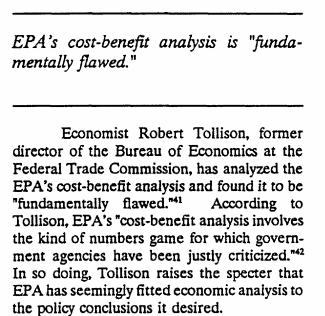
No, the report does not mention Tollison's connections with the tobacco industry, nor the fact the industry indeed paid the AdTI the$20.000 for the report. All in all, it's not even that much money and from the industry's point of view, this must have been a bargain to corrupt a think tank for an amount of money lower than an add campaign in a newspaper

In the draft version S. Fred Singer was named the first author and Kent Jeffreys the second author. It is unclear why Singer is listed as the reviewer (and not author) in the final report and why suddely Jeffreys "authored" the report.


The industry wanted to use the report for lobbying, that much is certain

Alexis de Tocqueville Institution


The report had the desired result. Samuel Chilcote, president of the Tobacco Institute reported
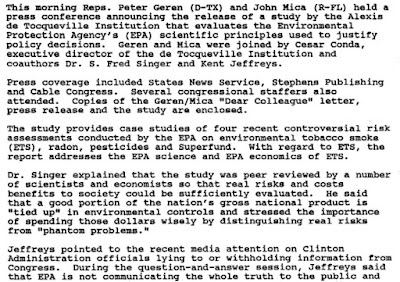
S. Fred Singer

Who those "peer reviewers" were is a mystery, but probably the 1994 advisory board of the AdTI gives a clue: with Gary M. Anderson, Jeffrey R. Clark, Robert B. Ekelund, Dwight R. Lee, Mark Thornton, Robert D. Tollison, Richard K. Vedder and Richard E. Wagner, eight of the nineteen board members were members of the economists' network. Probably they were the not so critical reviewers of the report.

In 1995 the AdTI published another excise tax report, this time not by the economists though, but by John E. Berthoud, president of the National Tax Payers Union.

In 1998, the AdTI's draft report Tobacco Smuggling: A Worldwide Phenomenon was sent to the tobacco industry.

This is not the work of an independent think tank.

Sunday, 27 December 2020

The corrupted tobacco economist network Part 55 - The final turn in astroturfing

 Overview of previous posts here

The tobacco industry had a long history of setting up astroturf organizations. But something would change in the way the industry astroturfed: the focus shifted from attacking the EPA on its tobacco viewpoints, to attacking everything the EPA did, hoping to create general mistrust against anything the EPA and "the government" concluded on any imaginable environmental problem. Let's first have a look at the 'old style' astroturfing.

Center for indoor air research

Founded in 1988, the Center for Indoor Air Research (CIAR) was a fake organisation set up by the tobacco industry  as illustrated by the minutes of a meeting held by the Executives of the Tobacco Institute


CIAR was dismantled as part of the Tobacco master settlement agreement (1988).


The industry used CIAR as a tool to hide the involvement of the tobacco industry, so the industry would be able to create a bigger network. John P. Rupp of PR-firm Covington and Burling wrote


The industry palyed it clever and never tried to alter the research results of the grantees. Nevertheless, it was clear the research results had to benefit the tobacco industry: 


The important thing to remember is that at the time the industry was working on one single issue, in this case ETS. This was the problem for groups like CIAR, as this one-sided approach easily led to the conclusion CIAR was a tobacco funded initiative. It made it difficult for the tobacco industry to find allies.

Therefore, the industry searched for better ways to lobby. Next post will explore the total switch in mindset occuring in the early 1990's. 

Sunday, 23 August 2020

The corrupted tobacco economist network Part 49. Or the one with a secret network of lawyers. Different people, same dishonesty.

Overview of previous posts here

Lawyers network

As mentioned in the first chapters, the 1984 social cost excise plan did not just aim for an economist in every state, the tobacco industry also wanted to set up a network of lawyers.

In 1986, James Savarese sent Fred Panzer of the Tobacco Institute a very interesting letter

Savarese was paid $11,400 to set up the network and from Savarese's billing, we know the reason the network was created


The members can be found in the appendix (to be published at the end of the blogseries).

Savarese's wrote small remarks next to some of their names,illustrating the layers werevery well aware why they were recruited
  • Anthony Wiener - Tony will be out of the country during August. He was very enthusiastic about the free speech arguments. Harvard J.D., with strong economic emphasis in his teaching and research.
  • George M. Sullivan - George would like to see a legal brief on the subject he is arguing.
  • William Mitchell  - Bill will be in Washington in late August for the American Political Science Association meetings. He would like to go to lunch with us on August 28. I did not make any commitments. 
  • John Bagby - John is a business law professor at Penn State, which is about halfway between Pittsburg and Philadelphia.
  • Professor J[ames].R. Kearl - Jim is Mormon, so he has a problem with most Tobacco Institute issues; however, he says he would probably be comfortable with a 1st Amendment op-ed on the advertising ban.
Savarese charged $3.000 for producing 3 op-eds on the topic of ad bans. With titles like "The censorship nightmare" and "Freedom of speech" should just mean that there should be little doubt the lawyers were libertarians too.

Savarese reported and proves again the industry was rewriting the so-called work of 'independent' academics.


Another document shows Savarese seemed to be less in touch with the lawyers than the economists, a message such as this seems unlikely in the economists network


It may be the use of layers was a one time thing. Neither Google nor the LTDL reveal much more activity than listed here. Whatever happened to the network, in 1989 Savarese forwarded to the Tobacco Institute the letters sent by the lawyers to their local congressman.

We know Marshall A. Leaffer sent a letter to Senator John Glen, probably including his op-ed on a possible tobacco advertisement ban


Philip Morris Network
Another document in the LTDL hints there must have been several networks, not just the one's ran by the Tobacco Institute.

The documents carries the remark "not on Philip Morris List", suggesting there may have existed similar networks to the network described in this paper. This has not been explored.

Friday, 14 August 2020

The corrupted tobacco economist network, Part 44: another example where the 'independent academics' allow the Tobacco Institute to alter the draft versions of their work.


Overview of previous posts here

Office of technology assessment on the costs of smoking: wrong again

In 1993 professors Robert Tollison and Richard Wagner wrote the paper The Office of Technology Assessment on the Costs of Smoking: Wrong Again. It was published by George Mason University's Center for Study of Public Choice. Once again, this was not an independent scientific publication. Tobacco Institute's Calvin George wrote


Everything Tollison and Wagner wrote had to be cleared by the Tobacco Institute's lawyers:


The LTDL shows indeed corrections were made by the industry.

 And yes, these changes do appear in Tollison's final draft


Friday, 19 June 2020

Corrupted tobacco economists network, Part 34: promo-tours all over the USA

Overview of previous posts here

Promo-tours all over the USA

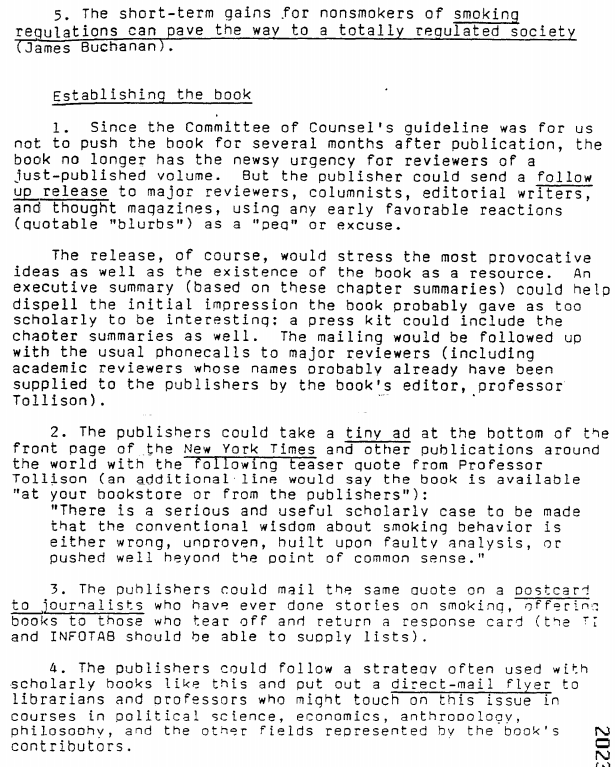
The Ogilvy and Mather promotion plan from previous blogpost effectively was executed and Robert D. Tollison and Richard E. Wagner started making media trips to promote Smoking and the State: Social costs, rent seeking, and public policy, just as the strategy dictated.

In 1992, the industry planned a new media tour to promote the book The Economics of Smoking. The document looks back on the 1988/1989 media tour

Assuming the economists earned at least $3,000 per tour stop (see appendix, to be published at the end of the blogseries), the authors must have earned well over $100,000 (on top of the $20,000 for writing the book).

PR-firm Ogilvy and Mather helped Tollison, giving him advice on how to communicate with the press
As always, the industry was evaluating the economists
The media tour results pleased the industry as the authors spoke with lots of media. 

In 1995, Tollison and Wagner participated in another media tour, though it is not clear from the LTDL which book they presented. The Economics of Smoking dates from 1992, so there may be a missing publication.  It is not clear also why Tollison and Wagner received more media training from PR-firm Fleishman-Hillard in 1991

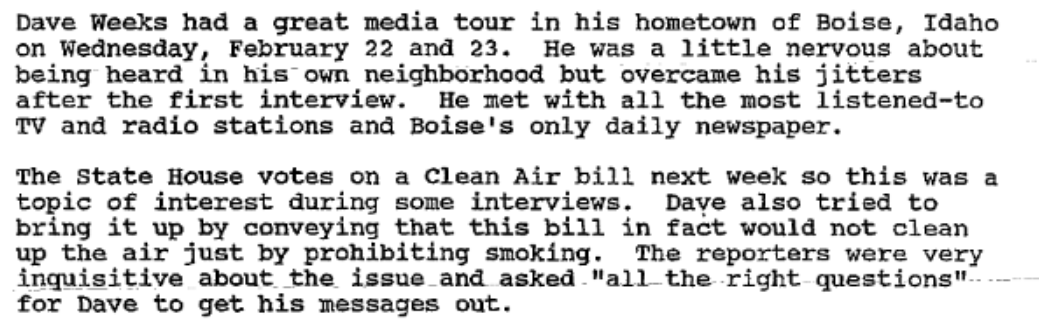
The LTDL has some examples of the interviews, showing Tollison’s one sided argumentation


Wednesday, 17 June 2020

Corrupted tobacco economists network, Part 33: Robert D. Tollison writes more tobacco books


Overview of previous posts here

Robert D. Tollison writes pro-tobaccco books, part III

Smoking and the state (1988)

The executive summary for this book was written by the Public Relations firm Ogilvy and Mather, but the Tobacco Institute did not like their work and rewrote the piece

The book had a clear purpose

Promoting smoking and the state

PR-firm Ogilvy and Mather designed the campaign to promote Tollison's and Wagner's book Smoking and the State: Social costs, rent seeking, and public policy


Tollison and Wagner agreed on the program presented by Ogilvy and Mather


The tobacco industry always tried to hide that it was lobbying with the aid of 'independent' academics. The scientists in the ‘Social Cost’ category usually were strictly separated from the ‘truth squads’ and the witnesses in these programs never appeared at the same place at the same time. This way, the industry wanted to create the illusion that different categories of scientists in non-related fields opposed the government's tobacco-regulations.


Reality was different: both the ‘tax’ and ‘truth squad’ academics took part in media tours set up by the industry. Ogilvy and Mather organized both tours, in one controlled operation and often mentioned both media-tours in one and the same memorandum, e.g. the memorandum written February 15, 1989


Similar notes were written on (small selection): February 1, 1989, on April 11, 1989, on August 17, 1989, etc.

There's one exception to this rule of separating thruth squad and the economists: when the American Medical Association held a meeting and the industry only became aware of this conference one month in advance. Probably because of a time constraint Tollison and David Weeks were touring at the same place and time.

Just as with legislative testimony, the Tobacco Institute did follow up how the scientists coped with their lobbying:


Saturday, 13 June 2020

How the Tobacco Institute recruited over 100 American economics professors. Part 31 - Robert D. Tollison writes pro-tobacco books

Overview of previous posts here

Robert Tollison writes several books

The Tobacco Institute did not just want the economists to produce op-eds, the industry wanted the attack on excise taxes to have some, even only superficial, 'real' academic credibility. One of the early tactics of the tobacco industry was to publish the book "Smoking and Society", but this was not the only book Robert D. Tollison wrote/edited on the topic:
  • 1986 Robert D. Tollison (ed), Smoking and society: toward a more balanced assessment, Lexington Books, Lexington, Massachussetts
  • 1988 Robert D. Tollison (ed), Clearing the air: perspectives on environmental tobacco smoke, Lexington Books, Lexington, Massachussetts
  • 1988 Robert D. Tollison, Richard E. Wagner, Smoking and the state: social costs, rent seeking, and public policy, Lexington Books, Lexington, Massachussetts
  • 1989 Richard E. Wagner and Robert Tollison, Charging Beneficiaries for Public Services: User Charges and Earmarked Taxes in Principle and Practice
  • 1991 Robert D. Tollison, Richard E. Wagner; The Economics of Smoking, Kluwer Academic Publishers, Dordrecht

Smoking and society (1986)

This passage in the 1983 Presentation on social costs/social values to INFOTAB board of directors meeting October 31, is interesting as it provides an overview of the research done by the industry in the period 1979-1984

(...)

(...)


The documents leaves no doubt Tollison's 1985 book "Smoking and Society: Toward a More Balanced Assessment" was ordered by the tobacco industry. The preface of the book acknowledges this, though not completely:

Tobacco industry sociological programs to influence public beliefs about smoking


While at least they did not hide the involvement of the industry, the book was not a spontaneous result of a 1984 workshop, but arose from a decision made by the Tobacco Institute no later than 1983. Moreover it did not name the funding organizations. The reason the industry needed scholars is clear: media-credibility


Even though written by academics, the industry dictated the topics the book had to cover, and who had to be the editor


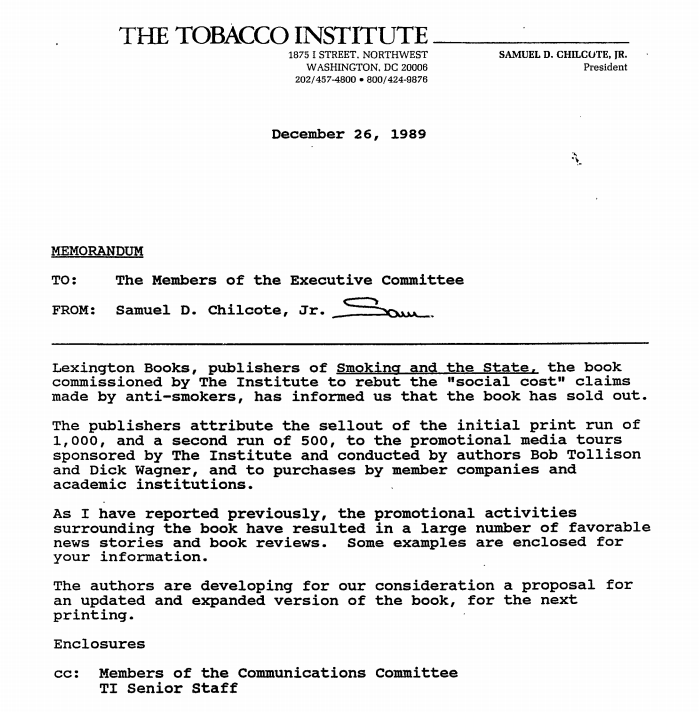
The Tobacco Institute paid $70.000 for the book, meaning INFOTAB must have paid another $70.000. A document from 1989, three years after publication, illustrates the industry was pleased with the output:


Samuel D. Chilcote Jr.


It seems the tobacco industry was happy paying $140,000 to publish a book printed in only 1500 copies. The target was not public readers, but the creation of material the field lobbyists could use.

Tuesday, 2 June 2020

Tuesday, 19 May 2020

The tobacco economists network - or how the Tobacco Institute recruited over 100 American economics professors. Part 14 of many

Overview of previous posts here

Side step: scientific witness program 

The 1985-1986 field staff evaluation of witnesses also talks about the scientific witness program (the program denying the health-risks of secondhand smoking)


Effectiveness was important for the industry, which even looked at the diplomas of the witnesses, and the effect on the audience (same memo as above):
The diploma also was important for the economic witnesses. Professor Cotton Mather Lindsay (1940-2015) wrote a piece calling himself "Mr." The industry disagreed

Sunday, 17 May 2020

The tobacco economists network - Part 12 - Overview of Testimony of Robert D. Tollison

Overview of previous posts here

Overview of testimony of Robert Tollison

Many of the network economists appeared during legislative hearings. Here we only consider the testimony in hearings attended by Robert Tollison, the others are listed in the appendix which will be publiced in the last blogpost of the series. Of course Tollison received training and he was given some practice questions


Chronology of hearings

Tollison probably got invited after writing a letter to Senator Stevens. Do notice pretends to write on his own behalf. That is a lie.
The report of the hearing by the TI is quite interesting 

We do not know how much Tollison earned for this hearing, but PR-firm Ogilvy and Mather billed the Tobacco Institute a couple ofthousand dollars for the public relations done for the hearing[9]

Do notice the total lack of honesty :

Robert D. Tollison, J.R. Clark, James M. Savarese


Probably Tollison mentioned in these last three hearings he was asked to testify on behalf of the Tobacco Institute because of the troubles he faced not admitting from the start he was testifying on behalf of the Tobacco Institute during an earlier testimony (see another blogpost). 

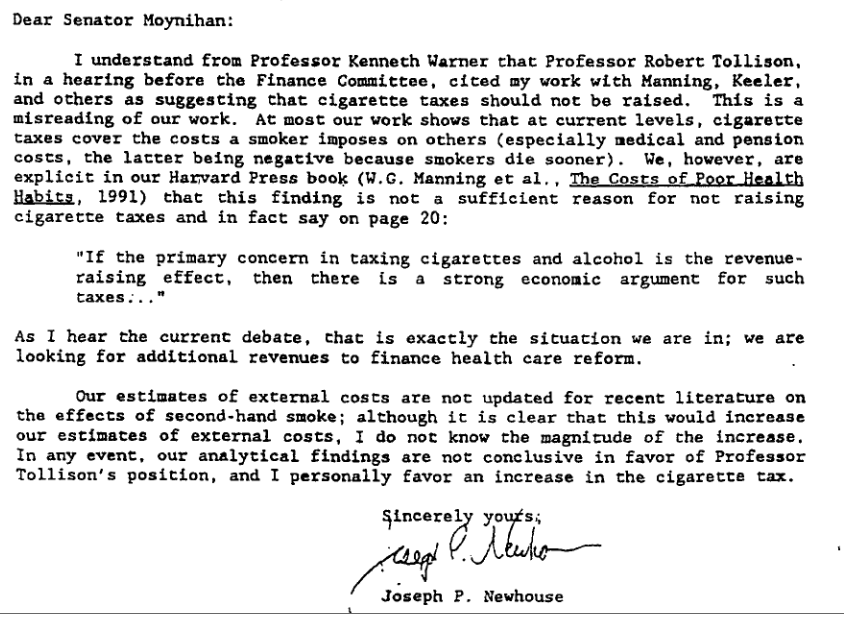
Tollison is not just addressing social costs, but spends a great deal denying the health risks of second hand smoking even though his statement was written AFTER the 1993 EPA-report.


The same memo shows Dwight R. Lee appeared during three different hearings that year. I did not find the invoices, but the Tobacco Institute anticipated that he would testify, and the 1994 budget listed


There may have been other times when testimony was offered than those mentioned in the appendix ((not yet published). The industry wrote a yearly overview of activitiesin 1989 and 1990, but overviews for other years could not be located.