Showing posts with label Henry Butler. Show all posts

Saturday, 11 July 2020

The corrupted tobacco economists network: Part 38 - the "scientific" output.

Overview of previous posts here

Scientific output

As stated in a previous post the Tobacco Institute wanted scientific output, because it needed an academic ground to attack social cost. Even when the network was formed, the Tobacco Institute handed out grants.

In 1986 nine economists proposed for the money, though the evaluation of the proposals show James Savarese was not too pleased and Savarese, not the Tobacco Institute, proposed to reject a couple. Savarese's memorandum makes clear the research had to benefit the industry

Henry Butler's proposal was rejected because the industry was not sure his research would be beneficial for the industry

Henry N. Butler

More proof the Tobacco Institute did not tolerate output they disliked can be seen in a 1992 letter to James Savarese setting forth why The Economics of Smoking Bans by William Boyes and Michael Marlow was not funded 


In 1988 the industry must have ordered some social cost papers. The papers had to be reviewed by the Institute's lawyers before clearance
.

Again, this is not normal scientific behavior.

Sunday, 7 June 2020

The corrupted 120+ member tobacco economists network - part 28. Writing "independent" letters to senators.

Overview of previous posts here

Letters to Senators 

The economists were paid if they sent their op-eds to their local congressmen and Senators.


Several of these are not economists, but professors of law. As we will see in another blogpost, the industry also tried setting up a lawyers network. 

The economists and lawyers did not exactly say they were paid by the Tobacco Institute, As an example, Ronald X. Groeber wrote
Ronald X. Groeber

As another example, the letter written by Gary M. Anderson (he sent a copy to the Tobacco Institute and on top wrote sorry for the delay, so the Tobacco Institute probably had asked him to forward it)
Gary M. Anderson

The full list of letters discovered can be found in the appendix which will be published with the last blogpost in the series

Saturday, 6 June 2020

Corrupted tobacco economists network - part 27 : several op-ed rounds

Overview of previous posts here

Several op-ed rounds

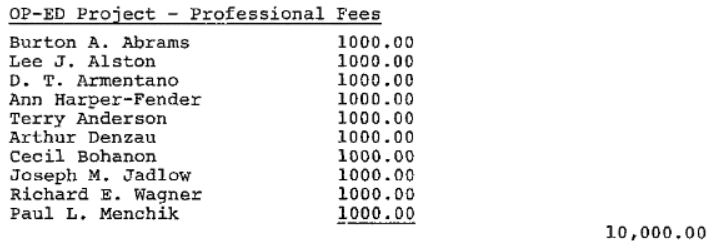
Even though the network was not complete yet, in a first campaign in 1985 the economists produced 34 op-eds, 18 being published, earning the authors $1.000 each


An op-ed round in 1986 saw 32 economists writing op-eds, 11 being rejected

The same year the Tobacco Institute launched the Packwood excise tax plan op-ed round. Most economists forwardedtheir op-eds to their local Senator

The 1987 op-ed campaign shows how the core-group communicated with the members of the network


The memorandum shows that:

  1. the economists were told what they had to write (at least if they wanted to make money)
  2. the core members controlled the output. But the memorandum does not mention the op-eds would pass by the Tobacco Institute and their lawyers.

The second billing for the project gives a clue how much the industry paid for the op-eds

Although Savarese calls the 1987 op-ed round the first one, clearly there were already campaigns in 1985 and 1986, and in 1985 the industry already had a list of economists willing to appear at hearings.

In 1988 there was the National Economic Commission op-edround and another one dealing with a possible advertisement ban on tobacco. Savarese once again made sure the economists and lawyers knew what they had to write. After some examples of arguments, Savarese concludes with a remark showing something interesting: Anna Tollison, wife of Robert, was involved in the whole operation 


Savarese billed three times $19.000 (or $57,000) for the op-eds

Robert J. Staaf received a letter from dr. John W. Richards, Jr. complaining that his op-ed was not very scientific. Of course the letter of complaint was forwarded to the Tobacco Institute
 (..)
The LTDL does not contain the answer to Richards even though a letter from Savarese shows Staaf must have replied.

In 1989, another round was set up. Only 20 network economists were contacted. The newspapers to be targeted were listed too. Not the major national ones, but the smaller local newspapers, the ones with less sophisticated editorial boards. At least 14 of the 20 op-eds got published


It is not clear that there was a full op-ed round in 1992, but Tollison and Wagner did send an op-ed to a local newspaper, titled scientific integrity consumed by anti-smokingzealotry. Not exactly the kind of title used in genuine academic literature.

Early 1993 EPA released a report stating second hand smoking indeed kills. The Clinton administration was thinking of drastically raising excise taxes (aka the monster tax). The industry answered (among other things) with a new op-ed campaign: 20 economists would be asked to write op-eds, so once again the industry did not use the entire network. If the op-ed got published, the economist each would receive $3.000. And again, the industry did closely follow up whichop-eds were (about to get) published:


(..)


In the end of 1995, the economists held another op-ed campaign, this time aimed at the American Food and Drug Administration (FDA) as the administration wanted further regulations on tobacco products. At least 15 op-eds were published
In 1988 there would be a last (?) op-ed round, but by then the LTDL shows major hiatuses, and the documents often do not any more carry names, making it harder to be sure who was involved.

Again, it is not clear why the industry usually picked only around 20 economists for these campaigns. Perhaps some states at the time were not considered a priority.

While superficially it may seem the op-eds were expensive, the industry wrote a memorandum about an op-ed written by Robert Tollison, showing the industry thought they were a bargain


Saturday, 30 May 2020

The corrupted 120+ member tobacco economists network. Part 23 of many

Overview of previous posts here

Economic associations meetings


Some of the recruited economists had formal bonds with the Western Economic Association (Gary M. Anderson, Dwight R. Lee, Richard L. Stroup, Thomas Borcherding)

At least five network economists at that point had formal bonds with the Southern Economic Association. Anno 2015, 3 of the 8 officers of the association were members of the Social Cost Consultants network (Peter Boettke, Fred McChesney & Jeffrey Clark). Back in 1985, Robert D. Tollison, ringleader of the economist network, was elected president of the Southern Economic Association. Consultant James Savarese saw the lobbying-potential, and wrote this letter 

James M. Savarese

James M. Savarese

Savarese's letters seem to imply the tobacco industry wrote material subsequently presented by the economists as their original work.

Savarese's plan worked out, and the economists presented their anti-tax (read: pro-tobacco) message during several conferences of economic associations They all knew their mission.
Tobacco Instititute, James M. Savarese, Robert D. Tollison

It is impossible to claim the economists attending these conferences, 'understanding their mission', and submitting their papers to the Tobacco Institute ‘for review in advance’ were useful idiots. They were aware their mission was manipulating the conference attendees.

In 1984, economists received $2,000 for presenting a paper, the chairman and members of the panel got $1,000. In 1991, the economists earned $5.000 per presentation


Friday, 15 May 2020

Tobacco economist professors network, Part 11: independent political testimonies ?

Overview of previous posts here

Political hearings

The Tobacco Institute wanted economists to testify for legislators to create the illusion that "the academic world" opposed excise taxes on cigarettes. The August 1986 Field staff evaluation of resources explains why the industry used this form of lobbying

The field staff evaluation also explains why the industry desperately wanted to 'own' an economist in every state

The industry taught the economists how to communicate and frame their message.

As the next blogposts will show, one can question the legitimacy of the testimony, as not all economists were always defending material they wrote, or even believed. At least 27 members of the network participated in hearings


The first hearings

The TI Excise plan is from 1984, and already in the same year the first economists testified. It is not certain how the industry persuaded them, and setting up the 'official' network seems to date from 1985.

The PR-firm Ogilvy and Mather reported


This makes clear the academics worked under a well defined strategy, even though at that point they may not have been aware of this. The Tobacco Institute wrote

Actually this summarizes the entire activities of the network. Even though in the next chapters there are further examples raising questions about the honesty of some network members, it is likely most of the economists never said anything they did not believe.  They were paid to say what they would have said anyway, as they were libertarians opposing any form of taxation in any case.

The problems with the network were:
  • the industry diverting the economists' attention to tobacco
  • the economists forgetting to mention they were being paid
  • the economists giving the industry material for their field lobbyists
This may not seem much of a problem, as the economists might have said the same if they were not paid.

It is not that simple though: by funding the economists, and promoting their output, the economists 1) created much more pro-tobacco output than they would've written if they were not paid 2) received much more attention than they deserved. And this was exactly what the industry needed: the massive output of the economists created a false balance. It was not all that important whether or not the economists' arguments were correct: the mere fact the economists opinions existed was enough to fit the message of doubt the industry wanted, because most people tend to believe when two different opinions exist, both must have some merit. That is incorrect: one of the opinions can be completely wrong. 

Preparing the economists

Ogilvy and Mather's annual report shows the PR-firm identified public smoking and creating doubt as the most important instruments in lobbying. Other LTDL documents show manufacturing doubt on health risks always was the industry's main focus.


The program around taxes emerged as the second most important issue. That's where the economists come into play


Tobacco Institute's lobbyist Dave Krogseng wrote to network economist Raymond Raab explaining to Raab what to say
  
This letter clearly illustrates the economists were not expressing their personal views but were acting as lobbyists. 

During the years to follow, the economists testified at many hearings, often local ones. This was the main reason the TI wanted to recruit an economist in every state, so politicians would not have the feeling some 'corporate scientists' were flown in from some far away metropolis.

Of course the testimonials were not the work of independent academics: the industry was aware in advance of the testimonials’ content. In 1985 Tollison forwarded Thomas Borcherding's draftstatement to the Tobacco Institute after the hearing, but the industry also knew what would've been said in hearings that were cancelled

Telling the tobacco industry what the content of your testimony will be cannot be considered as normal academic behavior. 

It is clear why the industry wanted copies of the statements: testimonials were not just useful on the day of a hearing itself, the industry also wanted to use the statements of the economists after the hearings