Showing posts with label Michael L. Davies. Show all posts

Saturday, 6 June 2020

Corrupted tobacco economists network - part 27 : several op-ed rounds

Overview of previous posts here

Several op-ed rounds

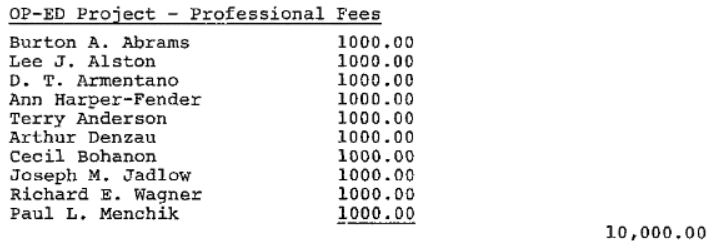
Even though the network was not complete yet, in a first campaign in 1985 the economists produced 34 op-eds, 18 being published, earning the authors $1.000 each

An op-ed round in 1986 saw 32 economists writing op-eds, 11 being rejected

The same year the Tobacco Institute launched the Packwood excise tax plan op-ed round. Most economists forwardedtheir op-eds to their local Senator

The 1987 op-ed campaign shows how the core-group communicated with the members of the network


The memorandum shows that:

  1. the economists were told what they had to write (at least if they wanted to make money)
  2. the core members controlled the output. But the memorandum does not mention the op-eds would pass by the Tobacco Institute and their lawyers.

The second billing for the project gives a clue how much the industry paid for the op-eds

Although Savarese calls the 1987 op-ed round the first one, clearly there were already campaigns in 1985 and 1986, and in 1985 the industry already had a list of economists willing to appear at hearings.

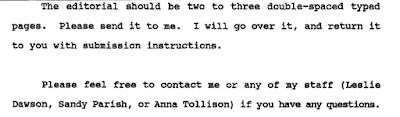
In 1988 there was the National Economic Commission op-edround and another one dealing with a possible advertisement ban on tobacco. Savarese once again made sure the economists and lawyers knew what they had to write. After some examples of arguments, Savarese concludes with a remark showing something interesting: Anna Tollison, wife of Robert, was involved in the whole operation 


Savarese billed three times $19.000 (or $57,000) for the op-eds

Robert J. Staaf received a letter from dr. John W. Richards, Jr. complaining that his op-ed was not very scientific. Of course the letter of complaint was forwarded to the Tobacco Institute
 (..)
The LTDL does not contain the answer to Richards even though a letter from Savarese shows Staaf must have replied.

In 1989, another round was set up. Only 20 network economists were contacted. The newspapers to be targeted were listed too. Not the major national ones, but the smaller local newspapers, the ones with less sophisticated editorial boards. At least 14 of the 20 op-eds got published


It is not clear that there was a full op-ed round in 1992, but Tollison and Wagner did send an op-ed to a local newspaper, titled scientific integrity consumed by anti-smokingzealotry. Not exactly the kind of title used in genuine academic literature.

Early 1993 EPA released a report stating second hand smoking indeed kills. The Clinton administration was thinking of drastically raising excise taxes (aka the monster tax). The industry answered (among other things) with a new op-ed campaign: 20 economists would be asked to write op-eds, so once again the industry did not use the entire network. If the op-ed got published, the economist each would receive $3.000. And again, the industry did closely follow up whichop-eds were (about to get) published:


(..)


In the end of 1995, the economists held another op-ed campaign, this time aimed at the American Food and Drug Administration (FDA) as the administration wanted further regulations on tobacco products. At least 15 op-eds were published
In 1988 there would be a last (?) op-ed round, but by then the LTDL shows major hiatuses, and the documents often do not any more carry names, making it harder to be sure who was involved.

Again, it is not clear why the industry usually picked only around 20 economists for these campaigns. Perhaps some states at the time were not considered a priority.

While superficially it may seem the op-eds were expensive, the industry wrote a memorandum about an op-ed written by Robert Tollison, showing the industry thought they were a bargain


Saturday, 23 May 2020

The tobacco economists network - or how the Tobacco Institute recruited over 100 American economics professors. Part 19 of many

Overview of previous posts here

Requesting an economist

Dwight R. Lee

After a while, the regional lobbyists must have known who the "best" economists were. Even though in 1987 he did not perform well, the training must have worked and in 1990 Bill Trisler simply requested Dwight R. Lee

Lee attended thehearing. Dwight Lee is the economist who by far attended the most legislative hearings, and Lee seems to have been the last core member active (until at least 1998).

Regional director Bob Pruett's wrote a thank you to letter in 1988 to Lee 
Dwight R. Lee

The same day, Pruett wrote another interesting letter 
Dwight R. Lee

Dwight R. Lee might not have been paid directly by RJ Reynolds, but the Tobacco Institute paid Lee $3,000. R.J. Reynolds was one of the companies funding the Tobacco Institute. Technically Lee did not lie.  


Dwight R. Lee


Someone else not lying was Fred S. McChesney, who testified for the Tobacco Institute in 1984.

In 2002 Fred McChesney was heard in a trial against Philip Morris
Fred S. McChesney

Of course McChesney's 1984 testimony was during a hearing on taxes, not a hearing on a tobacco company. Technically McChesney's answer was correct.

Michael L. Davis

In 1990 William Orzechowski wanted to use economist Michael L. Davis
Michael L. Davies, Mike Davis

Before the tour Davis participated in a Texas Tax Strategy Meeting held by the Tobacco Institute and indeed he did accept touring for the Tobacco Institute


Michael L. Davies

A summary of the tour shows they talked with many editors from newspapers.

Friday, 22 May 2020

Corrupted tobacco economists network. Part 18 of many

Overview of previous posts here

Economic experts witness team orientation

Probably still not satisfied with the economists’ performance, the industry set up an economic experts witness team orientation and media training program in 1988, attended by employees of the Tobacco Institute, and by the core members of the economists network

Robert Tollison and James Savarese moderated the session utilization of economic witness team
Tollison and TI-employee Debbie Schoonmaker moderated the session research programs

The following members of the network attended the meeting: Gary M. Anderson, Michael L. Davis, Dwight R. Lee, Anna Tollison  (Robert's wife), Robert D. Tollison, Richard E. Wagner. Or in other words: the core members.

Thursday, 14 May 2020

Corrupted economist professors, Part 10: activities

Overview of previous posts here

Lobbying 

The industry used different tactics to influence the public and legislators


The activities of the network will be explored in detail in the next posts.

Tuesday, 28 April 2020

The tobacco economists network - or how the Tobacco Institute recruited over 100 American economics professors. Part 2 of many


1. Over one hundred economists, led by core group
The economist network was set up by Robert D. Tollison of GeorgeMason University with the help of lobbyist/consultant James M. Savarese. Over time some 120 economists were active in the network although not all of them participated equally, nor did they all receive the same amount of funding for their lobbying.

The industry constantly evaluated the economists (see further). A core group was created in 1988 and it helped further refining the lobbying strategy:

A social cost committee of seven economists headed  y Jim Savarese and Bob Tollison is being formed. Others in the economist network may play a role researching and writing on this issue. However, this core group will create strategies and structure for a social cost program. The group will have its first meeting to begin implementing a strategy on February 1-2 in Washington.

This committee will be modeled after the economist network and will operate in a similar manner. The group will convene at least three times a year. A series of targeted brochures to various key audiences on the issue could be prepared for:- state legislators and staff
- federal legislators and staff
- academics
- media
-      Robert D. Tollison, Ph.D. Director, Public Choice Center George Mason University 
-      Richard E. Wagner, Ph.D. Holbert Harris University Distinguished Professor George Mason University 
-      Dwight Lee, Ph.D. Professor, Department of Economics University of Georgia
-      Richard Higgins, Ph.D. Economist Washington Economic Research Consultants (Former Deputy Director, Bureau of Economics, Federal Trade Commission)
-     Robert Ekelund Jr., Ph.D. Lowder Professor of Economics Auburn University
-     Michael L. Davies
-     Gary Anderson, Ph.D. Professor, Department of Economics, California State University at Northridge
-      Bob Ebel, Ph.D. Director, Public Finance Program The Urban Institute

With the exception of Ebel, this core group would be responsible for running the network. In another 1988 document, James Savarese lists the core group, this time without Ebel, who does not reappear in the files, so he must have dropped out early.  

This core group worked closely with the Tobacco Institute including participating in strategic meetings and more.  Realistically, the other 100+ professors may be regarded as subcontractors of Savarese &Tollison. Nevertheless all network members also had direct contacts with the Tobacco Institute over time.

Core Group
The tobacco industry wanted to recruit at least one economist per American state (we'll explain why). During the existence of the network, over 100 American economics professors were involved. The industry called those shown below the ‘core group’. They all worked closely with the Tobacco Institute

We'll explore the activities of the economist during the next year or so, but it is clear the industry had a clear vision how to you use the economists:


In the next number of posts, we will see the industry did not just hire the economists, but always evaluated them for effectiveness