Showing posts with label Cecil Bohanon. Show all posts

Sunday, 16 August 2020

The corrupted tobacco economist network, Part 45 - More tobacco publications.

Overview of previous posts here

Other tobacco publications

There have been more papers and booklets written by the members of the network, probably ordered by the tobacco industry. I didn't explore them because I don't think it will provide much new information and the list is long, very long, starting with:
  • Tollison, R.D., Wagner, R.E. (1983) : WHO: No Rx for a Healthier World. Center for Study of Public Choice, George Mason University, 39 p.
The following two pieces were published in the same volume of the same journal, so there may have been some pal-review:
  • Jackson, J. D., Ekelund, R. D. Jr. (1989) : The Influence of Advertising on Tobacco Consumption: A Debate: Some Problems with Chetwynd et al.'s Analysis, British Journal of Addiction 84 (November 1989), pp. 1247-1250
  • Boddewyn, J. J. (1989) There is No Convincing Evidence for a Relationship Between Cigarette Advertising and Consumption. British Journal of Addiction. Volume 84, Issue 11 (November 1989), pages 1255–1261

Many more papers were published by members of the network, e.g.:
  • Lee, D. R. (1990) : An Economic Analysis of the Economic Burden of Cigarette Smoking in Georgia Journal of the Medical Association of Georgia (March 1990): pp. 161-164.
  • Lee, D. R. (1990) : Social Cost and The Cigarette Excise Tax: A Misguided Rationale for an Inefficient Policy, The Journal of Private Enterprise (Fall 1990): pp. 17-33.
  • Rucker, R. R., Thurman, W. N., Sumner, D. A. (1990) : Production Rights with Limited Transferability: A Case Study of the U.S. Tobacco and Peanut Programs. American Journal of Agricultural Economics, December 1990
  • Ault, R. W., Ekelund, R. B., Jackson, J.D., Saba, R. B., Saurman, D. S., (1991) : Smoking and Absenteeism: An Empirical Study, Applied Economics. 1991, 23, pp. 743-754 .
  • Rucker, R. R., Thurman, W. N., Sumner, D. A., (1991) : An Economic Analysis of the Effects of Eliminating Restrictions on the Transfer of Tobacco Quota. in Current Issues in Tobacco Economics, Vol. 4, Tobacco Merchants Association of the United States, Inc., Princeton, NJ, 1991.
  • Lee, D. R. (1991) : environmental economics and the social cost of smoking. Contemporary Economic Policy, Volume 9, Issue 1, pages 83–92, January 1991
  • Bohanon, C.E, McClure, J.E. (1993) : The Prohibitive Taxation of Cigarettes. Indianapolis Star.
  • Saba, R. at. al. (1995) : The Demand for Cigarette Smuggling, Economic Inquiry.vol. 33, no.-2 (April 1995), pp: 189-202;
  • Coats, R. M. (1995) : A Note on Estimating Cross-Border Effects of State Cigarette Taxes National-Tax Journal, vol. 48, no. 4 (December 1995), pp. 573-84;
  • Rucker, R. R., Thurman, W. N., Sumner, D. A. (1995) : Restricting the Market for Quota: An Analysis of Tobacco Production Rights with Corroboration from Congressional Testimony Journal of Political Economy, 1995, 103(1): 142-175.
  • Boyes, W. J., Marlow, M. L. (1996) : The Public Demand for Smoking Bans, Public Choice, 88: 57-67. (Marlow was not a Savarese-network member, but was working for Philip Morris)
  • Lee, D. R. (1996) : The Turf Fight for Indoor Air Quality Protection. Center for the Study of American Business, Volume 79, May 1996 http://news.heartland.org/sites/all/modules/custom/heartland_migration/files/pdfs/5854.pdf
  • Vedder, R. K. (1997) : Bordering on Chaos; Fiscal Federalism and Excise Taxes in William F. Shughart II, ed., Taxing Choice: The Predatory Politics of Fiscal Discrimination (New Brunswick, NJ: Transaction Publish- ete, 1997)
  • Boyes, W. J., Marlow, M. L. (1997) : The Effects on Businesses of laws Restricting Smoking
  • Lee, D. R. (1997) : Will Government's Crusade Against Tobacco Work ? Center for the Study of American Business, Washington University, Contemporary Issues Series 86 , Jun1997, pp. 2-4
  • Lee, D. R. (1997) : The use and abuse of excise taxes. Tax Foundation, working paper 19, May 1997, 19 p.
  • McCormick, R. E., Tollison, R. D., Wagner, R. E. (1997) : Smoking, insurance and social cost. Regulation : the Cato review of business and government.- Vol. 20.1997, 3, p. 33-37

And then there is the output of other scholars, like this book:
Magda E. Schaler, Jeffrey A. Schaler (eds.) : Smoking, who has the right ? (Prometheus, 1998)

The connection of these authors to the economists network, if any, is not clear, but like the main members of the network, Jeffrey Schaler was working at. . . George Mason University.

The Schaler and Schaler-book contains contributions from George J. Annas, Gary S. Becker, Peter L. Berger, Richard Daynard, Antony Flew, Peter D. Jacobson, Stanton Glantz, Robert E. Goodin, Joseph R. Gusfield, Stephen J. Heishman, Graham E. Kelder, David A. Kessler, Mark Edward Lender, Stephen C. Littlechild, Rajendra Persaud, Robert N. Procter, David Ryder, Robert J. Samuelson, John Slade, Edward L. Sweda Jr, Robert D. Tollison, Richard E. Wagner, Lee S. Weinberg, Walter E. Williams, and Richard Vatz.

Although some were not members of the social cost consultant network, those underlined were people who had worked as consultants for the tobacco industry, via direct evidence in the Tobacco Legacy Documents Library. It raises questions why and how the book was compiled.

Clearly, in the 1980's and 1990's, economists suddenly were very interested in tobacco ...

Saturday, 20 June 2020

Corrupted tobacco economists network, Part 35: buying fake book reviews from the other network members


Overview of previous posts here

Buying positive book reviews

Media tours were not the only way Smoking and the State: Social costs, rent seeking, and public policy was promoted, the industry also wanted favorable book reviews. So once again the network economists began writing. James Savarese wrote


The economists did what they were asked

(etc...)


Of course, the economists' work first was checked for the right wording. The phrase "Most would sanction the government warning tobacco users of the health consequences of their habit" in Cecil Bohanon's review did not please the industry, so they added a word

Cecil Bohanon

A similar edit was made in the draft written by Ryan C. Amacher. Notice the similarity in handwriting. These edits were made by the Tobacco Institute. The edits appeared in Amacher's final version, published in The State, Columbia, S .C., Sunday, August 14, 1988

 
Ryan C. Amacher


Adding a word sometimes was not enough


Allen M. Parkman

The same document also shows the Tobacco Institute's lawyers had to review the paper before it could be sent to the newspapers. Not all reviews were published though

November 29, 1998, James Savarese sent the following invoice to the Tobacco Institute
Seventeen economists were asked to write a review. Assuming everyone writing a review got paid, every economist earned around $3.500 for writing a review. Calculated otherwise, the industry paid some $2.000 per page written.

TI president Samuel D. Chilcote reported to the members of the TI executive committee

Monday, 8 June 2020

Corrupted 120+ member tobacco professors network, part 29: embarrassing GSA-letters

Overview of previous posts here

Content of the GSA-letters

John F. Militello

John F. Militello sent his letter July 7, 1986. He wrote
John F. militello


That's not exactly the truth: February 25, 1986 James Savarese sent this letter to the Tobacco Institute during the ongoing Chase op-ed campaign
Jack Militello, James M. Savarese

Millitello's GSA letter was part of an organized campaign. James Savarese wrote a handy overview of theactivities each network economist was involved with until 1986 Militello's activities were listed as follows:
John F. Militello


Clearly, the GSA letter was not an effort of private citizen.

Arthur C. Mead

Arthur C. Mead's letter is somewhat bizarre

Arthur C. Mead

This is embarrassing 

J.J. Boddewyn

J.J. Boddewyn' text is what one would expect to read from a free market professor: freedom, freedom, freedom

J.J. Boddewyn


Boddewyn's last paragraph on enforcement is one-sided: if there would be something like a right to smoke at the work floor, this would imply the need of new regulation to enforce this right. . .

Morgan Reynolds

In 1979 the US Surgeon General concluded ETS is harmful. Reynolds still denied this:


Like all the network economists, Reynolds used one sided arguments like


Reynolds (and all the other economists) ignored facts like buildings will have to be painted less, there will be less economic loss from smoking related illnesses etc. Telling a one sided tale is not typical of economists, the standard description of whom is that there is no such thing as a one handed economist, because they always say on the one hand and on the other.

Reynolds again:
Morgan Reynolds

Following Reynolds logic, employers would not have a problem to pay that extra amount of money as they now could decrease the salary of non-smokers. After all, their workings conditions improved, meaning -following his logic- after a ban they suddenly are being overpaid...

Cecil Bohanon

Cecil Bohanon et al. use a weird analogy

Cecil Bohanon

Five people signed this crap. 

Allen Dalton

Allen Dalton clearly has a full understanding of the word 'addiction', as his letter proves

D. Allen Dalton

(do read his entire letter, it is bewildering)

1.1.1.7     Denying health Risks

Morgan Reynolds was not the only one of the economists to deny the health risks of ETS. S. Charles Maurice et al wrote:
Morgan Reynolds

Saturday, 6 June 2020

Corrupted tobacco economists network - part 27 : several op-ed rounds

Overview of previous posts here

Several op-ed rounds

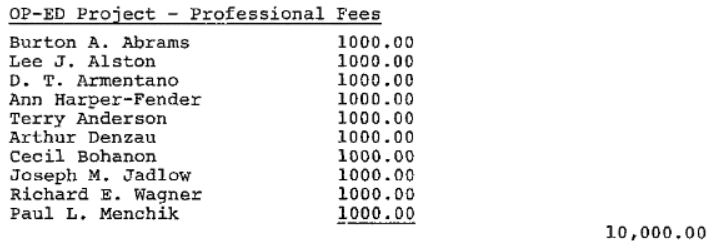
Even though the network was not complete yet, in a first campaign in 1985 the economists produced 34 op-eds, 18 being published, earning the authors $1.000 each


An op-ed round in 1986 saw 32 economists writing op-eds, 11 being rejected

The same year the Tobacco Institute launched the Packwood excise tax plan op-ed round. Most economists forwardedtheir op-eds to their local Senator

The 1987 op-ed campaign shows how the core-group communicated with the members of the network


The memorandum shows that:

  1. the economists were told what they had to write (at least if they wanted to make money)
  2. the core members controlled the output. But the memorandum does not mention the op-eds would pass by the Tobacco Institute and their lawyers.

The second billing for the project gives a clue how much the industry paid for the op-eds

Although Savarese calls the 1987 op-ed round the first one, clearly there were already campaigns in 1985 and 1986, and in 1985 the industry already had a list of economists willing to appear at hearings.

In 1988 there was the National Economic Commission op-edround and another one dealing with a possible advertisement ban on tobacco. Savarese once again made sure the economists and lawyers knew what they had to write. After some examples of arguments, Savarese concludes with a remark showing something interesting: Anna Tollison, wife of Robert, was involved in the whole operation 


Savarese billed three times $19.000 (or $57,000) for the op-eds

Robert J. Staaf received a letter from dr. John W. Richards, Jr. complaining that his op-ed was not very scientific. Of course the letter of complaint was forwarded to the Tobacco Institute
 (..)
The LTDL does not contain the answer to Richards even though a letter from Savarese shows Staaf must have replied.

In 1989, another round was set up. Only 20 network economists were contacted. The newspapers to be targeted were listed too. Not the major national ones, but the smaller local newspapers, the ones with less sophisticated editorial boards. At least 14 of the 20 op-eds got published


It is not clear that there was a full op-ed round in 1992, but Tollison and Wagner did send an op-ed to a local newspaper, titled scientific integrity consumed by anti-smokingzealotry. Not exactly the kind of title used in genuine academic literature.

Early 1993 EPA released a report stating second hand smoking indeed kills. The Clinton administration was thinking of drastically raising excise taxes (aka the monster tax). The industry answered (among other things) with a new op-ed campaign: 20 economists would be asked to write op-eds, so once again the industry did not use the entire network. If the op-ed got published, the economist each would receive $3.000. And again, the industry did closely follow up whichop-eds were (about to get) published:


(..)


In the end of 1995, the economists held another op-ed campaign, this time aimed at the American Food and Drug Administration (FDA) as the administration wanted further regulations on tobacco products. At least 15 op-eds were published
In 1988 there would be a last (?) op-ed round, but by then the LTDL shows major hiatuses, and the documents often do not any more carry names, making it harder to be sure who was involved.

Again, it is not clear why the industry usually picked only around 20 economists for these campaigns. Perhaps some states at the time were not considered a priority.

While superficially it may seem the op-eds were expensive, the industry wrote a memorandum about an op-ed written by Robert Tollison, showing the industry thought they were a bargain


Thursday, 21 May 2020

The tobacco economists network - or how the Tobacco Institute recruited over 100 American economics professors. Part 17 of many

Overview of previous posts here

The industry keeps evaluating

The industry kept evaluating for effectiveness


Full list of remarks:
  • Prof Dominick Armentano — "Yes: Contacted, make good witness"
  • Prof Summer LaCroix — "Yes: if needed in Hawaii"
  • Prof Allan Dalton — "Yes: Good Witness"
  • Prof Fred McChesney — "No Contact. Reported to be OK and could be used in future.
  • Prof Cecil Bohanon — "Should be replaced by listed Indiana Economist, Prof. James A Papke"
  • Prof Thomas Pogue — "Yes, Could be outstanding."
  • Prof Robert McMahon — "Yes: Creditable witness and one-on-one contact."
  • Pro Greg Neihaus — "Yes, outstanding witness"
  • Prof Raymond Raab — "Yes: Outstanding"
  • Prof Terry Anderson — "Yes, Good Witness"
  • Prof Terry Logue — "Yes: Outstanding witness"
  • Prof Kenneth Greene — "Yes: Only in particular situations with controlled information."
  • Prof Cliff Dobitz — "No contact: State not lend itself to Economic witness use."
  • Prof Richard Vedder — "No - Conflict minimizes effectiveness"
  • Prof William Mitchell — "Yes, Good witness"
  • Prof Ann Harper-Fender — "No contact - out of country, will contact in June.
  • Prof Arthur Mead— "Yes: Good witness"
  • Prof Dennis Hein — "Contact sometimes back; will probably be good witness and usable in 1988.
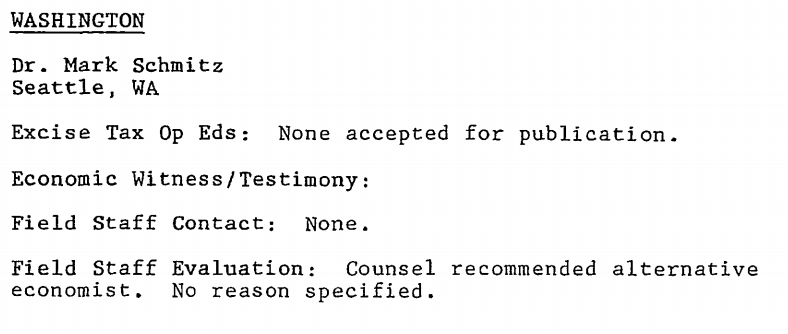
  • Dr Mark Schmitz — "Washington — No"
  • Dr Dennis Chinn — "Washington —Yes, Excellent"


In order to make the most of the new opportunities for the economist network, several factors had to be taken into consideration
(...)

Tuesday, 19 May 2020

The tobacco economists network - or how the Tobacco Institute recruited over 100 American economics professors. Part 15 of many

Overview of previous posts here

Savarese gets audited

The network was led by consultant James M. Savarese and economist Robert D. Tollison.

In 1997 James Savarese wrote he was under a new financial arrangement with the Tobacco Institute. 

The new financial agreement Savarese mentioned arose as result of the Tobacco Institute’s dissatisfaction with the way Savarese wrote his invoices (and maybe other reasons). Savarese nearly always mentioned the economists' names, but even in his correspondence with the Tobacco Institute he withheld two names (no idea why). As proof we are dealing with professionals, the Tobacco Institute in 1987 audited its subcontractor, leading to new arrangements with James Savarese.

The document is interesting because it shows the industry did not search for the economists, this job was left to Savarese. But:

The audit did generate some unfriendly messages within the Tobacco Institute and whatever sparked the dismay, the industry decided it would evaluate the economists themselves. 

Hurst Marshall wrote a letter to all regional VP's asking to fill a questionnaire


The impetus for these unfriendly communications is unclear but a few months earlier Savarese had been ordered to re-contact all the economists he listed

As another result of the audit, the Tobacco Institute seems to have made its own evaluation of the economists
[etc]
Tobacco employee Pete Sparber contacted 40 economists and 3 economists received less favorable reviews


Nevertheless, all three economists above stayed in the network for the next few years and still wrote op-eds (see another blogpost), but perhaps did not appear at any more hearings. The document does not mention why they wanted to replace Cecil Bohanon, but it shows the Tobacco Institute preferred James A. Papke who delivered very effective testimony in 1986

The same document finally solves the mystery why there were almost no women in the network 
Ann Harper-Fender
Thomas Borcherding also received a poor review 

Thomas Borcherding
Gary M. Anderson indeed would enter the network and he had already worked as assistant for Robert Tollison). Nevertheless. Borcherding does not seemed to have been kicked out but in the future would only be asked to write, not to deliver testimony.

The industry in the beginning did not like the newly recruited Gary M. Anderson even though he was a member of the core group. Interestingly in this memorandum Tollison/ Savarese are referred to as his "superiors"

Richard K. Vedder never was asked to testify. Lobbyist Bill Trisler explains
Richard K. Vedder