Showing posts with label Richard K. Vedder. Show all posts

Sunday, 29 August 2021

The corrupted tobacco economist network Part 59 - The Independent Institute

Overview of previous posts here

The first part of theis blog series explored the activities of the economists network in the 1980's and early 1990's. The second part of the series illustrated the tobacco industry finally would not just attack science, but would try to change the political landscpae by exploiting people's personal beliefs

That's where extremist free-market think tanks come to play.

THE INDEPENDENT INSTITUTE
At least 21 of the network economists have/had connections with the Independent Institute. In 1994, both core members Tollison and Wagner were among the members of the advisory board (Tollison had been on the board since 1986, the year the think tank was founded)


Clinton reform plan (1994)

As a part of the 1993 Clinton health reform plan, there was a suggestion to increase the excise taxes on cigarettes from 24c per pack to 99c, the so called "monster-tax".

The industry answered with the "monster op-ed" round, by setting up PR-firm APCO, and some more activities less relevant for the this story.

There also was an 'open letter' from the Independent Institute. It is not clear who ordered the letter, but no less than 52 economists from the economists' network signed the Open Letter to President Clinton on Healthcare Reform. It won't come as a surprise the letter draws the 'taxes' card. And is quite hysterical.


It may or may not be a coincidence so many of the social cost economists are affiliated one way or another with the Independent Institute. And it may or may not be a coincidence the letter fits the tobacco industry's social cost program. 

One has the impression the Independent Institute acted as a front for a campaign launched by the tobacco industry.


Detaxing America (1995)

In the 1980's and early 1990's, the industry paid economist to appear at economic meetings. It seems later on the industry simply organized its own conferences with think tanks acting as a cover.

In 1995, the Independent Institute organized the conference Detaxing America to promote the forthcoming book written by William F. Shughart II

Following tobacco economists attended the conference:  William Shughart II, Bruce L. Benson, Dwight R. Lee, Robert Ekelund Jr.,  Gary M. Anderson,  Richard Vedder and Mark Thornton

7 of the 17 invited speakers were members of Tollison's illegal social cost network. With several of the 13 other speakers (p. ex. DiLorenzo and Tullock) also being paid by the tobacco industry, but in other lobby-programs.

No, "Independent Institute" doesn't seem the best possible name to describe that think tank.

Books by the Independent Institute

The Independent Institute published several books and reports written by tobacco lobbyists. But even when the tobacco economists weren't the first author of a publication, they still were around.


1994 : William Mitchell and Randy Simmons, Beyond Politics (foreword by Gordon Tullock)

David J. Theroux of the Independent Institute wrote a letter to Tobacco Institute


Quite a strange move for an “Independent” Institute, no ? 


1995: Donald J Boudreaux and Adam Pritchard : Civil Forefeiture As A Tax. The authors thank 6 people for "instructive discussion and comments", four of them being tobacco economists : Bruce Benson, Dwight Lee, William Shughart and Bruce Yandle.

1995: William F. Shughart: The economics of excise taxation

1996 : Richard Vedder and Lowell E. Gallaway : The Melting Pot.

1997: William F. Shughart (ed): Taxing choice: The predatory politics of fiscal discrimination

Including Shughart, at least 7 of the 18 authors have been paid by the Tobacco Institute. Probably not a surprise, as already in 1994 David J. Theroux of the Independent Institute contacted the Tobacco Institute about the book, draft title Sin Taxes

David J. Theroux

(...)
Robert Higgs

Dr. Robert Higgs was one of the people asked by the Tobacco Institute in 1996 to write op-eds against FDA-regulations[11] Shughart was one of the most active members in the network of social cost consultants.

And to promote the book:


2000
: Dominick Armentano: Antitrust and monopoly

2000: Roger Meiners and Bruce Yandle : Regulation and the Reagan Era

The foreword of this book was written by Robert Crandall, another tobacco lobbyist (and then brother in law of S. Fred Singer).

The industry also used think tankers outside the social cost network to work for them. Another Independent Institute economist, Canadian Pierre Lemieux (also involved in the pro-tobacco group FORCES) wrote the book "Smoking and Liberty: Government as a Public Health Problem"and a whole lot of smaller texts, listed on his website on a page he titled Smoking, Liberty and Health Fascism. His extremist titles and views may be a reason the industry didn't use him more often.

This document suggests there also might have been a (small) Canadian network. I did not explore it any further. The John Luik in the document was twice fired from universities for being dishonest. His former Dean stated


John Luik


The Independent Institute is a fine example of tobacco interests and extremist free-market views finding and strenghtening each other, ultimately mingling into one big pseudoscientific mess benefiting the tobacco industry. 

Sunday, 16 August 2020

The corrupted tobacco economist network, Part 45 - More tobacco publications.

Overview of previous posts here

Other tobacco publications

There have been more papers and booklets written by the members of the network, probably ordered by the tobacco industry. I didn't explore them because I don't think it will provide much new information and the list is long, very long, starting with:
  • Tollison, R.D., Wagner, R.E. (1983) : WHO: No Rx for a Healthier World. Center for Study of Public Choice, George Mason University, 39 p.
The following two pieces were published in the same volume of the same journal, so there may have been some pal-review:
  • Jackson, J. D., Ekelund, R. D. Jr. (1989) : The Influence of Advertising on Tobacco Consumption: A Debate: Some Problems with Chetwynd et al.'s Analysis, British Journal of Addiction 84 (November 1989), pp. 1247-1250
  • Boddewyn, J. J. (1989) There is No Convincing Evidence for a Relationship Between Cigarette Advertising and Consumption. British Journal of Addiction. Volume 84, Issue 11 (November 1989), pages 1255–1261

Many more papers were published by members of the network, e.g.:
  • Lee, D. R. (1990) : An Economic Analysis of the Economic Burden of Cigarette Smoking in Georgia Journal of the Medical Association of Georgia (March 1990): pp. 161-164.
  • Lee, D. R. (1990) : Social Cost and The Cigarette Excise Tax: A Misguided Rationale for an Inefficient Policy, The Journal of Private Enterprise (Fall 1990): pp. 17-33.
  • Rucker, R. R., Thurman, W. N., Sumner, D. A. (1990) : Production Rights with Limited Transferability: A Case Study of the U.S. Tobacco and Peanut Programs. American Journal of Agricultural Economics, December 1990
  • Ault, R. W., Ekelund, R. B., Jackson, J.D., Saba, R. B., Saurman, D. S., (1991) : Smoking and Absenteeism: An Empirical Study, Applied Economics. 1991, 23, pp. 743-754 .
  • Rucker, R. R., Thurman, W. N., Sumner, D. A., (1991) : An Economic Analysis of the Effects of Eliminating Restrictions on the Transfer of Tobacco Quota. in Current Issues in Tobacco Economics, Vol. 4, Tobacco Merchants Association of the United States, Inc., Princeton, NJ, 1991.
  • Lee, D. R. (1991) : environmental economics and the social cost of smoking. Contemporary Economic Policy, Volume 9, Issue 1, pages 83–92, January 1991
  • Bohanon, C.E, McClure, J.E. (1993) : The Prohibitive Taxation of Cigarettes. Indianapolis Star.
  • Saba, R. at. al. (1995) : The Demand for Cigarette Smuggling, Economic Inquiry.vol. 33, no.-2 (April 1995), pp: 189-202;
  • Coats, R. M. (1995) : A Note on Estimating Cross-Border Effects of State Cigarette Taxes National-Tax Journal, vol. 48, no. 4 (December 1995), pp. 573-84;
  • Rucker, R. R., Thurman, W. N., Sumner, D. A. (1995) : Restricting the Market for Quota: An Analysis of Tobacco Production Rights with Corroboration from Congressional Testimony Journal of Political Economy, 1995, 103(1): 142-175.
  • Boyes, W. J., Marlow, M. L. (1996) : The Public Demand for Smoking Bans, Public Choice, 88: 57-67. (Marlow was not a Savarese-network member, but was working for Philip Morris)
  • Lee, D. R. (1996) : The Turf Fight for Indoor Air Quality Protection. Center for the Study of American Business, Volume 79, May 1996 http://news.heartland.org/sites/all/modules/custom/heartland_migration/files/pdfs/5854.pdf
  • Vedder, R. K. (1997) : Bordering on Chaos; Fiscal Federalism and Excise Taxes in William F. Shughart II, ed., Taxing Choice: The Predatory Politics of Fiscal Discrimination (New Brunswick, NJ: Transaction Publish- ete, 1997)
  • Boyes, W. J., Marlow, M. L. (1997) : The Effects on Businesses of laws Restricting Smoking
  • Lee, D. R. (1997) : Will Government's Crusade Against Tobacco Work ? Center for the Study of American Business, Washington University, Contemporary Issues Series 86 , Jun1997, pp. 2-4
  • Lee, D. R. (1997) : The use and abuse of excise taxes. Tax Foundation, working paper 19, May 1997, 19 p.
  • McCormick, R. E., Tollison, R. D., Wagner, R. E. (1997) : Smoking, insurance and social cost. Regulation : the Cato review of business and government.- Vol. 20.1997, 3, p. 33-37

And then there is the output of other scholars, like this book:
Magda E. Schaler, Jeffrey A. Schaler (eds.) : Smoking, who has the right ? (Prometheus, 1998)

The connection of these authors to the economists network, if any, is not clear, but like the main members of the network, Jeffrey Schaler was working at. . . George Mason University.

The Schaler and Schaler-book contains contributions from George J. Annas, Gary S. Becker, Peter L. Berger, Richard Daynard, Antony Flew, Peter D. Jacobson, Stanton Glantz, Robert E. Goodin, Joseph R. Gusfield, Stephen J. Heishman, Graham E. Kelder, David A. Kessler, Mark Edward Lender, Stephen C. Littlechild, Rajendra Persaud, Robert N. Procter, David Ryder, Robert J. Samuelson, John Slade, Edward L. Sweda Jr, Robert D. Tollison, Richard E. Wagner, Lee S. Weinberg, Walter E. Williams, and Richard Vatz.

Although some were not members of the social cost consultant network, those underlined were people who had worked as consultants for the tobacco industry, via direct evidence in the Tobacco Legacy Documents Library. It raises questions why and how the book was compiled.

Clearly, in the 1980's and 1990's, economists suddenly were very interested in tobacco ...

Thursday, 21 May 2020

The tobacco economists network - or how the Tobacco Institute recruited over 100 American economics professors. Part 17 of many

Overview of previous posts here

The industry keeps evaluating

The industry kept evaluating for effectiveness


Full list of remarks:
  • Prof Dominick Armentano — "Yes: Contacted, make good witness"
  • Prof Summer LaCroix — "Yes: if needed in Hawaii"
  • Prof Allan Dalton — "Yes: Good Witness"
  • Prof Fred McChesney — "No Contact. Reported to be OK and could be used in future.
  • Prof Cecil Bohanon — "Should be replaced by listed Indiana Economist, Prof. James A Papke"
  • Prof Thomas Pogue — "Yes, Could be outstanding."
  • Prof Robert McMahon — "Yes: Creditable witness and one-on-one contact."
  • Pro Greg Neihaus — "Yes, outstanding witness"
  • Prof Raymond Raab — "Yes: Outstanding"
  • Prof Terry Anderson — "Yes, Good Witness"
  • Prof Terry Logue — "Yes: Outstanding witness"
  • Prof Kenneth Greene — "Yes: Only in particular situations with controlled information."
  • Prof Cliff Dobitz — "No contact: State not lend itself to Economic witness use."
  • Prof Richard Vedder — "No - Conflict minimizes effectiveness"
  • Prof William Mitchell — "Yes, Good witness"
  • Prof Ann Harper-Fender — "No contact - out of country, will contact in June.
  • Prof Arthur Mead— "Yes: Good witness"
  • Prof Dennis Hein — "Contact sometimes back; will probably be good witness and usable in 1988.
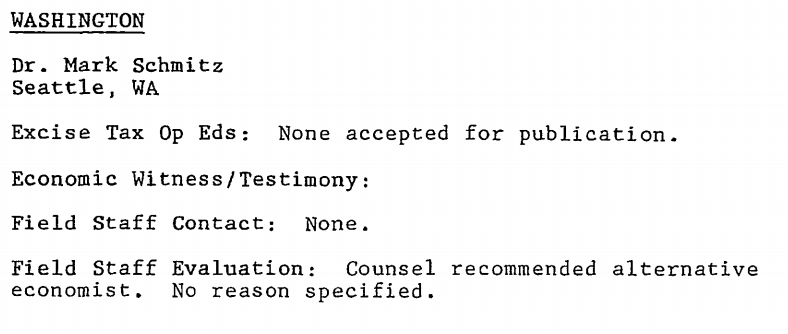
  • Dr Mark Schmitz — "Washington — No"
  • Dr Dennis Chinn — "Washington —Yes, Excellent"


In order to make the most of the new opportunities for the economist network, several factors had to be taken into consideration
(...)

Tuesday, 19 May 2020

The tobacco economists network - or how the Tobacco Institute recruited over 100 American economics professors. Part 15 of many

Overview of previous posts here

Savarese gets audited

The network was led by consultant James M. Savarese and economist Robert D. Tollison.

In 1997 James Savarese wrote he was under a new financial arrangement with the Tobacco Institute. 

The new financial agreement Savarese mentioned arose as result of the Tobacco Institute’s dissatisfaction with the way Savarese wrote his invoices (and maybe other reasons). Savarese nearly always mentioned the economists' names, but even in his correspondence with the Tobacco Institute he withheld two names (no idea why). As proof we are dealing with professionals, the Tobacco Institute in 1987 audited its subcontractor, leading to new arrangements with James Savarese.

The document is interesting because it shows the industry did not search for the economists, this job was left to Savarese. But:

The audit did generate some unfriendly messages within the Tobacco Institute and whatever sparked the dismay, the industry decided it would evaluate the economists themselves. 

Hurst Marshall wrote a letter to all regional VP's asking to fill a questionnaire


The impetus for these unfriendly communications is unclear but a few months earlier Savarese had been ordered to re-contact all the economists he listed

As another result of the audit, the Tobacco Institute seems to have made its own evaluation of the economists
[etc]
Tobacco employee Pete Sparber contacted 40 economists and 3 economists received less favorable reviews


Nevertheless, all three economists above stayed in the network for the next few years and still wrote op-eds (see another blogpost), but perhaps did not appear at any more hearings. The document does not mention why they wanted to replace Cecil Bohanon, but it shows the Tobacco Institute preferred James A. Papke who delivered very effective testimony in 1986

The same document finally solves the mystery why there were almost no women in the network 
Ann Harper-Fender
Thomas Borcherding also received a poor review 

Thomas Borcherding
Gary M. Anderson indeed would enter the network and he had already worked as assistant for Robert Tollison). Nevertheless. Borcherding does not seemed to have been kicked out but in the future would only be asked to write, not to deliver testimony.

The industry in the beginning did not like the newly recruited Gary M. Anderson even though he was a member of the core group. Interestingly in this memorandum Tollison/ Savarese are referred to as his "superiors"

Richard K. Vedder never was asked to testify. Lobbyist Bill Trisler explains
Richard K. Vedder