The previous blogpost mentioned in 1994 the Independent Institute authored the open letter against the Clinton Health Reform Plan. But the Independent Institute was not the only think tank aiming to work with the tobacco industry.
The Alexis de Tocqueville Institution invited itself to the industry in this letter to Philip Morris. Was AdTI at this point no pro-tobacco ? Probably not, the letter illustrates it all started with a remarkably one-sided and bit silly opposition against the tax-increase in the health reform plan. Thos one-sided viewpoint ultimately would become disastrous for the think tank.
Tim Lambert wrote a blogpost in 2004 (The Astroturf de Tocqueville Institute) showing the AdTI indeed started working with the tobacco industry in the 1990's.
The S. Fred Singer report
In 1994, late S. Fred Singer, best remembered as climate pseudo-skeptic, authored the Alexis de Tocqueville Institution report Science, Economics, and Environmental Policy: A Critical Examination. This report probably was ordered by the tobacco industry.
Early 1994, Cesar Conda, then president of the Alexis de Tocqueville Institution, had not decided yet who would author the paper (is not it lovely they already know what the report would conclude, without even knowing who would be the author?). Het wrote this remarkable letter:
Tim Lambert wrote a blogpost in 2004 (The Astroturf de Tocqueville Institute) showing the AdTI indeed started working with the tobacco industry in the 1990's.
The S. Fred Singer report
In 1994, late S. Fred Singer, best remembered as climate pseudo-skeptic, authored the Alexis de Tocqueville Institution report Science, Economics, and Environmental Policy: A Critical Examination. This report probably was ordered by the tobacco industry.
Early 1994, Cesar Conda, then president of the Alexis de Tocqueville Institution, had not decided yet who would author the paper (is not it lovely they already know what the report would conclude, without even knowing who would be the author?). Het wrote this remarkable letter:

The letter summarizes the corruption of this think tank: fake report, fake endorsements, wide press circulation. And all that for just $20.000
The letter also shows the focus was no longer only to attack regulations on tobacco, other environmental subjects would be thrown under the bus too. And indeed, it is in the pool of different American extremist conservative industry funded think tanks that organized global warming denial would finds its roots.
The letter
summarizes the corruption of this think tank: fake report, fake endorsements,
wide press circulation. And all that for just $20.000

Clearly: this report was as corrupted as a report can be.
The report contains the following passage:

No, the report does not mention Tollison's connections with the tobacco industry, nor the fact the industry indeed paid the AdTI the $20.000 for the report
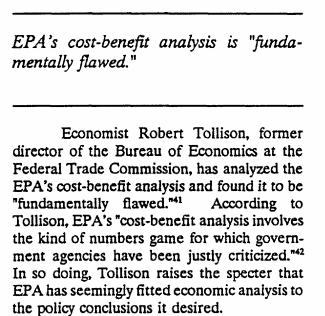
No, the report does not mention Tollison's connections with the tobacco industry, nor the fact the industry indeed paid the AdTI the $20.000 for the report
No,
the report does not mention Tollison's connections with
the tobacco industry, nor the fact the industry indeed paid the AdTI the$20.000 for the report. All in all, it's not even that much money and from the industry's point of view, this must have been a bargain to corrupt a think tank for an amount of money lower than an add campaign in a newspaper
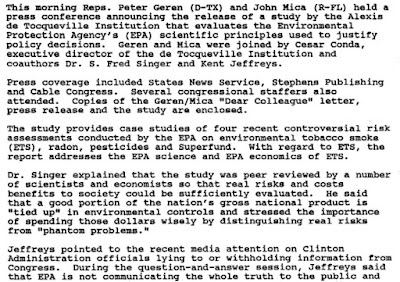
The industry wanted to use the report for lobbying, that much is certain

The report had the desired result. Samuel Chilcote, president of the Tobacco Institute reported
 |
In 1995 the AdTI published another excise tax report, this time not by the economists though, but by John E. Berthoud, president of the National Tax Payers Union.
In 1998, the AdTI's draft report Tobacco Smuggling: A Worldwide Phenomenon was sent to the tobacco industry.
This is not the work of an independent think tank.


