Showing posts with label Terry Anderson. Show all posts

Sunday, 18 July 2021

The corrupted tobacco economist network Part 58 - The role of Terry L. Anderson

Overview of previous posts here

As seen in the previous chapters, in the 1990's think tanks and libertarians started attacking all environmental sciences. The tobacco economists took part in this attack, with Terry L. Anderson playing a key role as an ideologist

Selection of publications:

1991: Terry L. Anderson wrote the book Free Market Environmentalism with Donald R. Leal. It became one of the books laying the grounds for the libertarian ideological attack on all environmental sciences.

Richard Stroup and Terry L. Anderson would become early TASSC's supporters and they were among the people exporting the TASSC-strategy to Europe through the UK based Institute of Economic Affairs. Both also were adjunct scholars at the Cato Institute

1995: Terry L. Anderson wrote a chapter in the book The True State of the Planet, attacking a wide variety of environmental issues. It's one of the first examples where the work of the economists and global warming denialism would emerge on the same surface. 

  • Chapter 1, by Nicholas Eberstadt - Population, Food, and Income: Global Trends in the Twentieth Century
  • Chapter 2, by Dennis Avery - Saving the Planet with Pesticides: Increasing Food Supplies While Preserving the Earth's Biodiversity
  • Chapter 3, by Robert C. Balling, Jr. - Global Warming: Messy Models, Decent Data, and Pointless Policy
  • Chapter 4, by Stephen Moore - The Coming Age of Abundance
  • Chapter 5, by Bruce N. Ames and Lois Swirsky Gold - The Causes and Prevention of Cancer: The Role of Environment
  • Chapter 6, by Roger A. Sedjo - Forests: Conflicting Signals
  • Chapter 7, by Stephen R. Edwards - Conserving Biodiversity: Resources for Our Future
  • Chapter 8, by Terry L. Anderson - Water Options for the Blue Planet
  • Chapter 9, by Kent Jeffreys - Rescuing the Oceans
  • Chapter 10, by Indur M. Goklani - Richer is Cleaner: Long Term Trends in Global Air Quality

Do notice in this book tobacco economist Terry L. Anderson and Kent Jeffreys (another author of a pro-tobacco report), suddenly became "specialists" in water pollution....

1997: (with Donald R. Leal) : Enviro-Capitalists: Doing Good While Doing Well. Hoover Institution. The book received a positive pal-review of fellow tobacco economist Bruce Yandle

1997: Terry L. Anderson and Pamela S. Snyder: Water Markets: Priming the Invisible Pump. Published by the Cato Institute.

2000: The Greening of U.S. Foreign Policy (with Henry I. Miller), published by the Hoover Institution. Anderson stated [2]

The green hand of foreign policy is a threat to national sovereignty without the offsetting benefit of improved environmental quality

2000: editor of Political Environmentalism:Going Behind the Green Curtain. Hoover Institution, also containing a chapter by network economist Bruce Yandle.

2001: Terry L. Anderson & Bruce Yandle were editors of the book Agriculture and the Environment – Searching for Greener Pastures published by the Hoover Institution.

2003: Anderson was editor of You Have to Admit It’s Getting Better—The Environment That is, another book published by the Hoover Institution.   

Tobacco economist Robert E. McCormick wrote the chapter The Relation Between Net Carbon Emissions and Income. While McCormick took no position on the scientific side, was poorly informed, writing "others claim there is no evidence of global warming; some even say the Earth is cooling"

Together Anderson's books (more than listed here) have played an important ideological role. All published by libertarian think tanks, they helped the message the industry and TASSC needed, by stating it would be better for the environment/health issues if there would be no government at all. His books have played an important role in creating a mindset in which the think tanks started drifting away from reality.

These books were highly ideological. Yet it is not impossible the books were commissioned by some industry. As early as 1987, during the "evaluations of economists sessions", the Tobacco Institute already remarked


Terry L. Anderson became George W. Bush's advisor on public lands issues somewhere in the late 1990's.  

In 2014, he wrote an op-ed in the Wall Street Journal defending the Keystone-pipeline. Written on behalf of his oil industry clients?

Saturday, 6 June 2020

Corrupted tobacco economists network - part 27 : several op-ed rounds

Overview of previous posts here

Several op-ed rounds

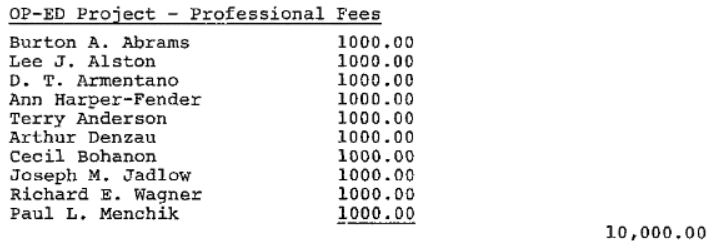
Even though the network was not complete yet, in a first campaign in 1985 the economists produced 34 op-eds, 18 being published, earning the authors $1.000 each


An op-ed round in 1986 saw 32 economists writing op-eds, 11 being rejected

The same year the Tobacco Institute launched the Packwood excise tax plan op-ed round. Most economists forwardedtheir op-eds to their local Senator

The 1987 op-ed campaign shows how the core-group communicated with the members of the network


The memorandum shows that:

  1. the economists were told what they had to write (at least if they wanted to make money)
  2. the core members controlled the output. But the memorandum does not mention the op-eds would pass by the Tobacco Institute and their lawyers.

The second billing for the project gives a clue how much the industry paid for the op-eds

Although Savarese calls the 1987 op-ed round the first one, clearly there were already campaigns in 1985 and 1986, and in 1985 the industry already had a list of economists willing to appear at hearings.

In 1988 there was the National Economic Commission op-edround and another one dealing with a possible advertisement ban on tobacco. Savarese once again made sure the economists and lawyers knew what they had to write. After some examples of arguments, Savarese concludes with a remark showing something interesting: Anna Tollison, wife of Robert, was involved in the whole operation 


Savarese billed three times $19.000 (or $57,000) for the op-eds

Robert J. Staaf received a letter from dr. John W. Richards, Jr. complaining that his op-ed was not very scientific. Of course the letter of complaint was forwarded to the Tobacco Institute
 (..)
The LTDL does not contain the answer to Richards even though a letter from Savarese shows Staaf must have replied.

In 1989, another round was set up. Only 20 network economists were contacted. The newspapers to be targeted were listed too. Not the major national ones, but the smaller local newspapers, the ones with less sophisticated editorial boards. At least 14 of the 20 op-eds got published


It is not clear that there was a full op-ed round in 1992, but Tollison and Wagner did send an op-ed to a local newspaper, titled scientific integrity consumed by anti-smokingzealotry. Not exactly the kind of title used in genuine academic literature.

Early 1993 EPA released a report stating second hand smoking indeed kills. The Clinton administration was thinking of drastically raising excise taxes (aka the monster tax). The industry answered (among other things) with a new op-ed campaign: 20 economists would be asked to write op-eds, so once again the industry did not use the entire network. If the op-ed got published, the economist each would receive $3.000. And again, the industry did closely follow up whichop-eds were (about to get) published:


(..)


In the end of 1995, the economists held another op-ed campaign, this time aimed at the American Food and Drug Administration (FDA) as the administration wanted further regulations on tobacco products. At least 15 op-eds were published. 
In 1988 there would be a last (?) op-ed round, but by then the LTDL shows major hiatuses, and the documents often do not any more carry names, making it harder to be sure who was involved.

Again, it is not clear why the industry usually picked only around 20 economists for these campaigns. Perhaps some states at the time were not considered a priority.

While superficially it may seem the op-eds were expensive, the industry wrote a memorandum about an op-ed written by Robert Tollison, showing the industry thought they were a bargain


Tuesday, 2 June 2020

Corrupted tobacco economists network - part 26 : organized op-ed campaigns in newspapers

Overview of previous posts here

Op-ed campaigns

A memorandum written by Tobacco Institute's Fred Panzer explains why the industry launched severalop-ed campaigns.  This memo strongly implies the op-eds were not written whenever the economists felt like writing something.

The campaigns were given different names like Phase II (also involving some "scientific papers").  In 1993 there was the monster op-ed campaign, etc...

The LTDL shows the industry paid a small bonus (900US$ for an Op-ed, only 125 US$ extra for forwarding it) to the economists sent an Op-Ed to their local politician, not just to a newspaper.  The industry specified the recipients. In states where the industry 'owned' more than one economist, they were given different politicians to contact. Panzer wrote
Fred Panzer, Tobacco Institute
The op-eds also proved to be a handy instrument for the field lobbyists

The free-market economists were supposed to write something against excise-taxes, but were not completely free to write anything. The industry dictated that they  had to mention


-         Excise taxes are regressive
-         Excise taxes are fundamentally inequitable
-         Excise taxes are an unfair burden on minorities
-         Government data demonstrates the unfairness of excise taxes.
-         Excise taxes are arbitrary
-         Excise taxes are hidden taxes
-         Excise taxes are an unfair burden on businesses
-         Excise taxes are bad economic policy

-         Excise taxes are historically controversial.

The last bullet refers to the argument "They are simply modern versions of the onerous British taxes which America's founders fought against". That is pure emo-argumentation.

Of course, op-eds had to be cleared by the Tobacco Institute's lawyers


As mentioned before, (at least the 1985) op-eds were also corrected by the PR-firm Ogilvy and Mather before the economists were allowed to send them to newspapers.

Nevertheless, even though the network members weren't free to write what they wanted, the Tobacco Institute did not erase every passage it didn't like. Again, this had a purpose 

James M. Savarese

Still, sometimes letting things the industry didn't like through, did not mean the Tobacco Institute let everything slip through. Fred Panzer of the Tobacco Institute wrote
Fred Panzer

The last line in this memorandum is more important than it may sound: it is the message the tobacco industry used to find business-partners.  The tobacco industry would try to scare other companies telling them something like "if the tobacco industry is going down, you're going to be next"

Again, as with the testimony, the output of the economists was closely monitored by the Tobacco Institute

(...)

The economists must have known it was bit strange they would receive more money if they would write their senator, once again disproving the thought they might have been useful idiots. Not all economists sent a copy of their op-eds to their Senator. Why not all of them tried to earn the extra cash is open to speculation.

Monday, 18 May 2020

Secret Tobacco economists network, Part 13 : political hearings and questionable ethics

Overview of previous posts here

Evaluating the witnesses

The industry evaluated the performance of the economists for effectiveness. The Tobacco Institute wanted to know if it would be good to use them again for future hearings, so it sent out questionnaires to its field agents to answer questions like


The same document also talks about other active programs, like Economic Impact studies produced by the Tobacco Institute (studies written to claim taxing the tobacco industry would have a negative impact), the scientific witness program and the helping youth decide program.

The August 1986 Field staff evaluation ofresources describes how the regional tobacco vice-presidents (RVP) thought the economists performed at the testimonies (emphasis added)


A memo from Susan Stuntz describes how the field lobbyists complained that the recruited economists were too conservative, making it difficult reaching liberal legislators. Stuntz dismissed this criticism


Of course, the economist were paid for their testimony


Still, being a good witness did not mean the economists were sure they would be asked for other output. This probably explains why the Savarese "tax hearing readiness" lists do not match with the activities of all economists in the network: economist not suited for testimony still benefitted the industry, as these economists were still useful when writing op-eds (and vice versa).

Monday, 11 May 2020

The tobacco economists network - or how the Tobacco Institute recruited over 100 American economics professors. Part 6 of many

overview of previous posts here

An operational social cost strategy

While still researching the social cost issue, the industry already started planning how to implement the "counterattack". In 1983, the first communications plan emerged, in 1984 a full excise tax plan.

In 1983 a prelimanary draft communication plan emerged. It is an important step toward the industry setting up a secret network of economists. The industry wanted  
Several lobbying-programs were selected  like p.ex. a "youth program" . For this series blogseries following domain matters


The suggested tactics included:


(...)

The goal to recruit economists in every state may be a result of an idea launched in 1983 by Brown & Williamson

No matter where they got the idea, by 1984 the Tobacco Institute wanted to set up a network of economic consultants, shown by the first draft of their full-grown Cigarette Excise Tax Plan. It is 109 pages long and gives a brilliant insight on how the industry operated (titles aside, all emphasis are mine)

Again, the industry selected some domains


The tactics for the business coalition now mentions the economists network


(...)


 (...)


At the time, the budget was still moderate


Thus, at the time (1984) the industry already had the idea to use economists, but the industry was still headhunting. The last page of the Excise Plan is wondering who to hire


Ed Battison from his side was also headhunting, and his report of the 1984 workshop carries an addendum with potential witnesses
-   GLEN LOURY, economist, Northwestern U., belongs to the group, Council For A Black Economic Agenda
-   WALTER WILLIAMS, George Mason U., professor, Center for Study of Public Choice, I.R.E.T. board member, against excise taxes.
-   AMITAI ETZIONI, sociology professor, George Washington U., has written on Role of Self-Discipline; and Education For Mutuality & Civility (in Futurist, 1982); Government Of Laws— Congress Excepted, 1979; Social Science vs Government—Standoff at Policy Gap, 1978 He is likely to be for individual freedom of smokers--ask Fred Panzer.
-   ROBERT D. TOLLISON, economist, George Mason U., Center For Study of Public Choice, has written on tax reform, social costs of the cigarette excise. Disinterest In Deregulation in the American Economic Review, 1984; Economic Regulation, Competitive Government, Specialized Resources; Instead of Regulation--Alternatives to ...; Rent Seeking, A Survey; F.T.C. Since 1970--Economic Regulation & Bureaucratic Behavior, 1982; Rational Choice & The Taxation Of Sin-a Reply by Grain, Deaton, Holcombe, & Tollison in Jour.of Public Econ.,v.16,1981. He is an authority on the economic inefficiency of excise taxes by his study of their higher than expected social costs.
-   RICHARD E. WAGNER, economist Florida State TJ, has written two papers on the irrationality of earmarking cigarette & alcohol excise taxes for Medicare and Medicaid, one for the recent association seminar and one for the TI; among his several books and articles is a recent text on taxation; articles on Government Spending, Trends and Issues by Beck and Wagner in SEJ, 1982; and Wagner's Law, Fiscal Institutions, and Growth of Government in National Tax Journal, v.30, 1977; he would testify against earmarking excises for public medical programs.
-   D.R LEE, George Mason U., Rent-Seeking & Its Implication for Pollution Taxation in SEJ, v.51, 1984; the Economics of Enforcing Pollution Taxation in Journal of Envir. Sc. & Manag., v.11,1984; Tax Rate & Tax Revenues In Political Equilibrium, by Buchanan & Lee, 1982; he is similar in his views and expertise to Tollison who is a colleague, but he is more inclined to take the inefficiency argument only and is a specialist in pollution problems.
-   PETER BLAU, social psychologist, has testified in the 1970's and has written Behavioral Sociology Or Behavioral Sociology in the American Sociologist, 1981; he is apparently for freedom of choice. 
-   TERRY ANDERSON, economics professor at Montana State IK, has written Who Cares About Efficiency in Cato Journal, 1982; he has seen limited service in helping state issues xn WA state. 
-   P. L. BERGER, Boston U., sociologist, has written among other articles, Democracy For Everyone in Commentary, vol.76, 1983. He is apparently for freedom from individual social restrictions. 
-   TED STERLING, Simon Fraser U., has written extensively as a contrarian. Among these are: Filtering Information About Occupation, Smoking & Disease in Jour. of Chronic Disease, 1984; Does Smoking Kill Workers Or Working Kill Smokers?—mutual relationship among smoking, occupation, and respiratory disease in International Journal' of Health Services, vol.8, 1978; Smoking & Cancer in American Journal of Public Health, vol.66, 1976; Critical Reassessment of Evidence Bearing On Smoking As a Cause of Lung Cancer, American Journal of Public Health, vol. 65, 1975; Review Of Claim That Excess Morbidity & Disability Can Be Ascribed to Smoking (Rejoinder) in Journal of American Statistical Assoc., vol. 68, 1973.
Other persons have been identified, but at present, it is not known clearly what their positions on the issues or on testimony are.
Battison's document makes clear that the industry was searching amongst the people already holding views that suited the industry’s purposes, and this indeed would become key in setting up the network: directing people's biases towards the tobacco industry’s ends.

Robert Tollison eventually would become a key person in setting up the social cost consultants. Other future members of the network of economists already mentioned on these lists are Thomas Borcherding, Fred McChesney, James Heins, David Klingaman, Richard Wagner, Walter Williams, Terry Anderson, Dwight R. Lee and S. Charles Maurice.

Did the industry know these guys probably would be corrupt? Not very likely. They knew they were libertarians, and that's why they were selected.

Refining the social cost strategy

The 1984 Tobacco Institute's Excise Tax Plan became more concrete in the version of July 11, 1984. 

Even though it would only be in the 1990's that the tobacco industry launched a full scale attack on EPA, far beyond tobacco related topics, hoping the public would start to have a general mistrust in science, the seeds of this action plan are already in the document of 1984.


The document show the industry was willing to pay external partners to work on topics not relevant for the tobacco industry, as long as those external partners also engaged in activities beneficial for the industry.

(...)


The work of the economists is mentioned:


And

and

In other words, setting up the economists network was part of well-defined strategy. And the goal was not to produce academic material.
It is clear the industry did not contact just any economist though. It is equally clear the recruited economists knew they would be working with the Tobacco Institute as this was explicitly mentioned to them (the underlining is in the original 1987 memorandum)


The first network activities appear to date from 1985, or two years before the note above was written. Several LTDL documents suggest the tobacco industry had difficulties finding an economist in every state and it was only in 1987 that Savarese completed the lists. As the industry dumped economists (see further), throughout the existence of the network new economists were recruited