Thursday, 12 March 2009

Labohm. Again. Sigh.

Hans Labohm(start here) is fond of repeating the same meme over and over again. Long after it has been disproven. And long after there has been demonstrated that he knows and understands what he says is misleading.

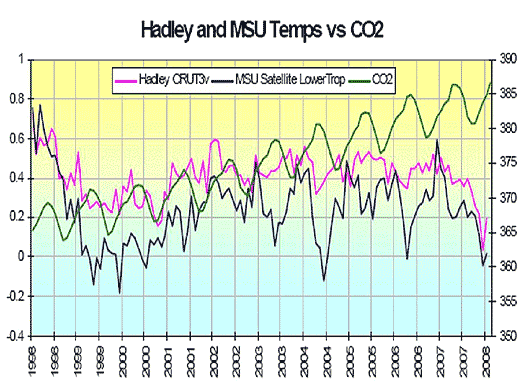
August 23, 2008, on the libertarian website Vrijspreker, Labohm presented a graph showing "for the past decades, there's no correlation between CO2 and temperature"

Hans Labohm Fraud cherrypick Joe d'Aleo Icecap


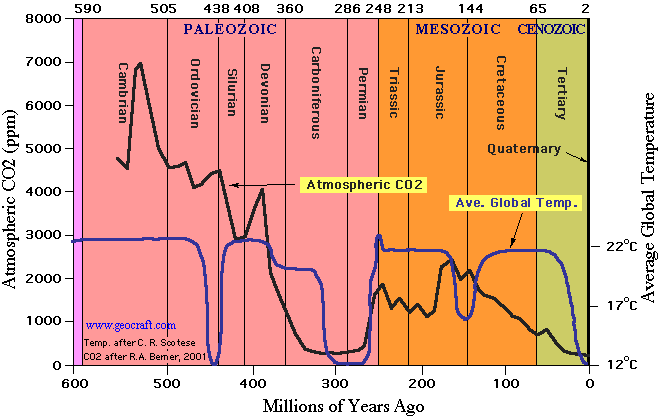
As he got the remark he cherry-picked his data, Labohm wrote a follow-up article in which he still uses a graph with a misleading timescale (as earth litterally was a diifferent planet in a time there were no trees yet)

Hans Labohm fraud cherrypick misleiding CO2 temperatuur

But finally he also presents this graph which is the one we need :

CO2 temperature correlation Vostok ice

This image leaves no doubt that indeed there is a correlation between CO2 and temperature. And that because of its short time interval, the first graph Hans Labohm presented was misleading. Which of course could be undeliberately and by no means is a proof of dishonesty.


Yet, in the third edition of Jason Magazine (jg 33), Hans Labohm presents this graph

Hans Labohm fraud Joseph d'Aleo Icecap cherrypick

he 'explains' :there's no a single correlation between temperature & CO2 (...) there's not a single timescale showing a correlation between CO2-concentrations in the atmosphere and temperature.
Of course, as the third graph above (a graph he himself posted) already showed, there absolutely is a correlation.

In the next edition of the magazine, Dutch student Desi Van de Laar wrote a rebuttal to Hans' text. In which she posts a graph showing the correlation.

The graph looks a bit like this one :

Relatie CO2 en temperatuur ijskern
Clearly, this is the second time Labohm has been shown his statement is false.


Hans wrote a rebuttal (jan 6, 2009) adressing Van de Laars rebuttal. A text he concludes with :

the last decade earth has been cooling, despite a CO2 rise. This presumably leads to the conclusion that CO2 isn't such an important factor in determing earth's temperature.
He present a graph to depict his words :
Hans Labohm manipulatie cherrypick
This is the second time he ignores the proof presented to him that his statement is false.

Back then, i did blog about it (posts he read), which means he's seen the evidence he's wrong no less than three times.


February 13, 2009 : Labohm writes a post on De Dagelijkse Standaard in which he writes :

The main thing is that since ten years earth has stopped warming while CO2-levels kept rising. This suggests there's not any causuality between CO2 and global warming (which isn't there any more anyway). Better than a thousand words, this graph shows what it's all about.
The graph hidden under the hyperlink is this one :


In the comments section, someone complains the time interval Labohm presents is way too short to be meaningful.

The same day Hans Labohm wrote this follow up post to adress this comment in which he answers :

Good point ! But no time scale will ever show a correlation between CO2 and Temperature. QED. P.ex. Look here
Of course, Hans' statement is wrong. And he knows very well that it is.


March 4, 2009 :Labohm publishes a post on De Dagelijkse Standaard which begins with :

(...) the temperature trend (which - i'll repeat it once more - shows no correlation with the level of atmospheric CO2) (...)

Once again Labohm is critisized by the readers of the site for his graph the commenters call 'misleading'. Hans replies by giving a link to this graph :

and this graph

So once again, Labohm HIMSELF presents the graph which clearly shows the correlation.

Interestingly, in this post he admits a ten year period is too short to support his claim that earth stopped warming a decade ago.


March 12, 2009 : Hans mailes around an article of his - published in the March-edition of the magazine Research Review.

Hans writes (remember, on DDS he admitted that a ten year temperature trend is meaningless) :

The illustrated graph shows declines in temperatures measured by surface and satellite thermometers over the last 10 years, while the CO2 concentration in the atmosphere still rises. It indicates that over this period there has been no warming, but cooling. It also shows that CO2 is not correlated with temperatures, which suggests that it has only little impact, if at all. The graph, which is based on the measurements of the official scientific institutions, is the best-kept secret of the ‘warmoholics’.
of course there's a graph (coming from the known unreliable source icecap from Joe d'aleo) to picturise Hans' words
Hans Labohm manipulation of data


i'm wondering which graph will accompany my next post on Hans Labohm...

UPDATE 1: March 13, 2009, in the comments section of De Dagelijkse Standaard, Labohm writes :
Not one timescale -millions of years, thousands, hundreds or tenths of years- shows a correlation between CO2 and temperatures.


UPDATE 2: March 17,2009 , Hans did it again in his post on De Dagelijkse Standaard :
Not one timescale -millions of years, thousands, hundreds or tenths of years- shows a correlation between CO2 and temperatures.
The graph behind the hyperlink is ...


Do notice
he does NOT provide links for the other timescales.
Which is no surprise, as he has demonstrated himself that such graphs actually would disprove his statement.


UPDATE 3 : March 24, 2009, Hans Labohm did it again :
no timescale shows a correlation between CO2 ans temperature. The last ten years earth has been cooling while cO2-levels kept rising.
The illustration behind the hyperlink is this one :

Hans Labohm De Dagelijkse Standaard libertarisme VVD PVV


UPDATE 4 : April 21, 2009, Hans Labohm presents a familiar graph :


UPDATE 5 :
i've stopped updating this post for half a year because i got bored, but allover this period Labohm has been using the very same "argument" over and over again.
Latest attempt to fool the audience : today, November 9, 2009, in this post on De Dagelijkse Standaard, accompanied by a graph we all know by now .
Labohm writes :

This graph illustrates (...) there's no correlation between CO2 & temperature, implying one can assumle there's no causality either.

UPDATE 6 :

November 16, 2009 In a guestlog on the Dutch NOS site, Hans Labohm writes :
The average temperature has been decreasing the past ten years, while CO2-levels int he atmosphere is still rising
This words are illustrated with this graph :


UPDATE 7 :
Last weekend, Labohm publised an article in the Dutch newspaper "Trouw". A prominent place in the article went to this graph :


UPDATE 8 :
December 14 2009
This page, by far, is the most visited one on my blog and as a result more and more people start asking Labohm why he keeps on using that misleading graph again and again.

Of course Hans never answers that question. But as he did get so much opposition on the NOS-weblog, he started trying other graphs that are equally misleading.

Labohm's posts belong to a series of a debate between him and real scientists. Bart Sprengers used the opportunity to write a post asking Labohm about his use of misleading graphs.

Here's what Labohm answered :

Bart asks : why did you show a graph showing temperatures in US, while the text was suggesting it would be about global temperatures ?Answer : it was graph that was easily available on the internet. But now i found another graph, showing a different picture. No correlation between cO2 and temperature !

I have a feeling this is not the last time seeing this new graph...


UPDATE 9 :
june 6, 2010
Once again i haven't been following Labohm but i just stumpled upon his presentation at the fourth international climate conference organised by the heavily Exxon-funded Heartland Institute. In his presentation, Labohm is showing the following graph to 'proof' there's no correlation between CO2 and temperature :
Hans Labohm klimaatsceptici misleiding

Conclusion
In his posts, Hans Labohm is presenting misleading facts, and given the chronology mentioned above, there's not doubt at all he isn't fully aware of the misleading nature of the facts he presents.

Hans Labohm is not wrong, Hans Labohm is a fraud.

Monday, 9 March 2009

Hans Labohm in De dagelijkse standaard.

Hans Labohm S. Fred Singer lie
In Holland a new website called De Dagelijkse Standaard was found to give a tribune to a couple of conservative writers to spread their worldview.

Of the contributors, best known in Belgium is Dutch columnist Derk Jan Eppink who recently announced to candidate for Lijst De Decker in the next European elections.

Another sounding name is Hans Labohm for whom the site has become his personal playground, with a daily post of his visions on climate science. I never took the trouble to comment on what Labohm wrote over there because it's simply too much too debunk and he's simply repeating the same things over and over again.

I couldn't resist though to give a few comments on the website (i know, i know, don't mock me) and once again stumbled onto something i couldn't believe.

Labohm made a post in which he's not saying much more than that S. Fred Singer wrote this text.

I replied (amongst other things) that S. Fred Singer received fundings from the industry.
Labohm tries to deny Singer received money saying:

Unproven. Made up. Slander.
The strange thing on this statement is that 3 monts earlier, on December 30, 2008 i received an email from Hans in which he admits Singer received money from Exxon.

Instead of denying Singer received fundings, in the mail he sent me Hans Labohm is drawing the card Singer didn't receive all that much money... So Labohm is perfectly aware Singer received fundings from the industry.

Could it be someone is making statements on DDS he knows to be untrue ?


UPDATE : Meanwhile on DDS, Hans Labohm replied to what i said. His two main points are :

  • this has nothing to do with climate science. Even if it would be true -which is unknown to me (remember that not only he sent me a mail in which he admits to be aware Singer received money, but on DDS i reminded him of the existance of this mail - J) it is not relevant.
  • "jules should not be allowed to post on De Dagelijkse Standaard any more"

The NIPCC rapport Labohm often cites was well funded: S. Fred Singer declared it was worth143.000 US $.

Wednesday, 4 February 2009

Hans Erren vs the people of Shishmaref

In his blog on the Dutch newspaper Volkskrant called klimaathype (i suppose this needs no translation), skeptic Hans Erren presents his views on Global Warming.

Shismaref Shishmaref Sarichef global warming
Erren's latest post is comparing the Dutch Wadden Sea island Vlieland with the Alaskan island Sarichef where the Inuït Village Shishmaref is located. The island received some attention in Holland because of the movie The Last Days of Shishmaref by director Jan Louter, which tells the story of the islanders who fear they'll have to move to the mainland as their island slowly gets swallowed by the sea.

The Wadden Islands (or Frisian Islands) including Vlieland, are a chain of islands in the North of Holland and continuïng in Germany until the border with Denmark.

Basically the islands are sandplates sticking out above sea level, and therefore the tide has great influence on their shorelines. Mankind has done efforts to decrease erosion in order to slow down natural processes, but of course the process itself cannot be fully halted.

At the erosion side, the islands shrink while at the other side progradation makes them grow. As a result the shorelines are ever moving and in Dutch we say the islands are "walking". Because of erosion, in 1736 on Vlieland an entire village (Westeynde) was swallowed by the sea.

Erren compares the present events at Sarichef, a small (7 km long) sandy island in Alaska, to what has happened to Vlieland in the past.

Sarichef island also knows a lot of erosion, to such an extent the islanders are worried their entire village might disappear in the nearby future as erosion is taking away a couple of metres of land every year.

There are several different natural causes for this erosion, yet some effects can be linked to global warming. The arctic area in recent times has known a fast increase in temperatures, causing the permafrost to melt, making the soil more vulnerable for erosion. Above that, increased temperatures result in less sea-ice, ice which serves as a natural storm surge.

The AAAS-website has a longer article on the subject : In Arctic Alaska, the Warming Climate Threatens an Ancient Culture


On the Volkskrantblog, Hans Erren writes (my translation) :

Hans Erren global warming Shishmaref Sarichef
Hans Erren
Sarichef is a Wadden Island in Alaska, comparable to Vlieland. For the inhabitants from the village Shismaref the same fate is waiting as the inhabitants of Westeynde. They only just started living there and aren't used to walking islands, therefore they blame climate change.

That's why they don't want that the island to 'disappear in the sea".
Is the Island disappearing ? Well, no. It's just moving a little bit. At the South-West side, there's a strong growth, just like on Vlieland.

Of course, even without AGW there'd be erosion on Sarichef, that much is true. But as mentioned above, global warming probably increases erosion. Yet even if AGW is a hoax, there are two very clear problems with Erren's words. Erren writes :
  • They only just started living there and aren't used to walking islands
It's clear Erren wants to make his readers think the islanders simply aren't aware of natural processes on such islands. What he doesn't mention is the area has been inhabited for hundreds of years already. All that time, the 'walking-island-effect' has occured, and the inhabitants know the phenomena.

  • Is the island disappearing ? Well, no, it's just moving a little bit. At the South West Side, there's a strong land-growth, just like on Vlieland.
in the comments section, Erren is asked for some more information and a source for his claim. His answer is nothing but an attempt to distract attention from the question :
All i can do is point out the similarity in geometry between Vlieland and Sarichef. For the Wadden Islands there's this map by Gerbrand Gaaff (...) Progradation at the South, Erosion at the North Side.
Clearly, he doesn't even get close to answering.

I spent an hour to find a source which supports Erren's statement but all i could find was info (p.ex. in Living with the coast of Alaska by Mason et al.) which says the island doesn't grow on the South-East as Erren states, but actually is lenghtening to the North-East

Meanwhile on the volkskrantblog, Erren again is asked for sources. Given the red herring in his first reply, I'm rather curious now what he's going to say.

Friday, 23 January 2009

Libertarism, climate change and tobacco part II : Vincent De Roeck is unhappy

Earlier i reported the Dutch libertarian website vrijspreker.nl, besides denying man's role in the present global warming, also has been heavily opposing a ban imposed by the Dutch government on smoking in public places.

On their website, they promoted the TICAP-conference with close connections to the tobacco-lobby to oppose such prohibitions.

Vrijspreker today announced that the conference has been cancelled by the EU. Apparantly the reason for this is a violation in the EU rules. The person they got the news from is someone with a very familiar sounding name ... young Vincent De Roeck whoms vision on global warming already has been adressed.

Vincent De Roeck is unhappy he's not going to be able to be fooled by the tobacco-lobby conference dressed up as a freedom of speech conference (my translation):

Vincent De Roeck Margareth Thatcher Global Warming klimaatverandering
Vincent De Roeck and the Iron Lady
it's a scandal. I was inscribed for a anti-prohibition conference next week in the European Parliament. Today i discover the bureau of the EP has prohibited it. Freedom of speech ? A typical deed from that disguisitng EUSSR.

An article with some more background on the TICAP-conference and the interesting career of Dr Gio Gori (whom was gonna give the talk "The passive smoking fraud") can be found in the article Parliament acts against commercial interests in the EPOnce again we can see the close ties between libertarians and an industrial lobby, probably because the industry is drawing the card of using the libertarian bias towards "freedom without government intervention" as it seems to be the ways to get libertarian support : somehow there grows a situation where libertarians will claim there's no need to act on ... [insert scientific subject], while the industry is willingly giving them plenty of financial means to spread the viewpoint there's no need for government action on the subject.

People with a firm biological background would call this the perfect symbiosis !

Tuesday, 20 January 2009

Hans Labohm's continuous dishonesty


Hans Labohm dishonesty manipulatie & leugens
Earlier i've demonstrated that Hans Labohm has been deliberately misleading by choosing a graph that uses a timescale not suited to support his conclusion there's no correlation between CO2 and temperature.

I've also mentioned that after severe criticism on his post, Labohm was forced to write a second article, in which he posted a graph that leaves no doubt there IS a correlation.

He published this extra post on August 25, 2008.

This implies that, as he's proven to be aware of the correlation, Labohm after this date cannot deny this relation any more. Or can he ?

Exactly the same CO2/temp-correlation argument he used in the article I commented on my blog, was repeated in another article that was published in the Dutch JASON-magazine. (the article itself isn't online)

Just as on the vrijspreker website, Labohm received a lot of criticism on his writing. In an 'official' rebuttal in the magazine's next edition by Desi Van de Laar, a student in politicology, presented a graph which clearly demonstrates the correlation.

Hans Labohm has written an answer adressing her remarks which hasn't been published (yet?), but he did sent the draft to his entire mailing list. He did so on January 6, 2009. Or half a year after there has been demonstrated on the vrijspreker website that the CO2-temperature correlation he denied does appear when choosing the correct timescale. Which also was demonstrated by Van de Laar. And again, on my blog on december 26, 2008

Therefore you might assume Labohm would not be using the same debunked graph again to deny the correlation between CO2 & temperature ? Well, here's the funny part ... The answer to Van De Laar he mailed around reads (my translation) :

IPCC-climatologists concluded that man has a substancial influence on the present day warming. Yet the last decade earth has been cooling, despite a CO2 rise. This presumably leads to the conclusion that CO2 isn't such an important factor in determing earth's temperature.
A passage he finishes by presenting ... the very same graph again...
Hans Labohm is a fraud

Given the date he mailed this last text, Hans Labohm is aware that his graphic is misleading.

Hans Labohm is a total fraud.

update : Labohm keeps being dishonest by repeating this same graph over and over and over

Monday, 19 January 2009

Libertarism, climate change and the tobacco lobby

For people new to the climate change debate, at first glimpse it might be strange that so many climate skeptics have a past in which they, one way or another, deny a relationship between tobacco and (second hand) smoking. It's strange, because the two topics are totally unrelated, and it's strange because it is unlikely that a single person is an expert in both a medical topic and one dealing with earth sciences.

Prof Naomi Oreskes in her presentation The American denial of Global Warming seeks where the root of this denialism lays : her conclusion (which I agree with) is that the scientific denialism actually is a consequence of the libertarian hatred against the ‘state’ and where science gets attacked because of the eventual political consequences it might have. When in conflict with the libertarian political-religious dogmatic framework, the scientific information in conflict with the dogma simply has to be wrong…

S. Fred Singer global warming & tobacco
The thought expressed above of course does explain why so many skeptics have a history of denying so many different and independent scientific issues : the infamous skeptic S. Fred Singer has a past of denying aspects in completaly differents domains as the relations between : tobacco & cancer; CFC’s & Ozone-depletion; asbestos & lung cancer; CO2 & global warming...

Singer might be an extreme case, but people like Tim Ball or Richard Lindzen all have expressed their doubts not just on climate change, but also on the tobacco-subject. All those people are linked to right wing libertarian "free-market" thinkthanks. Given the fact it’s often the same names denying scientific findings for both of the subjects, it’s no surprise to find a remarkable similarity in the tactics of the organized denialism on tobacco & global warming.

Global Warming skeptics basically copied the strategy developed by the tobacco industry in the 60’ies which have proven to work back then. And, given the high dose of confusion amongst the public on the field of climate change, there's no doubt the tactics still work.

As a result of a trial on tobacco related illnesses, an American court obliged some tobacco companies to release internal documents. The result is available on the website Tobacco Legacy Documents which gives a clear insight in the tactics useb by the tobacco-lobby. The documents reveal the names of people associated with this lobby, names which all too often sound really familiar for someone following the global warming debate.

When the American government came to the conclusion (1989) that tobacco is just as addictive as heroin or cocaine, the tobacco lobby’s response was (a.o.) to create an Astroturf group called ARISE. This group fabricated the argument that smoking brings pleasure to its users and therefore is a good thing. ARISE states :

The sensory and pharmacological effects of substances such as alcohol, chocolate, coffee, tea and tobacco give pleasure, and so can have beneficial effects on health . They also provide a pharmacologically calming effect, which aids relaxation, and in moderation are also beneficial to health

(..)
Pleasure is a vital component of human life and, amongst other things, can be a positive contributor to living as well as an antidote to negative mood states . Research shows that the human immune system can be enhanced or suppressed on the basis of psychological state . So if pleasurable activity enhances one's mood, then one's health is likely to be affected in a positive way.

The fact smokers are ill more often than their colleagues who don’t smoke was well known already in the nineties, yet still ARISE writes:

The pharmacological effects of coffee, tea and tobacco improve attention and memory and increase achievement at work.
The thing sounding very familiar is this statement by ARISE that clearly sounds very libertarian :
The recent emergence of neo-puritanism whereby people in positions of authority and so-called 'experts' make pronouncements telling us which pleasurable things are permissible and which are not, is at best misguided and at worst, potentially dangerous to our wellbeing.
Another fine example of how the lobby was communicating toward the public is shown in this article published in the Belgian newspaper Het Nieuwsblad (12 okt 1993) some fragments :
“Daily little joys” like coffee or tobacco, indicate humans need pleasure to recuperate from our daily efforts, and they increase our quality of life. A surprising point of view, as it’s expressed by real scientists “The positive effects of such products are often neglected” prof Warburton [founder of ARISE] explains.

The professor works at the university of Reading (UK) The newspaper depicts the lobbygroup as follows : ARISE is an international association conducting research towards the joy that some products can bring.

The remarkable final conclusion reads : Prof Warburton doesn’t have much respect for people that
warn the public for the dangers : today people informing the public for a good cause are the new high priests that control pleasure, with epidemiologists as their oracles.
It’s impossible not to notice it: this phrasing sounds very
familiar for anyone who ever read libertarian/right wing liberal texts

When reading the "freedom"-discours of Warburton, it won't such a big surprise that a Belgian associate to the lobby Group is the aforementioned Belgian philosophy of law professor Frank Van Dun.
Frank van Dun wrote a text called "Pleasure and Political culture" which can be found in the tobacco legacy documents library and which goes as follows :

Frank Van Dun tobacco tabak
Frank Van Dun
Intolerance is back in style, drinkers, smokers, drivers, are depicted as evils to bedealt with severely . Just look at the campaigns involving cancer. The use of political means for the prevention of disease requires totalitarian control over the lives of people . Making such control acceptable is the hidden agenda behind anti-pleasure campaigns . The moral issue is whether the results justify the costs . To live is to make choices . To drink alcohol and coffee, a to smoke are all personal choices
The question of course how this vision on politics and science is combined with scientific reality :

The political question who is to make the choice . The medical and economic arguments against smoking are only of relatively small importance, since they are buried under imponderables which vary from one person to the next, i.e, genetic susceptibility.

Clearly, van Dun mineralizes the negative effects of smoking. In the beginning of the nineties (when this text was written), the effects of active smoking were well known. Above that the question arises whether Van Dun’s (and many other libertarian’s) viewpoint is right that smoking is an individual choice. Given the big budgets the tobacco industry did spent in publicity, the question if a free will is as free as Van Dun claims is one that could be asked. And i think it should be asked, because imho it is answered in an incorrect manner by libertarians, resulting them to make conclusions on society and politics that are just as incorrect ..

Frank van Dun ends his text on tobacco with something that is totally non related to the topic of smoking, and is so general actually it can be “used” as a libertarian conclusion for a whole lot of non-related topics :
Decency moreover dictates that they are not misused to disguise unstated moralistic and political motivations, the craving of tyranny and intolerance of those who can justify their existence only in the control over the lives of others
I have the feeling that this exact same quote could’ve been used to express a libertarian’s feeling when speaking on the subject of climate change. Anything is possible, except a government taking actions that affects individuals. No matter if the subject is smoking, the economy or … climate change

Meanwhile, recently the Dutch government has imposed a ban on smoking in public places. Much to the regret of the liberarian website vrijspreker.nl (the same site where Hans Labohm published his ridiculous article), which in the past years had dozens of articles urging the public to oppose to this unacceptable violation of individual rights the ban in their eyes is.

TICAP The international coalition against prohibition tobacco libertarianism
In their latest post, the website draws the attention to the nice people of TICAP (The International Coalition Against Prohibition), which soon will hold a conference to oppose a smoking ban.

Of course the first thing I did was entering the names of the speakers on the conference in the tobacco legacy documents search string. Even though that database is quite outdated, still most names of speakers on the TICAP-conference can be found in this lobby documents. One example : Barrie Craven turns out to have been a member of the lobbygroup The European Science and Environement Forum or ESEF. When looking at the academic members of ESEF (p31) you can find the names of …. well known climate skeptics like Sallie Baliunas, Robert C Baling, Sonja Boehmer-Christiansen, Fred Singer, Willie Soon and Vincent Gray.

Global warming skepticism cannot be understood without understanding the background of the skeptics, that much is sure. The skepticism in my opinion results from a dogmatic, quasi-religious, belief in the libertarian dogma of free market capitalism without any interference. The fallacies used in climate change discussions remind me to the fallacies made by creationists. Anything is possible, except the dogma to be wrong. If it requires attacking science to save the dogma, science gets attacked ...

Friday, 2 January 2009

Loose thoughts on some frequent fallacies

Some of you will have read parts of this post before, because I’m recycling some thoughts expressed in the erased post that was commenting on Frank Van Dun’s writings. I consider the ideas expressed back then important enough to take them up again. My apologies for that :-)

Proof vs. Doubt
Often in a discussion you'll see people dismissing scientific findings as unproven without ever getting close to formulating something to support their claim that the science isn’t proven.

An important thing to take into account is the context or meaning the word "proven" is used in, because there's a subtle difference in the meaning, depending how the word is used in different situations.

As a lot of philosophers of science have stated, in a certain way a 'positive' proof is something that simply doesn't exist or at least cannot be proven ‘absolutely’. Even when a proof survived plenty of verifications and failed attempts to falsify it, it still doesn't mean the proof in the future cannot be proven 'wrong' any more. In other words, there's simply no way telling if a proof will be standing till the end of times or not; because theoretically there's always the possibility it will be proven wrong somewhere in future.

This idea that a positive proof at the very fundamentals maybe doesn't even exist could lead into dismissing every form of scientific conclusion as being 'unproven'. Of course this thought isn't compatible with how every day science works : science uses, one way or another, some kind of 'positive' proof as a mean to support a conclusion (do notice the context I'm using the word 'positive' in, I'm not saying the proof itself has to be 'positive').

Yes, scientists have to be aware that every proof can turn out to be wrong at some point in the future. But this notion doesn't paralyze science because a 'positive' proof isn't discarded by expressing nothing more than the thought that it could be wrong. Nor is it rejected on grounds of the notion at the heart a positive proof doesn't exist. Rejecting a proof on such grounds would imply rejecting science.

One has to make a clear distinction between the "philosophical" meaning of the word proven and the concrete daily use of the concept (positive) proof.

From a "philosophical" point of view, an 'unproven assumption' vaguely has the sound of a pleonasm in it.

In some fields of science, you can have a nice mathematical proof, but in most earth sciences, a proof often will consist of estimates based on some sort of assumptions. The scientific question regarding the assumptions made, is whether those assumptions have been built up the way they should. Or have been ‘proven’, to call it differently. Such a positive proof which will only become 'unproven' by demonstrating some sort of flaws in it. In a debate, often you’ll see a skeptic getting stuck in lots of insinuating and suggesting things could be wrong. Which, as just stated, doesn't disprove anything.

I like this quote (certainly with Inhofe's "650 scientist SAY that" list) which can be found in the first chapter of IPCC's AR4 :

Indeed, when Albert Einstein was informed of the publication of a book entitled 100 Authors Against Einstein, he is said to have remarked, ‘If I were wrong, then one would have been enough!’ (Hawking, 1988); however, that one opposing scientist would have needed proof in the form of testable results.
In discussions, I’ve noticed often skeptics will express an unwritten law that says that whatever the facts are, there may not be any actions imposed by governments. By claiming there's no consensus, and constructing lots of doubt about the scientific certainties, skeptics like libertarians are able to convince themselves there's no need for action on the subject of AGW because there's no proof there actually is an AGW.

Such (eventual) governments actions are not rejected because science is wrong, but because of a vague idea of doubt it could be wrong or unproven, so there's no need to act (yet)

Lobbygroups have understood very well that by creating such doubt amongst the public is a very useful way of preventing any actions on whatever the subject will be taken because there'll be no support for such actions amongst the general public.

This tactic of manufacturing doubt has been given some attention on this blog before. As said in that previous post, the aim of the skeptics-lobby was to create confusion about the views of the scientific community. And with success. It's a tactic first used by the tobacco-lobby when they attacked scientific conclusions about the relation between tobacco and cancer and has been further refined ever since.

Daniel Engber describes it as follows in his paper "the paranoid style in American Science"
This corporate strategy of "manufactured uncertainty" has become only more refined in the last 40 years. According to former Assistant Secretary of Energy David Michaels, whose startling new book, Doubt Is Their Product: How Industry's Assault on Science Threatens Your Health, comes out this week manufacturers routinely hire "product defense" firms to challenge scientific findings and stave off government regulation. Scientific consultants are brought in to dust off and reanalyze data sets, group and regroup subject pools, and dream up confounding variables-all so that a given study can be discredited as inconclusive or, worse, labeled as "junk science"
The way to reach such doubt is easy, and whether the arguments are any good isn’t important at all because : throw enough dirt, and some will stick.


A consensus
Because of all the lobby work, a lot of people have the impression there’s a lot of arguing going on within the scientific community itself whether there actually is a human induces global warming. Now it is clear there’s no unanimity, but the AGW is much more supported than the general public often thinks.

Professor Naomi Oreskes, a science historian, did have a closer look at how scientists themselves think about anthropogenic global warming in a paper on "The Scientific Consensus on Climate Change" For this, she did a random scan through peer review literature. Her conclusion is very clear :
This analysis shows that scientists publishing in the peer-reviewed literature agree with IPCC, the National Academy of Sciences, and the public statements of their professional societies. Politicians, economists, journalists, and others may have the impression of confusion, disagreement, or discord among climate scientists, but that impression is incorrect. (2)
No matter how hard skeptics have tried to create the illusion scientists disagree themselves on the topic, the Oreskes paper makes clear there's little controversy within the scientific community.

Of course the fact there's a consensus by itself by no means proofs anything. The only conclusion which can be made is the idea that publishing scientists don't agree on the topic is wrong. Or in other words, it’s does indicate there’s a lot of noise produced by a certain lobby, noise that isn’t represented within the scientific community itself. Which demonstrates how powerful the lobby's tactics have proven to be…


The case of Simple logics
During discussions, often I see people with little or no scientific background debating the subject of climate change as they seem convinced just a little "common sense" definitely is more than sufficient to join a debate on a scientific issue.

Also, I’ve seen people express a firm belief that a logician can help finding fallacies scientists aren't able to see. They are convinced knowing the ancient Greek philosophers can help finding flaws in climate science. The case of Aristotle vs IPCC.

The important thing they completely fail to see is that having no scientific background and without having sufficient knowledge on the topic; you probably won't even understand the arguments used, the result being 'simple' logics won't bring you far in finding fallacies. Also, a layman will often fail to incorporate the science that is not mentioned in the article, whereas this science usually is necessary to make a valid judgment on the subject.

Actually, a lot of lobby arguments consist of cherry-picked conclusion, where the flaws aren’t in what they wrote, but in what they didn’t write. While everything written in the article can be 100 % correct, the paper can be wrong. Not having the background makes it impossible to detect such faulty science.

Earlier I’ve written, half-mockingly, that "common sense" is the thing every scientist fears coming out of the mouth of the layman, because way too often "common sense" equals "nonsense". The layman will often fail to detect a certain process with as a result the layman’s simple logics will demonstrate nothing more but the layman's lack of knowledge on the topic.

As an example, an argument I've heard several times being used is that CO2, because it's heavier than O2 should be 'hanging' lower in the atmosphere than more lightweight gasses like O2. There's one thing this simple logics fails to see though: the fact there's turbulence in the atmosphere resulting in a fairly good mixture of the different gasses, making the lower atmosphere rather homogeneous. Only at very high altitudes (> 80 km) there indeed will be a separation depending on the molecular weight. Not knowing this extra factor made the"common sense" fail. The common sense was simply ... too common

Simple logics oversimplification


UPDATE : Mike Kaulbars of the excellent greenfyre blog wrote a post dealing with some more fallacies and logical flaws in often heard arguments : Have you stopped debating your climate science? Well worth reading !